

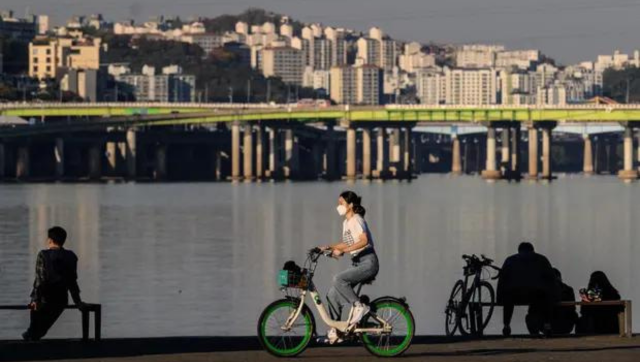
 "'Hikikomori': South Korea paying its 'lonely' youth to go out and socialise")
Seoul: After reports emerged saying more than a million people in South Korea are living as recluses due to the coronavirus scare, the country has decided to offer its ‘lonely’ youths a monthly living allowance of 650,000 won ($490) in order to help them get out of their homes. Apart from the allowance the government has also announced to provide support for health, employment, and education. According to the Korea Institute for Health and Social Affairs, 350,000 South Koreans between the ages of 19 and 39, or about 3% of that age group, are thought to be lonely or alone. The Koreans are describing the illness among their youth with a Japanese word called Hikikomori that loosely translates to “to pull back”. The government aims to make it simpler for persons who experience it to leave the house and travel to work, school, or other destinations. A monthly grant for living expenses for those between the ages of nine and 24 who are experiencing significant social disengagement is a part of the scheme launched this week, which builds on measures introduced in November. Teenagers are also given a budget for cultural experiences. A government document explaining the measures states that 40% of secluded youngsters started living in seclusion as teens and that impoverished backgrounds make up a majority of their backgrounds. The report covers case studies of young people who used seclusion as a coping mechanism for difficulties in their familial relationships. One young person talks about how domestic abuse contributed to their sadness. Domestic abuse left me so miserable when I was 15 years old that I started to live alone. One more claimed to have isolated themselves after their family “went bankrupt.” The administration stated in a statement that the new measures are intended to increase government assistance “to help reclusive youth recover their daily lives and reintegrate into society.” Other forms of assistance include aiding with school and gym materials as well as correcting the afflicted people’s physical appearance, including any scars “that adolescents may feel ashamed of.” In addition to having a comparatively high youth unemployment rate of 7.2%, South Korea is attempting to address a fast dropping birthrate that further jeopardises productivity. According to Shin Yul, a political science professor at Seoul’s Myongji University, “this policy is fundamentally a welfare measure.” “While it’s good to try different strategies to increase the working-age population, it cannot be seen as a long-term solution to fix the population problem here,” the author writes. Last month, President Yoon Suk-yeol referred to the birth rate as a “crucial national agenda.” With women having an average of 0.78 children this year, South Korea became the only nation in the world with a fertility rate below one. Women choose not to have children for a variety of financial reasons, including the high expense of having children, the slowing economy, the lack of work opportunities, and the rising cost of housing. Read all the Latest News , Trending News , Cricket News , Bollywood News , India News and Entertainment News here. Follow us on Facebook, Twitter and Instagram.
The administration stated in a statement that the new measures are intended to increase government assistance “to help reclusive youth recover their daily lives and reintegrate into society
Advertisement
End of Article


 "Russian drones over Poland: Trump’s tepid reaction a wake-up call for Nato?")
 "As Russia pushes east, Ukraine faces mounting pressure to defend its heartland")
 "Why Mossad was not on board with Israel’s strike on Hamas in Qatar")
 "Turkey: Erdogan's police arrest opposition mayor Hasan Mutlu, dozens officials in corruption probe")
 "Russian drones over Poland: Trump’s tepid reaction a wake-up call for Nato?")
 "As Russia pushes east, Ukraine faces mounting pressure to defend its heartland")
 "Why Mossad was not on board with Israel’s strike on Hamas in Qatar")
 "Turkey: Erdogan's police arrest opposition mayor Hasan Mutlu, dozens officials in corruption probe")



