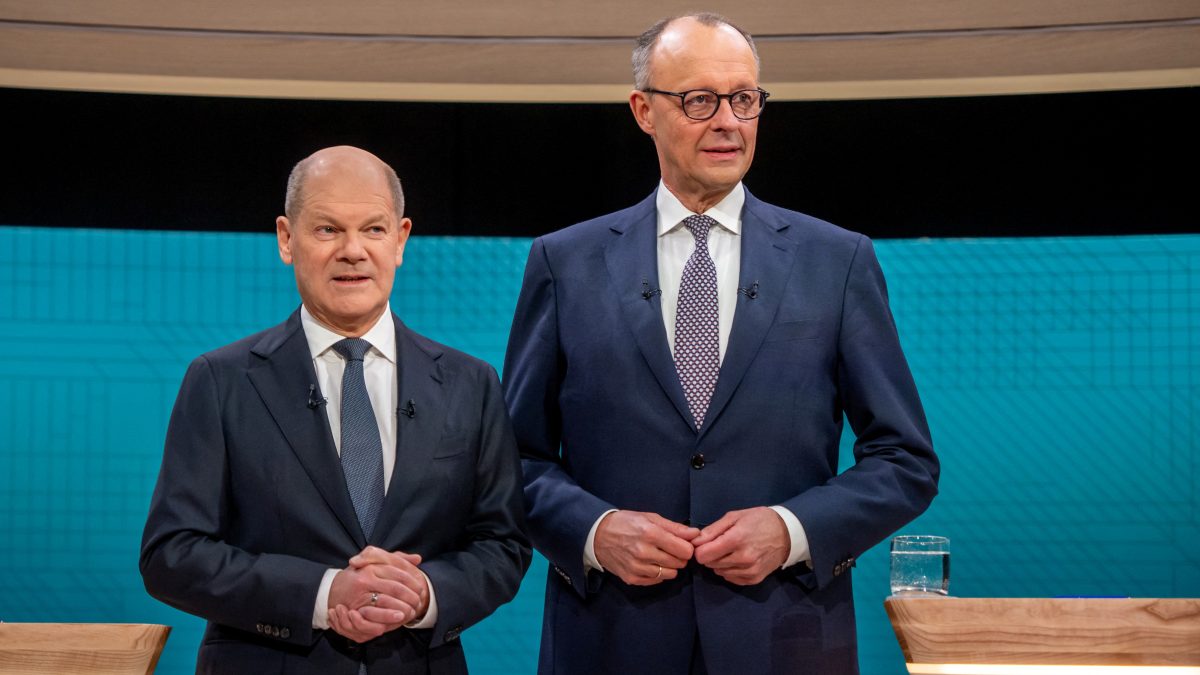
 "Social Democratic Party (SPD) Chancellor Olaf Scholz and his conservative rival of the Christian Democratic Union (CDU) Friedrich Merz are pictured in a studio of the ARD and ZDF television broadcasters ahead of the first TV debate between Scholz and Merz in Berlin, Germany. Reuters")
German political parties negotiating the upcoming coalition government have reached an agreement, Conservative leader and election winner Friedrich Merz announced Saturday (March 8).
Merz’s Christian Democratic Union (CDU) and the Social Democrats (SPD) of outgoing chancellor Olaf Scholz were involved in the talks.
Friedrich Merz is most likely to become the next German chancellor.
In a statement, co-leader and parliamentary group leader of the SPD Lars Klingbeil also confirmed that negotiations have concluded successfully and further move forward.
‘Talks to conclude by Easter’
Meanwhile, Merz said a joint paper should be the basis for coalition negotiations, which could begin next week if necessary. The Conservative leader has vowed to conclude the whole process by Easter, according to German media reports.
The CDU/CSU emerged victorious in the parliamentary elections on February 23, securing 28.5 per cent of the vote. The far-right Alternative for Germany (AfD) took second place with 20.8 per cent, while the SPD came in third with 16.4 per cent. Despite AfD’s strong showing, all major parties have ruled out forming a coalition with them.
In Germany, coalition governments are typically formed through a two-step process: parties first engage in exploratory talks to assess potential alliances before entering formal coalition negotiations.
Key areas of cooperation
Ahead of the elections, both CDU and the SPD sparred over several issues of national importance, like the Ukraine war and immigration.
The two parties are said to have discussed sending weapons to Ukraine, something that Scholz opposed but Merz supports, with conditions.
Merz has also pledged stricter policies to curb illegal migration, including turning away arrivals at Germany’s borders and expanding border controls.
He also set an economic growth target of 1-2 per cent and vowed to reduce energy costs to support businesses.
Why AfD was not included in talks?
After winning the elections, Merz ruled out a coalition with the AfD, saying it was “out of the question.”
Merz also criticised the AfD’s stance on Russia, stating that the party has “not a single critical word to say about Russia” regarding Ukraine. He stressed that this position does not align with the values of the CDU/CSU, making a coalition with the AfD “completely out of the question.”
Impact Shorts
More Shorts(With inputs from agencies)