

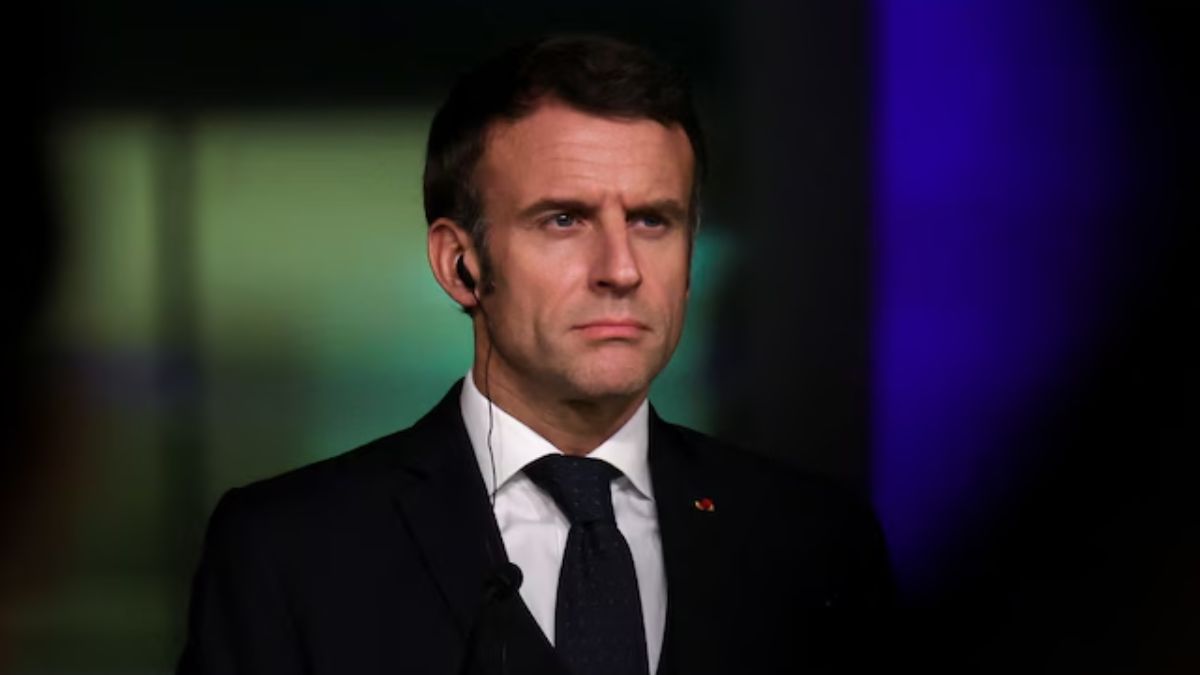
 "Is Macron's election gamble going to pay off? Or will he serve France to far-right on platter?")
French President Emmanuel Macron had called snap parliamentary elections with the hope that the voters would rally around his centrist coalition to stop the surge of far-right in the country. The surveys do not suggest it’s happening.
Voters in France are casting their ballots in the first round of elections on Sunday (June 30). The second round will be held on July 7.
Since the announcement of polls, surveys have shown that the far-right party National Rally (RN) of Marine Le Pen is going to emerge as the single-largest party and Macron’s centrists could be relegated to a distant third.
Earlier this month, Macron dissolved the parliament and called snap elections after Le Pen’s RN won the European Parliament elections in the country. It polled more than double the votes than Macron’s centrist coalition. In a shock-address from the presidential palace, Macron then said the people must be heard clearly through the parliamentary elections.
“I have decided to give you back the choice of our parliamentary future through the vote. I am therefore dissolving the National Assembly,” said Macron.
The choice of the French public does not appear to be what Macron would have thought. The condition is such that his Renaissance (RE) party appears to be out of the fight and the contest appears to be between the RE and the New Popular Front, a newly-formed coalition of leftist parties .
Macron’s centrists staring at rout, say polls
The Le Pen-led RN is set to win nearly the double of votes than Macron’s bloc, according to the latest surveys.
Impact Shorts
More ShortsAs per the opinion poll published just two days before the voting on Friday in Les Echos newspaper, the RN was set to win 37 per cent of the popular vote as against 20 per cent of Macron’s bloc.
A week before, the RN was projected to win 35 per cent of the vote and Macron’s bloc 22.
In both the polls, the newly-formed left-wing bloc New Popular Front (NPF) was set to win 28 per cent of the vote.
The figures are in line with other polls published since the announcement of the elections . Previously, the polls by Ipsos, Odoxa, and Opinionway-Vae Solis have also similarly shown that RN is on its way to be the single-largest party, followed by the leftist coalition NPF, and Macron’s RE-led bloc relegated to a distant third.
Did Macron misjudge French public’s mood?
France, like much of Europe, is in the throes of a far-right surge — or so the flood of banner headlines suggest.
The right-wing forces are indeed on a march in France but neither are all of these parties 'far-right' —extremists— nor the popular anger a result of a widespread acceptance of far-right beliefs. It is a mix of frustration with status quo of years of leftist and centrist rule, the concerns around immigration unaddressed by the centrists and leftists, economic insecurities, and certainly rising acceptance and mainstreaming of right-wing ideas.
Then, what would explain Macron’s decision to call elections right after a defeat from the right-wing parties in the European Union elections?
Macron appears to have been driven by the idea that faced with the choice of a far-right surge, whose antisemitic and neo-Nazi associations have shocked many, and the left-wing forces who will hike taxes and bring unpopular spending plans, the French public would rally around Macron’s pragmatic right-leaning centrist bloc. As polls suggest, it appears to have been a miscalculation.
The New York Times has reported that the chatter in Paris is that Macron has played a “wild gamble” after having “lost touch with reality” with his “blinding ego”. The paper reported that people are struggling to understand how Macron could risk so much.
The stakes are unprecedented in these elections. A far-right victory would mean the takeover of domestic polity by a fundamentally different dispensation. Even though Macron will remain in office till 2027 and, as president, will be in charge of foreign and defence policies, an RN government would mean he would have a constant tussle at home.
At a time when Macron has supported Ukraine to the hilt amid the worst security threat to the continent since World War II, the takeover of France by Europe sceptic RN, whose leader Le Pen has praised Russian leader Vladimir Putin in the past and has questioned the support of Ukraine, could be disastrous for the agenda of Macron’s presidency.
Swasti Rao, a scholar of Europe at the Manohar Parrikar Institute for Defence Studies and Analyses (MP-IDSA), says that the upcoming phase of ‘cohabitation’ would not be easy for Macron. Cohabitation is the notion in France when the presidency and the parliament are controlled by different parties.
“Macron, as president, may remain in charge of foreign or defence policies, but he would lose the domestic agenda. He would also lose strict control over the country and government’s finances. Both of these developments could derail his defence spending plans and foreign policy objectives, such as the assistance to Ukraine in terms of financial aid or weapon deliveries or training of personnel. The pressure on him to resign as his party would have lost popular vote would also rise,” said Rao, an Associate Fellow at the Europe and Eurasia Center at MP-IDSA.
How to understand Macron’s unpopularity, far-right’s surge?
Macron, who has been elected as the President of France twice, appears to have been driven into a corner. How did it come to this?
For starters, the centrist Macron faced double whammy. On immigration and national security, he initiated tough policies. That alienated sections of left-leaning voters. For many on the right, however, he was not stern enough. As voters from both sides of the spectrum drifted to extreme positions, Macron’s centrist platform found itself facing challenges from converging left-wing parties and the rising right-wing party RN of Le Pen.
Rao of the MP-IDSA, however, stresses that the European or French right-wing is not the MAGA-type right-wing as seen in the United States. She says that the European right-wing forces have a moderating effect once they come to power.
Rao tells Firstpost, “Being in the government has a sobering effect on you. If you have to govern, you have to sober up. You may say you want to ban immigrants but, once you are in power, you have to face the reality that Europe is an ageing society and it needs immigrants. The demographic decline is way too clear in Italy. After coming to power, Italian Prime Minister Giorgia Meloni has moved from her rhetoric against immigration in general to checking illegal immigration. She has largely moderated just like any other mainstream leader. The same moderation is expected to an extent to France’s National Rally if and when it comes to power.”
While France’s shares the concerns over immigration and like in Italy or Germany, Rao says France also faces anti-incumbency that has been in making for more than a year now — France was hit with major violence over proposed pension reforms last year.
“The anxiety around immigration is a major contributor to the support for right-wing parties in Europe. In France, the support for the far-right is further driven by anti-incumbency against Macron. The EU election results and the results of the French parliamentary elections should make the European centrists realise that if they will not address immigration or look into other grievances of people, the anxious voters will keep turning to the right-wing,” says Rao.


 "Russian drones over Poland: Trump’s tepid reaction a wake-up call for Nato?")
 "As Russia pushes east, Ukraine faces mounting pressure to defend its heartland")
 "Why Mossad was not on board with Israel’s strike on Hamas in Qatar")
 "Turkey: Erdogan's police arrest opposition mayor Hasan Mutlu, dozens officials in corruption probe")
 "Russian drones over Poland: Trump’s tepid reaction a wake-up call for Nato?")
 "As Russia pushes east, Ukraine faces mounting pressure to defend its heartland")
 "Why Mossad was not on board with Israel’s strike on Hamas in Qatar")
 "Turkey: Erdogan's police arrest opposition mayor Hasan Mutlu, dozens officials in corruption probe")



