

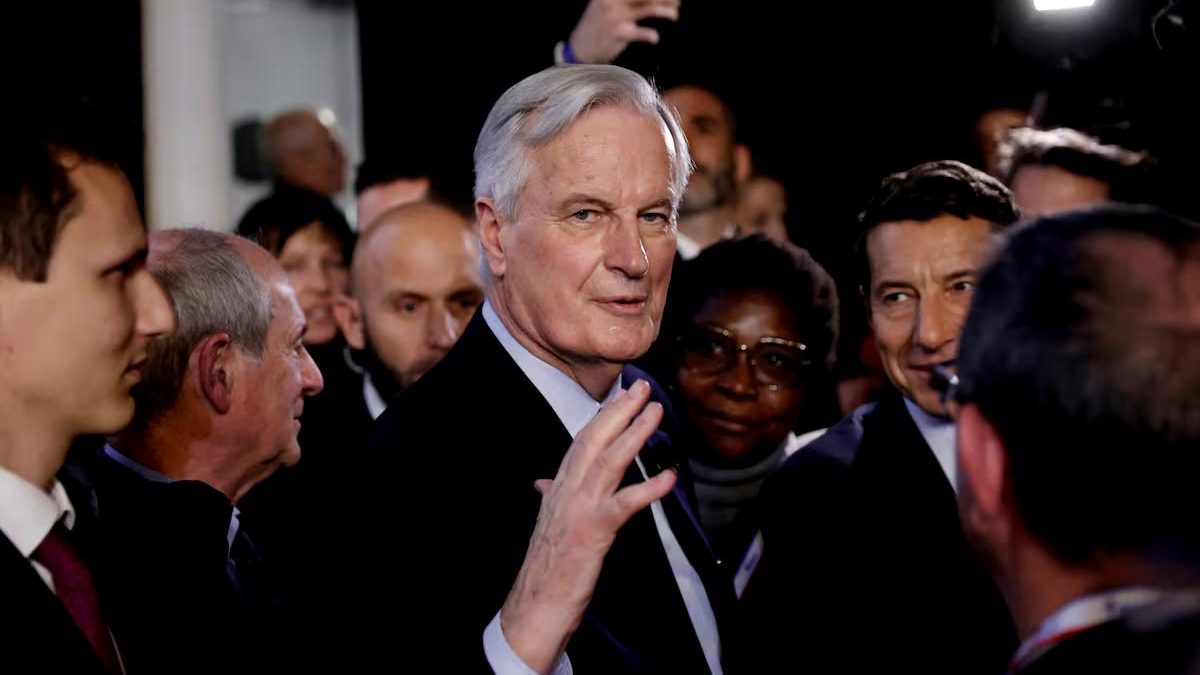
 "France: Ahead of no confidence vote, PM Barnier says survival ‘possible’ for his minority govt")
French Prime Minister Michel Barnier faces a critical no-confidence vote on Wednesday (December 4), just three months into his tenure, after invoking special constitutional powers to pass a contentious budget without parliamentary approval.
The move has intensified political tensions, with both left-wing and far-right parties uniting to challenge his minority government.
In a televised interview on Tuesday (December 3) night, Barnier acknowledged the precariousness of his position but said he hoped for a “reflex of responsibility” among lawmakers to prevent further instability.
He stressed the importance of maintaining governmental continuity, especially amid France’s current economic challenges, according to BBC.
The contentious budget
The budget in question proposes €60 billion in tax increases and spending cuts aimed at addressing France’s ballooning deficit. Barnier’s decision to bypass a parliamentary vote has been met with sharp criticism from opposition leaders, who accuse him of undemocratic practices and failing to consider the populace’s needs.
President Emmanuel Macron, currently on a state visit to Saudi Arabia, has dismissed calls for his resignation, asserting his commitment to serving his full term until 2027.
He described discussions of his potential departure as “make-believe politics” and reaffirmed his role as a “guarantee of stability” for the nation.
A tricky situation in the National Assembly
The National Assembly, France’s lower house of parliament, is deeply divided, with no single party holding a majority. The left-wing New Popular Front and the far-right National Rally, typically adversaries, have found common ground in their opposition to Barnier’s government.
The no-confidence motion requires at least 288 of 574 votes to pass; combined, the opposition holds over 330 seats, though some members may abstain.
If the motion succeeds, it would mark the first time a French government has been toppled by such a vote since 1962. Barnier would remain as a caretaker prime minister until President Macron appoints a successor, a process that could extend into the new year.
Impact on France’s economy
The political uncertainty has already impacted France’s economy, with declines observed in the CAC 40 index and the euro. Analysts warn that continued instability could exacerbate financial challenges, especially as the European Union pressures France to reduce its substantial debt.
As the National Assembly prepares for the decisive vote, the nation watches closely, aware that the outcome will significantly influence France’s political and economic trajectory in the coming months.


 "Russian drones over Poland: Trump’s tepid reaction a wake-up call for Nato?")
 "As Russia pushes east, Ukraine faces mounting pressure to defend its heartland")
 "Why Mossad was not on board with Israel’s strike on Hamas in Qatar")
 "Turkey: Erdogan's police arrest opposition mayor Hasan Mutlu, dozens officials in corruption probe")
 "Russian drones over Poland: Trump’s tepid reaction a wake-up call for Nato?")
 "As Russia pushes east, Ukraine faces mounting pressure to defend its heartland")
 "Why Mossad was not on board with Israel’s strike on Hamas in Qatar")
 "Turkey: Erdogan's police arrest opposition mayor Hasan Mutlu, dozens officials in corruption probe")



