

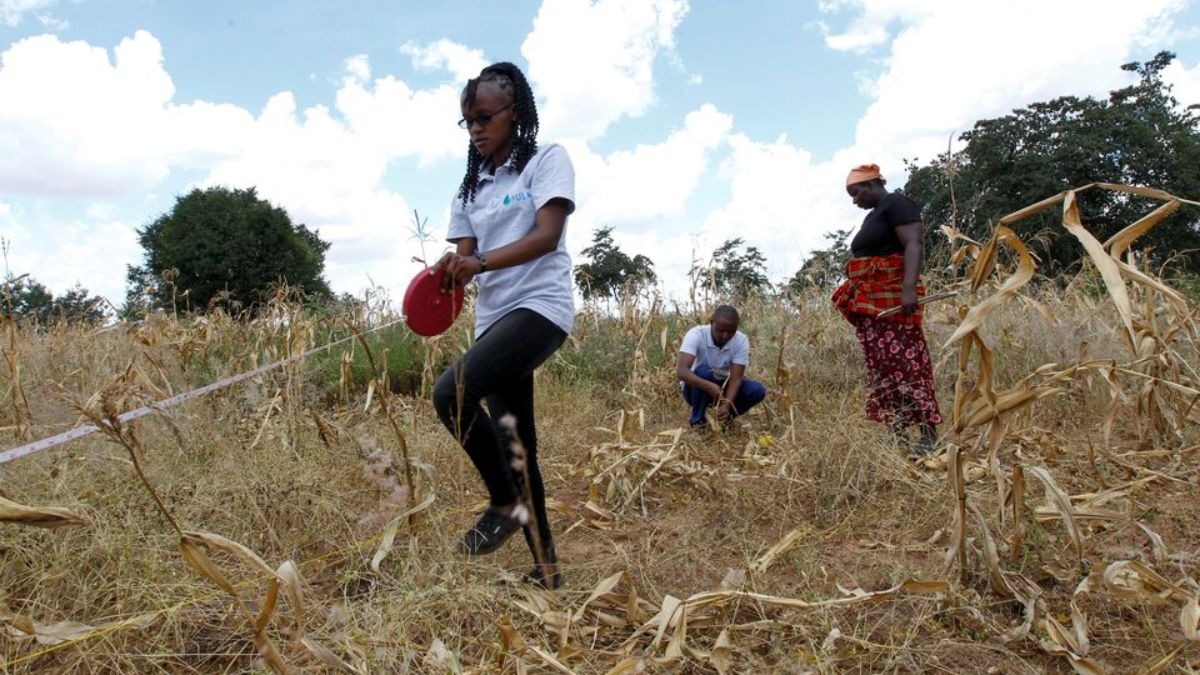
 "Fake fertilisers spoil more than half of Kenya's agricultural land, farmers claim")
When Benson Wanjala started farming in his western Kenya village two and a half decades ago, his 10-acre farm could produce a bountiful harvest of 200 bags of maize. That has dwindled to 30. He says his once fertile soil has become a nearly lifeless field that no longer earns him a living.
Like many other farmers, he blames acidifying fertilizers pushed in Kenya and other African countries in recent years. He said he started using the fertilizers to boost his yield and it worked — until it didn’t. Kenya’s government first introduced a fertilizer subsidy in 2008, making chemical fertilizers more accessible for smaller-scale farmers.
About 63% of arable land in Kenya is now acidic, according to the agriculture ministry, which has been recording a decline in production of staples such as maize and leading exports of horticulture and tea. The production of maize declined by 4% to 44 million tons in 2022, according to the Food and Agriculture Organization, which didn’t say why.
The agriculture ministry didn’t respond to questions, especially after a scandal over fake fertilizer in April. The fertilizer was found to be quarry dirt in misleadingly labelled bags that were distributed to farmers through a national subsidy program. President William Ruto said about 7,000 farmers bought the fake fertilizer and would be compensated with the correct product.
Problems with soil health are growing as the African continent struggles to feed itself. Africa has 65% of the world’s remaining uncultivated arable land but has spent about $60 billion annually to import food, according to the African Development Bank. The spending is estimated to jump to $110 billion by 2025 due to increased demand and changing consumption habits.
Impact Shorts
More ShortsIn May, Kenya hosted an Africa-wide soil health summit to discuss declining production, climate change and other issues that have increased food security concerns. Agriculture is a key part of the economy in Kenya, making up more than a quarter of the GDP.
At the summit, Stephen Muchiri, executive director of the Eastern Africa Farmers Federation, advocated for a return to traditional farming practices to replenish lifeless soils, including planting a variety of crops and doing as little as possible to disturb the land.
“Inorganic fertilizers were never meant to be the foundation of crop production," he said, later adding that because of “commercially inclined farming, our soils are now poor, acidic, and low in biomass resources, and without life!”
He said farmers should rotate crops on their land and source compost material from livestock such as goats: “There must be some kind of transition and adaptation for our soils to revert back to fertility.”
Experts say soil acidity causes land degradation by decreasing the availability of plant and essential nutrients, making soil more vulnerable to structure decline and erosion.
The program coordinator for the Alliance for Food Sovereignty in Africa, Bridget Mugambe, advised the phasing out of chemical fertilizers.
“Soil health goes beyond the quick fixes provided by chemical fertilizers. In fact, chemical fertilizers have extensively damaged our soils in Africa. We need to think of our soils in a more holistic way," she said.
The soil health summit by the African Union — which in 2006 recommended that members use more chemical fertilizers — adopted a 10-year plan that calls for increased investment to produce both organic and chemical fertilizers locally and triple their use for increased production.
During the summit, AU commissioner for agriculture Josefa Leonel Correia Sacko asserted that the continent was “losing over $4 billion worth of soil nutrients each year."
Kenya heavily relies on imported fertilizer due to low local production. The main supplier is the European Union, followed by Saudi Arabia and Russia.
The Alliance for a Green Revolution in Africa’s Kenya manager, John Macharia, said Kenya’s recent fertilizer scandal should not discourage farmers.
“It’s still imperative that we are able to work with the government to actually ensure that we have the right fertilizers coming to our stores,” Macharia said. He recommended both chemical and organic ones as long as they address the specific issue in the soil, and said soil analysis would guide farmers.
Declining soil quality is a food security concern across Africa.
In Zimbabwe, once a regional breadbasket, about 70% of soils are acidic, according to the government. The government in the past introduced chemical fertilizers in an attempt to strengthen soils, but wrong usage caused a decline in organic matter.
“Before the introduction of mineral fertilizers, our forefathers had the knowledge and understanding that if you add organic manure, the soil becomes fertile, and crops perform better," said Wonder Ngezimana, a crop science associate professor at Zimbabwe’s Marondera University of Agricultural Sciences and Technology. “That has been a traditional norm in Zimbabwe and elsewhere in Africa where people scavenge for any kind of organic matter to add to the soil.”
That includes animal manure, grass, leaves and twigs, crop residue, ash and compost. But many farmers in Zimbabwe no longer have cattle because of recent drought, Ngezimana said: “Farmers are struggling to maintain soil health because they can’t generate enough quantities of organic matter.”
AGRA recommended that farmers test their soil’s acidity and apply lime to reverse high acidity.
But farmers say both are limited and costly. Soil testing services are available in government agricultural agencies, public universities and private organizations at prices ranging from $20 to $40.
Wanjala, the farmer, said he cannot even find the money cattle for manure, and barely for seeds.
“I cannot afford more expenses,” he said.


 "Russian drones over Poland: Trump’s tepid reaction a wake-up call for Nato?")
 "As Russia pushes east, Ukraine faces mounting pressure to defend its heartland")
 "Why Mossad was not on board with Israel’s strike on Hamas in Qatar")
 "Turkey: Erdogan's police arrest opposition mayor Hasan Mutlu, dozens officials in corruption probe")
 "Russian drones over Poland: Trump’s tepid reaction a wake-up call for Nato?")
 "As Russia pushes east, Ukraine faces mounting pressure to defend its heartland")
 "Why Mossad was not on board with Israel’s strike on Hamas in Qatar")
 "Turkey: Erdogan's police arrest opposition mayor Hasan Mutlu, dozens officials in corruption probe")



