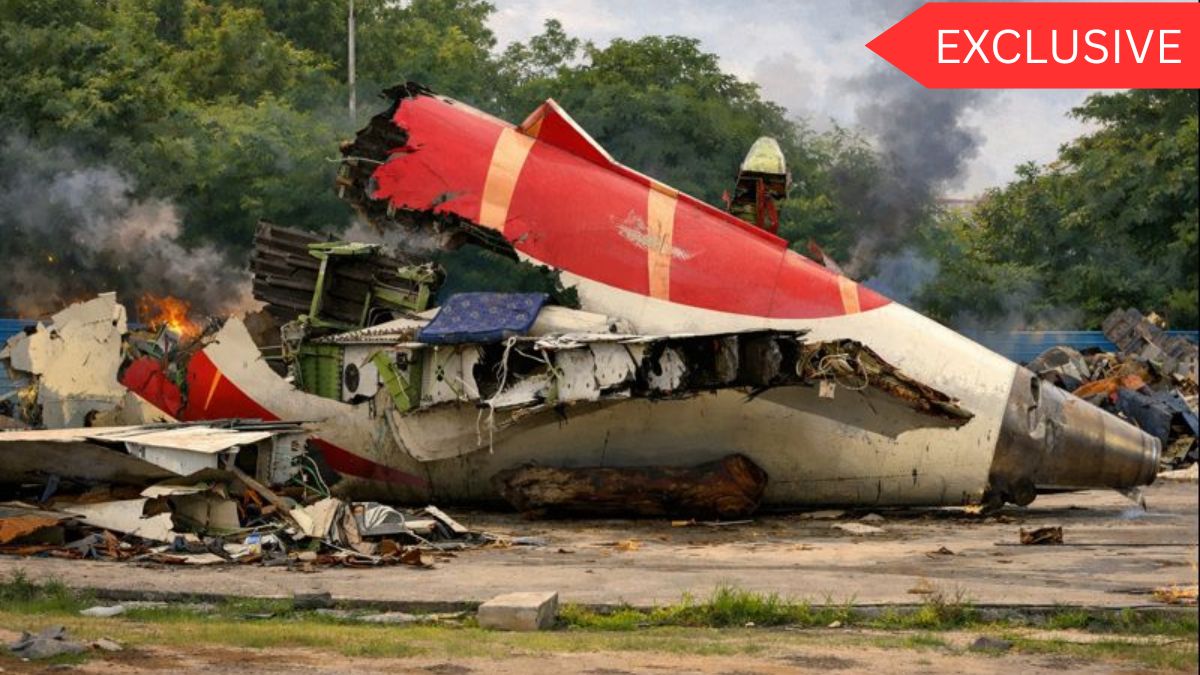
 "Air India Boeing 787 Dreamliner crashed on June 12, 2025.")
“Don’t blame the pilots yet. Look at the plane."
That is the blunt message from Boeing whistleblower Ed Pierson, who has torn into the growing narrative of pilot error following the deadly Air India 787 crash in Ahmedabad that killed over 260 people — including 242 on board the flight. Calling the Dreamliner an “electrical monster”, Pierson told Firstpost that investigators were overlooking deep-rooted manufacturing and systems failures.
What began as a routine take-off from Ahmedabad ended in a fireball killing people on board and in the canteen of the medical college hostel it crashed into and reigniting global scrutiny of aircraft safety. Pierson argues that the focus on pilot error ignores longstanding flaws in the Boeing 787 itself.
Ahmedabad crash: A routine take-off ends in fireball
At 13:39 on June 12, an Air India Boeing 787-8 Dreamliner took off from Sardar Vallabhbhai Patel in Ahmedabad for London’s Gatwick Airport. Seconds later, the aircraft crashed into a neighboring area. Thick black smoke filled the sky as AI171 turned into a fireball.
The plane was carrying 230 passengers and 12 crew members. All but one were killed — charred to death. Vishwash Kumar Ramesh was the sole survivor. On the ground, the aircraft’s tail section crashed into the Atulyam hostels of BJ Medical College, killing several students and taking the total death toll to 260.
In the six months since the Aircraft Accident Investigation Bureau (AAIB) released its preliminary report, theories ranging from mechanical failure and fuel contamination to manufacturing defects have taken a back seat, while attention has increasingly shifted towards pilot error.
Quick Reads
View AllBoeing whistleblower questions probe
Slamming the preliminary report as “horrible”, former Boeing senior manager-turned-whistleblower Pierson raised serious concerns about the direction of the investigation, while also pointing to Boeing’s quality control failures and weak regulatory oversight.
In an exclusive conversation with Firstpost, Pierson flagged long-standing quality control concerns inside Boeing’s factories, describing the scale and complexity of the manufacturing sites where he first noticed serious problems.
“I saw incredible pressure to get the work done,” he told Firstpost , “Manufacturing, quality control and supply chain employees were under an inordinate amount of pressure."
‘Robots don’t make aircraft’: Inordinate pressure on workers?
Pierson said the culture of long working hours led to repeated mistakes. Quality control inspections flagged problems across multiple systems, including flight controls, electrical systems, hydraulics and pressurisation.
“It was a wide gamut of issues,” Pierson said, “We began seeing a lot of our quality control reports indicating issues primarily with flight control systems, electrical systems, hydraulic systems, and pressurisation. It included everything."
He emphasized that despite automation, aircraft manufacturing is largely dependent on human labour. “It’s not all robotics and AI. These planes are built by employees,” he said.
Describing a high-stress environment on the factory floor, Pierson said, “We witnessed all kinds of mistakes, arguments, and communication breakdowns. This should not happen… we are building planes."
Pierson also highlighted repeated failures during system-wide functional tests, which are designed to verify that every aircraft system is working correctly.
“We saw multiple test failures, which was downright dangerous,” he said, adding that such issues reflected a long history of manufacturing quality lapses. Pierson testified before the US Congress on several occasions, flagging these concerns.
‘An electrical monster’: Pierson rejects pilot-error theory
Pierson said these problems were not confined to a single factory and extended back to the development of the Boeing 787 itself.
“There were serious problems when the 787 was first built,” he said. “They used to call some of them the ’terrible teens’. Around two dozen aircraft were so flawed that extensive rework was required."
Calling the aircraft an “electrical monster”, Pierson said failures in systems such as fuel cut-off switches could send incorrect signals through the aircraft.
“There are multiple power panels and circuits. It’s an incredibly complex airplane — an electrical monster,” he told Firstpost .
The Wall Street Journal’s report ‘disgusting’
Pierson rejected the pilot error theory, insisting that investigators must first conduct a thorough examination of potential system faults and failures before attributing blame to dead pilots.
Responding to a Wall Street Journal report that hinted at pilot error while the investigation remains ongoing, Pierson described the coverage as “disgusting — in one word”.
“When we read the Wall Street Journal’s report, it felt like we were reading one of those magazines that has no credibility,” he said. “We were shocked to see that it came from the Wall Street Journal. It was obvious that the reporter was criticizing and going along with the narrative that US authorities have put forth."
“There is a pattern. Right after the accident, there are expressions of condolences and promises, but immediately, a doubt is raised, and pilots are blamed. We’ve seen this time and again. There’s an immediate effort to protect the same parties that are under investigation,” he said.
The great omission in the Ahmedabad crash probe
Pierson said the AAIB’s preliminary report omitted crucial information, including data related to sensors, stabilizers and the full cockpit voice recording.
“Issues with the sensor, stabiliser, and full audio tape were not mentioned in the preliminary report. A teeny-tiny portion of the pilots’ conversation was released. It was done to imply that the pilots deliberately or accidentally made a mistake, and we take a big issue with that,” Pierson told Firstpost.
He also flagged the absence of data from key aircraft systems. “There’s a system called Acars [Aircraft Communications Addressing and Reporting System], which is like a text messaging data link that sends information back and forth from the airplane to the operation centers and the maintenance centers. There was no information about that system in the report."
“There’s another system called AHM, which is an aircraft health management system, designed to collect information and send it in real-time,” Pierson said.
“Neither was mentioned in the report."
“The outright withholding of critical information which should be out in public was stunning to us. The preliminary report was honestly horrible, he said, “We thought it was a terrible report."
‘Why no pilots’: Questions about the investigation team
He also questions why no pilots were included in the initial team probing the Ahmedabad plane crash. He said, “Why don’t they want the Aviation Maintenance Technicians (AMTs), who work on these planes? These individuals know way more than an engineer because an engineer may have only designed a part of the system, but these individuals work with it every day."
Pierson welcomed the intervention of India’s Supreme Court. The top court observed while hearing a plea filed by the father of late Captain Sumeet Sabharwal that no one in the country believed it was the pilot’s fault.
AAIB–NTSB meet: ‘Not expecting a lot’
When asked about the upcoming meeting between the AAIB and the National Transportation Safety Board (NTSB) in Washington next week, Pierson said he was “not expecting a lot”. He also highlighted what he described as the “horrible deterioration” of the NTSB.
“I used to put the NTSB at a very high pinnacle of my mind. They had a great reputation over the years, with a deep understanding of forensic knowledge. However, ever since the Max crashed back in 2018, we’ve seen the horrible deterioration of the NTSB,” he said.
From gold standard to ‘self-licking ice cream cone’
Citing the Boeing 737 Max crashes, Pierson alleged that Boeing and the NTSB were aware of electrical failures but failed to act.
“Information was provided to us that clearly showed that the second Max airplane had evidence of electrical failures before the plane crashed, and Boeing knew about it. We gave NTSB the documentation to show this and support it, but they refused to pass it on to the accident investigators,” he said.
Pierson accused the NTSB of focusing on optics rather than accountability. “There’s a lot of getting in front of the camera and talking about a big game. We feel like there’s a lot of show. It’s like a self-licking ice cream cone sometimes."
He also highlighted the agency’s limited independent oversight capacity. “NTSB has only about 450 employees. They have to investigate every transportation type-related major accident, which includes oil pipeline explosions, train wrecks, bridge disasters, maritime disasters, and small airplane crashes,” Pierson said.
‘Out of touch and failing’: Why Easa grounded planes — and FAA would not
Pierson also strongly criticized the United States aviation regulator, the Federal Aviation Administration (FAA), calling it completely “out of touch and failing”.
He said the FAA’s leadership lacks an understanding of conditions on the factory floor. “The FAA leader needs to talk to these mechanics and technicians on the floor, but he is completely out of touch,” Pierson said.
By contrast, Pierson praised the European Union Aviation Safety Agency (Easa) for its handling of the Airbus A320 software issue in November.
Calling it a “great example”, he said, “I commend the European Union Aviation Safety Agency (Easa) for taking this approach. They spotted the issues and grounded these planes because they wanted to fix the core issues. I think it’s a great example of how things should be done."
Drawing a comparison with the FAA, Pierson said, “FAA would do something exactly opposite. It identifies a defect or an unsafe condition under its continued operational safety program; instead of inspection, it will be postponed for years. We’ve seen this over and over again.
The big question: Are we investigating modern aircraft with outdated tools?
Pierson said the accident investigation system itself is no longer fit for purpose.
“The accident investigation process does not match the modern airplane sophistication. It is outdated and needs to be fixed,” he said.
The question becomes significant as the world waits with the families of the victims of the Ahmedabad plane crash to know what exactly led to the loss of over 260 lives.