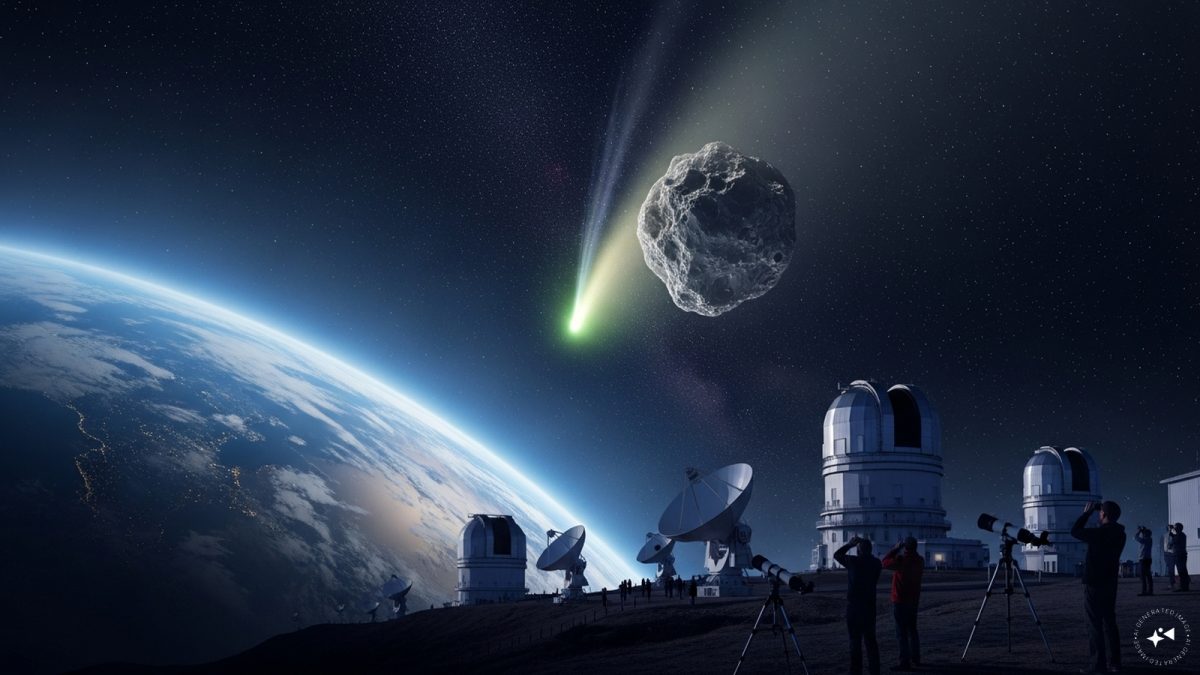
 "Interstellar comet 3I/Atlas makes its closest approach to Earth, offering a rare chance for observation and discovery.")
A rare visitor from beyond our solar system is set to dazzle sky watchers this week. The interstellar comet 3I/Atlas will make its closest approach to Earth on Friday, 19 December, coming within about 170 million miles. That distance is roughly twice that between Earth and the Sun. It will be only the third interstellar object ever confirmed, after Oumuamua in 2017 and Borisov in 2019.
A rare interstellar traveller
Astronomers have established that 3I/Atlas originated outside the solar system, though its exact point of origin remains uncertain. The comet is travelling at a striking speed of around 130000 miles per hour, making it the fastest interstellar object recorded so far. Experts believe it has been wandering through the galaxy for billions of years. David Jewitt, an astronomer at the University of California, Los Angeles, described observing it as “catching sight of a speeding bullet for a fraction of a second.”
When and how to observe
Stargazers eager to see this cosmic visitor can look toward the eastern horizon before dawn on Friday. NASA advises using binoculars or a small telescope, where the comet should appear as a faint, glowing light beneath Regulus, the brightest star in the constellation Leo. Those unable to view it in person can watch an online broadcast by the Virtual Telescope Project starting at 11 p.m. Eastern Time on Thursday, 18 December, if weather conditions permit.
Discovery and scientific study
The comet was first identified on 1 July by a telescope in Chile that forms part of the Asteroid Terrestrial Impact Last Alert System, supported by NASA. Since its discovery, space researchers have monitored it closely as it travelled past Mars and near the Sun. Several NASA missions, including Hubble, have captured images of it. The comet’s close passage gives scientists a rare opportunity to study its structure and chemical makeup. Early data suggests that 3I/Atlas has a high concentration of carbon dioxide compared to water vapour, implying it may have formed in extremely cold regions far from its original star.
A unique cosmic messenger
Astrophysicists consider 3I/Atlas an important clue for understanding how and where comets form across the universe. Darryl Seligman of Michigan State University wrote that this object might show that many comets are born much farther from their stars than previously thought. Alternatively, the solar system itself may once have produced such distant comets that were later ejected into space.
Quick Reads
View AllThe International Asteroid Warning Network, a global organisation with more than eighty observatories, is also tracking the comet and will publish its findings next year. After passing Jupiter in the spring, the visitor will continue its endless journey back into deep space, offering humanity one brief but valuable look into the mysteries of the cosmos.