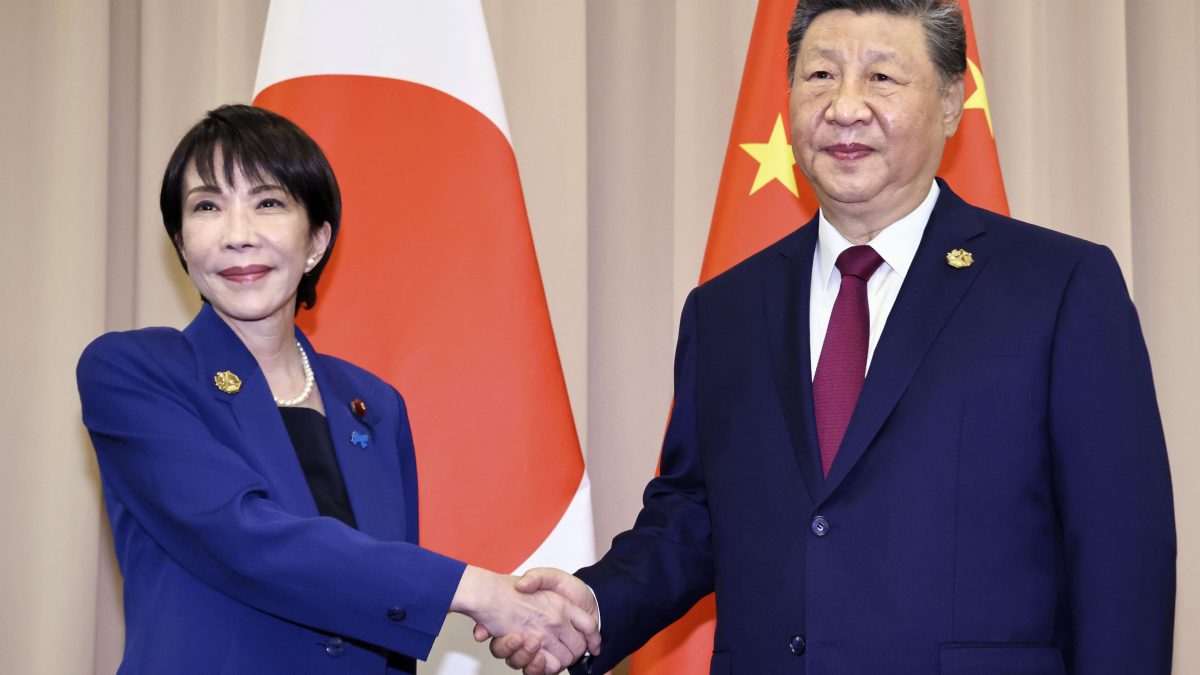
 "Chinese President Xi Jinping, right, shakes hands with Japanese Prime Minister Sanae Takaichi in Gyeongju, South Korea. File image/AP")
China has banned exports of dual-use items to 20 Japanese entities it says supply Japan’s military, the commerce ministry said on Tuesday, in the latest escalation of tensions between Beijing and Tokyo.
The move comes despite Prime Minister Sanae Takaichi securing a strong electoral mandate earlier this month after drawing criticism from Beijing over remarks on Taiwan.
Restrictions target key industrial units
According to China’s commerce ministry, the measures apply to units of major Japanese conglomerates, including shipbuilding and aero-engine divisions of Mitsubishi Heavy Industries.
The restrictions effectively cut the listed entities off from seven rare earth elements and related materials under China’s dual-use export control regime, along with other critical minerals. Among the restricted materials are dysprosium, yttrium and samarium, which are essential components in automobiles, aircraft, weapons systems and consumer electronics.
Supply impact and export controls
It remains unclear how quickly shortages may emerge. Japanese companies are known to maintain rare earth stockpiles, and as of December — the latest period for which data is available — China continued to ship large volumes to Japan.
China maintains an export control list covering around 1,100 dual-use items and technologies. Manufacturers must obtain licences before exporting such items regardless of the destination.
Tokyo protests move
Japan’s Deputy Chief Cabinet Secretary Kei Sato described the measures as “completely unacceptable” and said Tokyo had demanded their withdrawal.
Beijing said the restrictions were intended to curb Japan’s “remilitarisation” and nuclear ambitions, adding that foreign organisations and individuals were also barred from transferring Chinese-origin dual-use items to the listed entities. However, companies may still apply for export approvals under “special circumstances”.
China said firms operating in good faith need not be concerned and that normal economic and trade exchanges between the two countries would not be affected.
Strategic backdrop
Ryo Sahashi, a professor at the University of Tokyo, said the measures could be seen as a response to closer Japan–US security ties and Tokyo’s expanding defence posture.
Takaichi has pledged to revise Japan’s key security documents, accelerate reforms to military export rules and strengthen defence industry capabilities. She has also advanced a military build-up launched in 2023 that aims to raise defence spending to 2 percent of GDP by the end of March, significantly increasing Japan’s defence outlays despite its pacifist constitution.