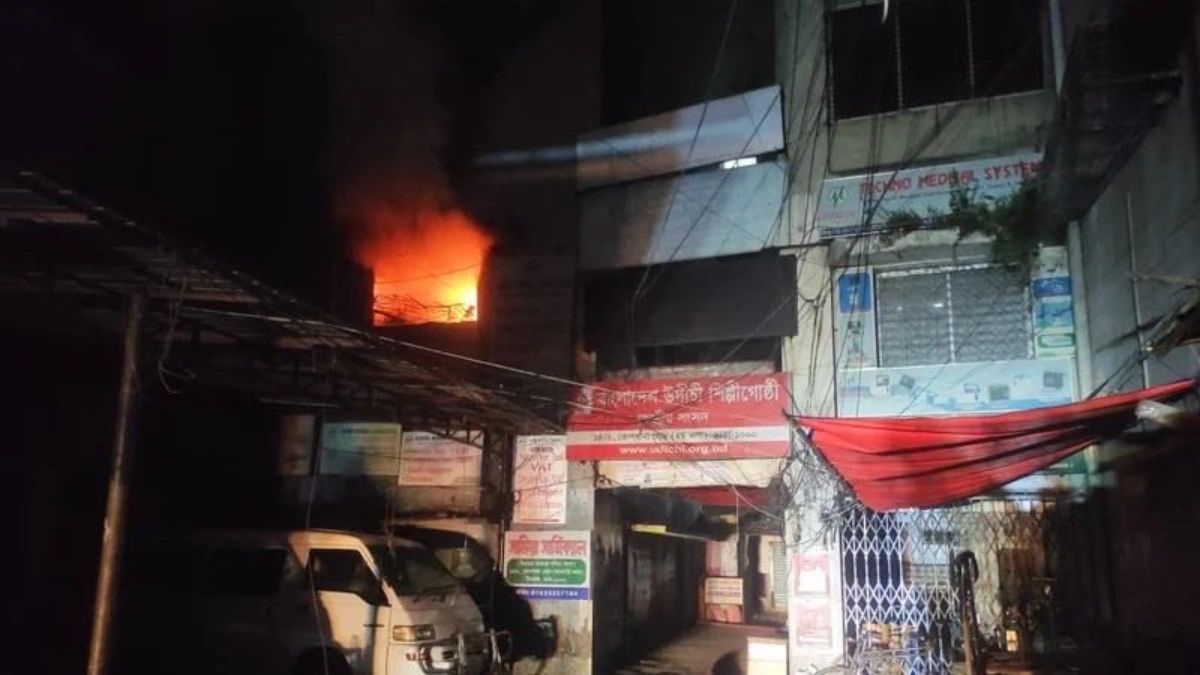
 "The photograph shows the Dhaka office of Bangladesh Udichi Shilpigosthi, the country's premier anti-communal, progressive cultural group, in Dhaka on fire on December 19, 2025. (Photo: X/Siddhant Mishra)")
In the latest attack in the ongoing wave of nationwide street violence in the country, a mob stormed the office of Bangladesh Udichi Shilpigosthi, the country’s premier anti-communal, progressive group, in Dhaka on Friday evening and set it on fire.
Locals said that a group of people arrived at the Udichi Shilpigosthi’s office on Topkhana Road around 7 pm and set it on fire after vandalising it, according to Dailu Sun newspaper.
It was not immediately known if there were any casualties in the attack.
This is the latest attack on cultural and media institutions in the ongoing mob violence across Bangladesh. Mobs on Thursday night set the offices of Prothom Alo and Daily Star newspapers on fire. They also set on fire the office of Chhayanaut, an organisation dedicated to Bangla culture.
Bangladesh is currently in the grips of nationwide violence after the death of Sharif Osman Hadi , a prominent figure in last year’s movement that ousted then-Prime Minister Sheikh Hasina, on Thursday. He was shot by unidentified assailants in Dhaka last week.
Since the news of Hadi’s death broke, mobs have attacked the house of India’s Assistant Indian High Commissioner in Chattogram, set on fire the house of former minister Mohibul Hasan Chowdhury Nowfel, demolished the Awami League office in Rajshahi, and attacked cultural centres and media offices.
ALSO READ: Hasina gone, Bangladesh’s extremists dismantle 1971 foundation to become ‘East Pakistan’ again
Since the rise of anti-Hasina movement last year, Islamist groups have often attacked Bangla cultural institutions. Analysts have said that Islamist forces that ousted Hasina are working to systematically change Bangladesh’s character as a nation. From a nation founded on the basis of shared Bangla culture, they want to reshape Bangladesh as per their extremist vision of an Islamic state.
“There were always two ideas of Bangladesh and the one aligned with Pakistan appears to be getting stronger by the day, according to Deep Halder, a Bangladesh watcher and author of ‘Being Hindu in Bangladesh: The Untold Story’ and ‘Inshallah Bangladesh: The Story of an Unfinished Revolution’.
“One was the idea that led to the foundation of Bangladesh in 1971. It envisioned the nation as a sociocultural entity centred around language and culture. Under this idea, people would rise above religion. The second idea was that of East Pakistan that imagined the nation strictly in religious —Islamic— terms. This second idea now appears to be getting stronger by the day,” Halder previously told Firstpost.