

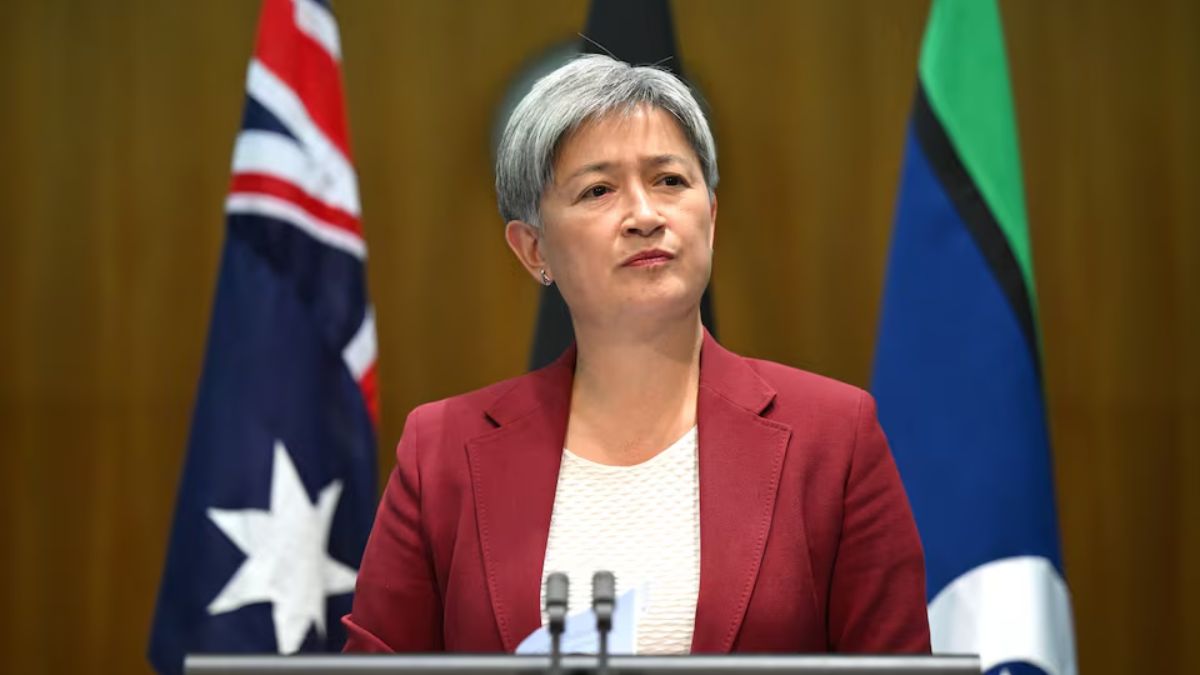
 "Australia will consider recognising Palestinian state, says Foreign Minister Penny Wong")
Australia will consider unilaterally recognising a Palestinian state in an effort to resolve the Israel-Palestine dispute and ensure lasting peace in the Middle East, the country’s Foreign Minister Penny Wong said.
Wong’s statement put Australia in the league of United States, United Kingdom, and Spain, which have expressed the intention to unilaterally recognise a Palestinian state. Such a recognition is part of their commitment to the proposed two-state solution to the long-running Israeli-Palestinian conflict.
Israel has, however, rejected such proposals of unilateral recognition with the argument that any recognition should come after direct negotiations between the Israelis and Palestinians.
Speaking at Australian National University (ANU), Wong on Tuesday said that the two-state solution is “the only hope to break the endless cycle of violence” in the Middle East.
Israel’s own security depends on 2-state solution: Wong
Wong said that the opposition to the two-state solution is misplaced. She said that “those who claim recognition is rewarding an enemy” were wrong because Israel’s own security depends on a two-state solution.
“There is no long-term security for Israel unless it is recognised by the countries of its region,” said Wong.
Wong, however, ruled out any role of Hamas, the principal terrorist group based out of Gaza that fights against Israel, in the future Palestinian state. She said, “There is no role for Hamas in a future Palestinian state.”
Impact Shorts
More ShortsThe State of Palestine has the status of a non-member observer state in the United Nations (UN). The Palestinian Authority (PA), the Palestinian administration that partially governs the West Bank, last week formally asked the UN Security Council (UNSC) to reconsider its 2011 application for full membership of the UN.
What’s 2-state solution?
The two-state solution refers to the arrangement where a Jewish State of Israel and an Arab State of Palestine will co-exist in the West Asia. This is the widely accepted solution to the long-running Israeli-Palestinian conflict.
Earlier this year, UK Foreign Secretary David Cameron said that the recognition of the Palestinian state, including at the UN, would make progress towards the realisation of the two-state solution irreversible". He said Palestinians must have “a political horizon so that they can see that there is going to be irreversible progress to a two-state solution”.
“We should be starting to set out what a Palestinian state would look like – what it would comprise, how it would work. As that happens, we, with allies, will look at the issue of recognising a Palestinian state, including at the United Nations. This could be one of the things that helps to make this process irreversible,” said Cameron in January.
Separately, the Biden administration in the US is also considering options for the American and international recognition of the Palestinian state after the war in Gaza is over, according to a report in Axios. This is a shift in US policy as the hitherto policy said that such a recognition should only come after direct negotiations between PA and Israel have worked.
The Biden administration has linked the normalisation of ties between Israel and Saudi Arabia to the creation of a pathway for the establishment of a Palestinian state after the war in Gaza, according to the report. Since the beginning of the Israel-Hamas War, Saudis have publicly stated that any normalisation of ties with Israel would be conditional to “irrevocable” progress towards the Palestinian state.


 "Russian drones over Poland: Trump’s tepid reaction a wake-up call for Nato?")
 "As Russia pushes east, Ukraine faces mounting pressure to defend its heartland")
 "Why Mossad was not on board with Israel’s strike on Hamas in Qatar")
 "Turkey: Erdogan's police arrest opposition mayor Hasan Mutlu, dozens officials in corruption probe")
 "Russian drones over Poland: Trump’s tepid reaction a wake-up call for Nato?")
 "As Russia pushes east, Ukraine faces mounting pressure to defend its heartland")
 "Why Mossad was not on board with Israel’s strike on Hamas in Qatar")
 "Turkey: Erdogan's police arrest opposition mayor Hasan Mutlu, dozens officials in corruption probe")



