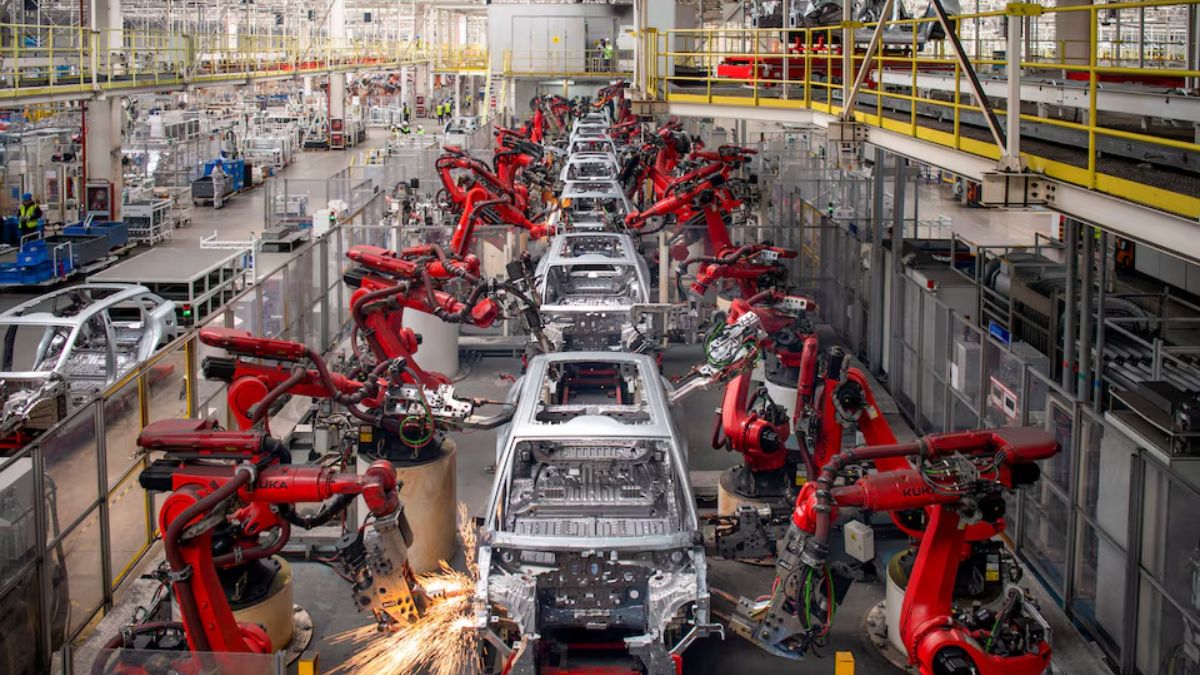
 "Robotic arms assemble cars in the production line for Leapmotor's electric vehicles at a factory in Jinhua, Zhejiang province, China, April 26, 2023. (China Daily via Reuters/File Photo)")
China in November surpassed the $1 trillion-mark in trade surplus as its exports grew despite US President Donald Trump’s tariff war, but the factory deflation did not just extend into 38th consecutive month but worsened — reflecting the complex and concerning reality of the Chinese economy.
Despite Trump’s tariffs, China’s exports in the January-November period rose 5.9 per cent year-on-year. While shipments to the United States fell by 29 per cent year-on-year, exports significantly rose to Southeast Asia, Africa, Europe, and Latin America.
The decline of exports to the United States was offset to an extent by Chinese businesses’ strategy to move final assembly lines of many goods to Southeast Asia, Mexico, and Africa to bypass Trump’s tariffs.
But the worsening factory deflation that has entered the 38th consecutive month also reflects falling industrial profits, persisting weak domestic demand, and risk of a recession.
China’s economic fundamentals remain concerning — despite export growth
China’s factory deflation extended into the 38th consecutive month in November and fell by 2.2 per cent month-on-month.
The factory deflation refers to a sustained decline in the prices of goods leaving factories. Instead of what consumers pay (measured by consumer price index), it means what producers get for products shipped out of factories and is measured by producer price index (PPI).
If factory deflation has extended into 38th month even as exports have risen consistently to an all-time high, it means that the domestic demand has remained persistently low and domestic consumers are not in a good shape.
Quick Reads
View AllPersistent and worsening factory deflation means that industrial profits are constantly falling and factories are plagued by overcapacity and the domestic economy has excess supply.
To make it worse, China’s GDP deflator —the broadest measure of prices— is set to decline for the third consecutive year in 2025, the longest streak since China transitioned toward a market economy in the late 1970s, according to Bloomberg.
Even for an export-oriented economy like China, such a scenario is very concerning and means that the fundamentals of the economy are concerning. For one, the share of exports in the GDP has consistently fallen in the past two decades — falling to around 20 per cent from the peak of 35 per cent in 2006.
If the situation persists in the coming months, factories could start closing as their profits are already squeezed and job losses could mount. In any case, squeezing profits would put a stop on industrial investment and that would further slow growth.