

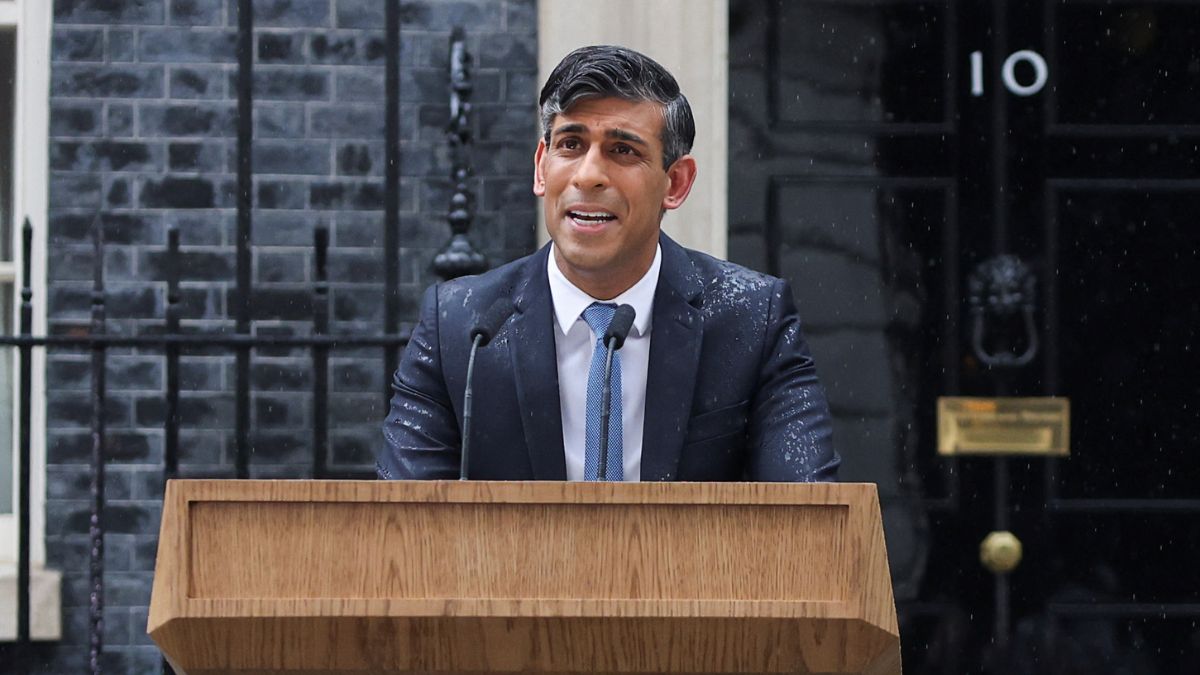
 "5 reasons Rishi Sunak will take big part of blame for Conservative Party's loss")
Rishi Sunak bears ultimate responsibility for the “chaos” the Conservative Party is mired in. This is what Lord Ben Houchen, re-elected as Tees Valley mayor earlier this year, said in May. He said lots of Tories were “fighting each other like rats in a sack” and the blame “ultimately lies with Rishi”. His comments came as a surprise and a telling blow to Prime Minister Rishi Sunak, who though still reeling from disastrous local election results had hailed Lord Houchen’s victory as a sign that the Tories could still win the general election.
This was also the time when Sunak was facing defection from his party. Senior leader and Dover MP Natalie Elphicke had defected to the Labour Party, protesting Sunak’s record on housing and stopping small boat crossings.
Two months later as the UK voted in the parliamentary election, Politico commented that Sunak “seems doomed to electoral oblivion” on Thursday. It said that as the Conservative Party’s fifth prime minister in eight years, Sunak “will never be judged on his own terms now, and this is his curse”.
Sunak failed to fix chaos and infighting
Lord Houchen and Elphicke were not exceptions. There were strong rumours earlier this year that a group of Tory MPs were keen on replacing Sunak with his former leadership rival and now Leader of the House of Commons in his Cabinet, Penny Mordaunt.
Impact Shorts
More ShortsThe Daily Telegraph reported in March that a meeting was held between leading figures on the right wing of the Tory party and prominent supporters of Mordaunt from when she previously ran for the Tory leadership after the exit of Boris Johnson as prime minister in 2022. they were prepared to back her, it said.
However, Sunak could stay in his office as some senior party leaders dismissed the idea of replacing the British Indian leader at this juncture in the electoral cycle as “madness”.
At that time, Sunak was also dealing with defections from his party. Senior leader and Dover MP Natalie Elphicke had defected to the Labour Party, criticising Sunak’s record on housing and stopping small boat crossings.
Two months later, as the UK headed to the polls for the parliamentary election, Politico noted that Sunak seemed “doomed to electoral oblivion,” remarking that as the Conservative Party’s fifth prime minister in eight years, Sunak would not be judged on his own merits, a predicament described as his “curse."
Sunak failed to address economic woes
Sunak has struggled to address the economic fallout from the pandemic and the energy market disruptions caused by the war in Ukraine, which have led to a cost-of-living crisis severely affecting the poorest Britons.
Although he has argued that the UK economy is recovering, with inflation starting to ease, these improvements have come too late for many.
A study by the National Institute of Economic and Social Research estimated that the UK’s real GDP is two to three per cent lower than it would have been if the country had remained in the EU, with real income about eight to nine per cent lower compared to pre-pandemic levels.
Sunak’s migration policy failed
Sunak’s handling of immigration has been a significant point of contention. The increase in immigrants and asylum seekers crossing the English Channel has led to criticism of the government’s border control measures.
Sunak’s plan to deport migrants, some to Rwanda, has faced accusations of violating international law and being inhumane. Critics argue that this strategy fails to address the underlying causes driving people to flee their countries.
One of the objectives of Brexit, undertaken by Sunak’s party, was to reduce illegal immigration to the UK, while dealing with asylum seekers separately. However, asylum seekers make up only about 11 per cent of the UK’s immigrant population, with half of them being Ukrainians who entered under a specially designed system with substantial public support.
The primary driver of migration to the UK is economic, reflecting the country’s own labour needs. Migration researchers point out that while Brexit curtailed the free movement of EU workers, it did not eliminate the labour shortages that have fuelled increasing migration to the UK since the 1990s.
As a result, non-EU migrants have filled many roles in sectors like retail and the National Health Service, which were previously occupied by European workers. Additionally, some European migrants who used to travel between the UK and the continent have now chosen to remain in place.
Sunak couldn’t fix healthcare crisis
The NHS, a cornerstone of British society, has been facing severe challenges, with long waiting lists and delays in critical care. Reports of patients enduring lengthy waits for ambulances and hospital beds have highlighted the strain on the healthcare system. Despite these issues, Sunak has not managed to implement effective reforms, further eroding public trust in his leadership.
Sunak couldn’t shake off Johnson-Struss legacy
Sunak has also been burdened by the legacy of his predecessors, Boris Johnson and Liz Truss. The Conservatives have governed the UK for 14 years and successive Conservative governments have tackled significant challenges, including Brexit, one of the deadliest Covid-19 outbreaks in Western Europe and soaring inflation due to Russia’s invasion of Ukraine.
Despite these external challenges, many blame the Conservatives for various issues Britain faces today—sewage spills, unreliable train services, a cost-of-living crisis, rising crime rates, and a surge in migrants crossing the English Channel.
The party’s reputation also suffered due to ethical lapses among government ministers, including lockdown-breaching parties and displays of expensive wearables amid public hardship. These scandals led to Boris Johnson’s resignation and exit from Parliament after misleading lawmakers. His successor, Liz Truss, lasted only 45 days before her economic policies caused turmoil.
Sunak also faced severe criticism for his lavish living. He is anyway the richest MP in the House of Commons and is richer than King Charles III. And there are factors governing the whole of Western Europe, with the incumbent governments in France and Germany facing serious challenges ahead of elections. As one commentator put it, to some extent, Sunak’s biggest crime is simply to be in office during a widespread anti-incumbent trend throughout the Western democratic world.


 "Russian drones over Poland: Trump’s tepid reaction a wake-up call for Nato?")
 "As Russia pushes east, Ukraine faces mounting pressure to defend its heartland")
 "Why Mossad was not on board with Israel’s strike on Hamas in Qatar")
 "Turkey: Erdogan's police arrest opposition mayor Hasan Mutlu, dozens officials in corruption probe")
 "Russian drones over Poland: Trump’s tepid reaction a wake-up call for Nato?")
 "As Russia pushes east, Ukraine faces mounting pressure to defend its heartland")
 "Why Mossad was not on board with Israel’s strike on Hamas in Qatar")
 "Turkey: Erdogan's police arrest opposition mayor Hasan Mutlu, dozens officials in corruption probe")



