

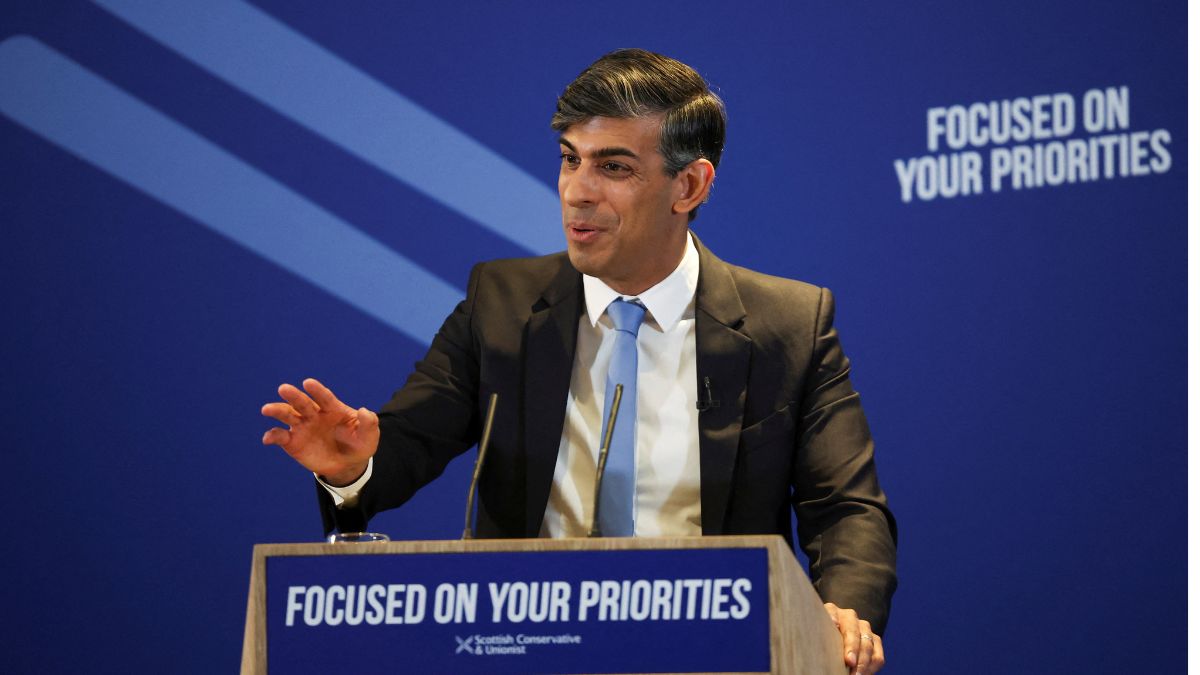
 "5 issues UK will be voting on and why Sunak’s party is under pressure")
The United Kingdom, which consists of England, Northern Ireland, Scotland and Wales, is poised to hold its national election on Thursday, with opinion polls indicating that Prime Minister Rishi Sunak’s Conservative Party may face significant backlash for failing to deliver on their long-standing promises.
Different constituents of the UK have different voting age eligibility — 18 in England and 16 in Scotland, for example. Of about 67 million people in the world’s sixth-largest economy, over 45 million are eligible to vote.
Since assuming power in 2010 when the world was still in a major global financial crisis (the 2008 meltdown), Sunak’s Conservative Party has led the country through three subsequent elections. However, a sluggish economy, declining public services, and a series of scandals have rendered the Tories, as they are commonly known, vulnerable to criticism from both the left and right.
Here’s a look at the issues that the Britons would be voting in tomorrow’s general election:
Economy, the core issue
Britain has grappled with high inflation and slow economic growth, which have collectively contributed to a sense of impoverishment among the populace. While the Conservatives succeeded in curbing inflation—slowing it to 2% in the year through May after it peaked at 11.1% in October 2022—economic growth remains lacklustre. This has raised serious questions about the government’s economic policies.
In May this year, an Institute for Fiscal Studies (IFS) report said that the past 14 years had marked the worst period for income growth in the UK in generations. It said that income growth has been slow “for essentially everyone – rich and poor, old and young”. This means that even while income inequality has been stable, progress on reducing absolute poverty has been painfully slow.
Impact Shorts
More ShortsIn addition to stagnant income growth, Britons are contending with a cost-of-living crisis, characterised by surging prices and stagnant wages.
The ruling Conservative Party has promised £17 billion ($21.6 billion) per year in tax cuts, which includes reducing the main rate of National Insurance contributions by 2 percentage points. This approach is intended to provide immediate financial relief to workers by lowering mandatory salary taxes.
In contrast, Labour Party leader Keir Starmer has proposed comprehensive reforms across several key sectors, including the National Health Service, home-building, and the energy sector. The Labour Party has pledged £7.4 billion ($9.4 billion) in tax increases to fund these initiatives, aiming to boost investment in these critical areas.
These differing economic strategies have been central to the debate over how to address the UK’s pressing economic challenges and are likely to influence voter’s choice on Thursday.
Housing crisis, an emotive issue
Rising property prices, increased rents, and a shortage of affordable new builds have contributed to a prolonged housing crisis. The Local Government Association reports that the number of temporary accommodations, necessitated by the lack of social housing, surged by 89 percent over the ten years leading up to March 2023.
This crisis has been exacerbated by austerity measures aimed at reducing the government’s budget deficit, which were introduced by the Conservative-Liberal Democrat coalition in 2010. According to Mia Gray, an economic geography professor at the University of Cambridge, Britain is experiencing “an affordable housing crisis.” She explains that the complexities of this crisis have been significantly worsened by austerity policies, particularly cuts to local government budgets.
Gray highlighted that in 2020-2021, the Department for Levelling Up, Housing and Communities allocated only 52 percent of the budget, in real terms, compared to what it had allocated in 2009-2010 for communities, including housing support. She described these figures as “staggering” and urged public attention to the issue.
To address the crisis, the Conservatives have pledged to build 1.6 million new homes if they win the general election. Meanwhile, Labour officials have committed to reinstating local house-building targets, which were eliminated in 2023, with a goal of constructing 1.5 million new homes in the coming years.
Healthcare crisis, a throbbing pain for voters
Founded in 1948 in a country that showed determination to build a fairer society out of the ruins of World War II, the National Health Service (NHS) offers free healthcare to citizens and residents. It is funded through taxation.
But in recent times, the NHS has been beset by long waiting lists, even for basic services like dental care to critical care issues like cancer treatment. The British media is full of reports of seriously ill patients enduring hours-long waits for ambulances and even longer waits for hospital beds.
Though the numbers declined slightly from September 2023 to April 2024 (for which the latest official figures are available), still some 7.6 million people including 6.33 million individual patients were on waiting lists for treatment within the NHS. The number was a record 7.8 million last September.
Another indicator of the healthcare crisis is the proportion of patients waiting more than four hours to see a doctor at Accident & Emergency (A&E) departments. Reports say it has increased during the Conservative Party rule from about 6 per cent in early 2011 to over 50 per cent in December 2022 and to around 42 per cent now.
Immigration and asylum debate, a policy headache
The rise in the number of immigrants and asylum seekers in recent years, crossing the English channel in easily available inflatable boats have led to bitter criticism of the government over its control on the borders and ability to secure them.
Sunak’s primary strategy to halt these crossings depended on his plan to deport migrants, some of them to Rwanda. However, critics have argued that this plan violates international law. They have called it inhumane, and one that fails to address the root causes driving people to flee war, unrest, and famine.
Environment, a long-term worry
Prime Minister Sunak has retreated from several environmental commitments in what he called a “proportionate” approach to deal with the issues relating to climate change. These decisions included extending the deadline for ending the sale of petrol- and diesel-powered vehicles and approving new oil drilling in the North Sea.
Critics contend that these policies are misguided, especially as the world endeavours to combat climate change. Being an island nation, the UK is particularly vulnerable to climate change. Studies have repeatedly warned that areas such as Liverpool, Southport, Blackpool and Morecambe are more vulnerable and predicted to be swamped by rising seawater over the next few decades if prompt action is not taken.
Why is Sunak’s party under pressure?
The Conservatives have been ruling the UK for 14 years, and are facing the election as Sunak decided to go for the snap polls. During these years, the successive governments of the party have navigated a series of formidable challenges including Brexit.
The aftermath of the global financial crisis inflated Britain’s debt, prompting the Tories to impose years of austerity measures to balance the budget. Besides leading the country through Brexit, managed one of the deadliest Covid-19 outbreaks in Western Europe, and faced soaring inflation following Russia’s invasion of Ukraine.
Despite these external pressures, many hold the Conservatives accountable for the myriad issues that Britain faces today — from sewage spills and unreliable train services to the cost-of-living crisis, rising crime rates, and the surge of migrants crossing the English Channel.
The party’s reputation has also been tarnished by repeated ethical lapses among government ministers, including lockdown-breaching parties in government offices and expensive wearables shown off by people in power while the masses were struggling with their daily needs. These scandals forced former Prime Minister Boris Johnson from office and ultimately out of Parliament after he was found to have misled lawmakers. His successor, Liz Truss, served only 45 days before her economic policies wreaked havoc on the economy. And incumbent Sunak has already been a subject to fierce criticism.
With these pressing issues at the forefront, the July 4 election will be a critical moment for the British electorate, who have to decide whether to continue with the Conservatives or opt for change. The pre-poll opinion polls suggest that the UK is in the middle of a wind of change. Some already see the Labour Party’s Keir Starmer as the next prime minister, ending the long political exile of the centre-left party in the UK.


 "Russian drones over Poland: Trump’s tepid reaction a wake-up call for Nato?")
 "As Russia pushes east, Ukraine faces mounting pressure to defend its heartland")
 "Why Mossad was not on board with Israel’s strike on Hamas in Qatar")
 "Turkey: Erdogan's police arrest opposition mayor Hasan Mutlu, dozens officials in corruption probe")
 "Russian drones over Poland: Trump’s tepid reaction a wake-up call for Nato?")
 "As Russia pushes east, Ukraine faces mounting pressure to defend its heartland")
 "Why Mossad was not on board with Israel’s strike on Hamas in Qatar")
 "Turkey: Erdogan's police arrest opposition mayor Hasan Mutlu, dozens officials in corruption probe")



