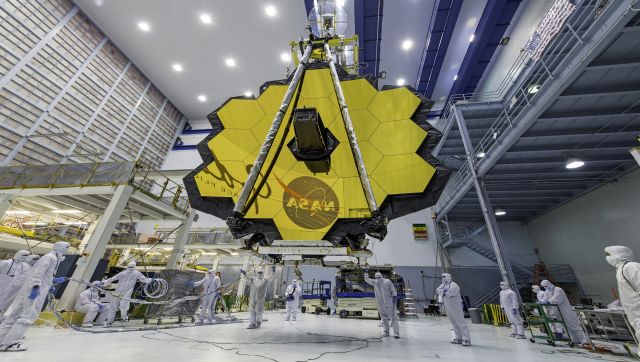
 "Explained: The James Webb telescope that brought us an image of how the universe looked 13 billion years ago")
The much-hyped James Webb telescope released its first full-colour picture on Tuesday — and it doesn’t disappoint.
The image, which may look like sesame seeds on a bun to some, is said to be the deepest, most detailed infrared view of the Universe to date, containing the light from galaxies that has taken many billions of years to reach us.
United States president Joe Biden speaking after he was shown the image during a White House briefing was quoted as saying, “These images are going to remind the world that America can do big things, and remind the American people — especially our children — that there’s nothing beyond our capacity.
“We can see possibilities no one has ever seen before. We can go places no one has ever gone before.”
The first image from the Webb Space Telescope represents a historic moment for science and technology. For astronomy and space exploration.
— President Biden Archived (@POTUS46Archive) July 11, 2022
And for America and all humanity. pic.twitter.com/cI2UUQcQXj
What exactly is the James Webb telescope? How does it work? What did the first image reveal? Here are the answers to all your questions surrounding the telescope and its mission.
All about the James Webb telescope
The James Webb telescope is the world’s most powerful space telescope ever built.
The Webb Telescope was jointly developed by NASA, the European Space Agency (ESA) and the Canadian Space Agency.
Development first began in 1996, when it was known as the Next Generation Space Telescope, before it was renamed in September 2002 after James Webb, who was the head of NASA in the 1960s and helped launch the Apollo program that eventually went to the moon.
The project suffered from numerous setbacks and delays, including a redesign into 2005, and ended up costing $10 billion.
Construction was completed in 2016, and the Webb Telescope underwent extensive testing before it was approved for launch.
After all of its testing, the $10 billion telescope was launched on 25 December 2021, from ESA’s launch site at Kourou in French Guiana, aboard an Ariane 5 rocket. After its launch, the telescope travelled nearly 1.5 million kilometres to a Lagrange point — a gravitationally stable location in space in 30 days.
How does it work?
The Webb telescope is an infrared telescope, meaning it uses infrared radiation to detect objects in space.
ABC News reports that it is able to observe celestial bodies, such as stars, nebulae and planets that are too cool or too faint to be observed in visible light — what is visible to the human eye.
The telescope’s centrepiece is the main mirror, measuring more than 21 feet (6.5 metres) in diameter and made up of 18 smaller, hexagonal-shaped mirrors.
The Webb telescope is different than the famous Hubble telescope in that it orbits the sun, whilst Hubble orbits Earth.
Another special feature of the telescope is that its infrared capabilities are uniquely powerful, allowing to detect light from earliest starts. This will allow scientists to peer further back in time than any previous telescope, to within a few hundred million years after the Big Bang, 13.8 billion years ago.
What is its mission?
There are four goals of the Webb Telescope. Firstly, scientists want to study the first stars and galaxies formed right after the Big Bang.
The second part of the mission is to compare the galaxies from the past to those of today.
Thirdly, the telescope is meant to see where stars and planetary systems are being born.
And last but not the least: to observe the atmospheres of extrasolar planets (beyond our solar system), and perhaps find the building blocks of life elsewhere in the universe. The telescope will also study objects within our own solar system.
Heidi Hammel, vice president of the Association of Universities for Research in Astronomy and an interdisciplinary scientist working on Webb, was quoted as telling Space.com, “Webb is designed to be an incredibly powerful tool that will see out to the edge of the cosmos, the most distant galaxies, maybe even the first stars that formed. But because it is so powerful, it has capabilities that we can apply everywhere in the cosmos, even in our local neighbourhood, the solar system.”
What did today’s image reveal?
The first image taken today has been met with applause from all.
Calling it Webb’s First Deep Field, it shows the galaxy cluster SMACS 0723. The BBC reports that the cluster itself isn’t actually that far away – “only” about 4.6 billion light-years in the distance. But the great mass of this cluster has bent and magnified the light of objects that are much, much further away.
“Even though this is by no means the farthest Webb can see, it’s the deepest image ever taken, and shows the power of this remarkable telescope: tremendous sensitivity, a broad range of wavelengths, and sharp image clarity,” Jonathan Lunine, chair of the astronomy department at Cornell University, told AFP.
What’s next for James Webb telescope?
The next set of images will be released late Tuesday evening (Indian time), revealing details about the atmosphere of faraway planets, “stellar nurseries” where stars form, galaxies locked in a dance of close encounters, and the cloud of gas around a dying star.
The Conversation reports that after 12 July, the James Webb Space Telescope will start working full time on its science mission. The detailed schedule hasn’t yet been released, but astronomers across the world are eagerly waiting to get the first data back from the most powerful space telescope ever built.
With inputs from agencies
Read all the Latest News, Trending News, Cricket News, Bollywood News,
India News and Entertainment News here. Follow us on
Facebook,
Twitter and
Instagram.

 "'Indian food, our pride': $200k settlement in Palak Paneer case a moral victory against racism in the west")
 "India’s air dominance in Operation Sindoor forced Pakistan to seek ceasefire, European report says")
 "How Pakistan’s support may have led Bangladesh towards a very costly mistake")
 "India vs New Zealand Live Score 3rd T20: Kishan, Abhishek tee off after Samson bowled on first ball")
 "'Indian food, our pride': $200k settlement in Palak Paneer case a moral victory against racism in the west")
 "India’s air dominance in Operation Sindoor forced Pakistan to seek ceasefire, European report says")
 "How Pakistan’s support may have led Bangladesh towards a very costly mistake")
 "India vs New Zealand Live Score 3rd T20: Kishan, Abhishek tee off after Samson bowled on first ball")