

 "Israel bombing Lebanon every 4 hours as ceasefire falters: Report")
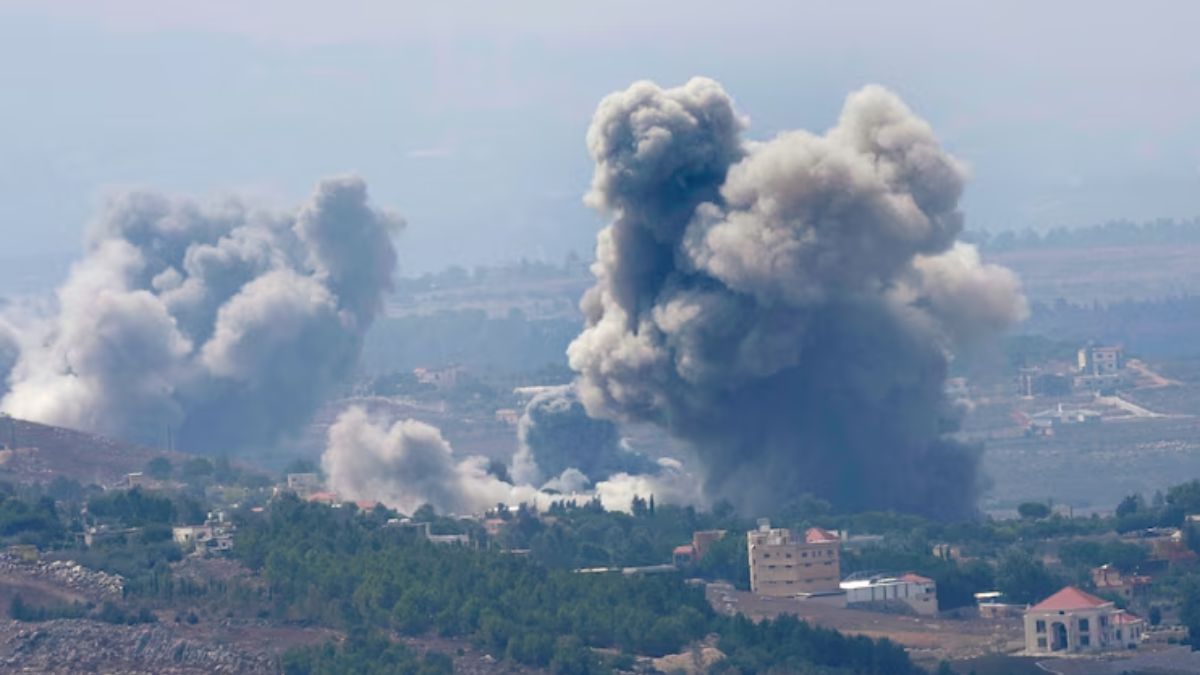
Israel has been striking targets in Lebanon at a relentless pace, roughly once every four hours, exposing the fragility of a US-brokered ceasefire that was meant to halt hostilities between Israel and Hezbollah more than a year ago.
As diplomatic meetings loom and international pressure mounts, the intensity and frequency of Israeli attacks are raising fresh doubts over whether the truce still holds in any meaningful sense.
According to conflict monitoring data cited in recent reports, Israel has carried out nearly 1,850 attacks on Lebanon since the ceasefire came into force, despite formal commitments to de-escalation. The airstrikes, drone attacks and ground operations have continued almost uninterrupted, even as diplomatic mechanisms designed to stabilise the border remain in place.
Strikes intensify ahead of ceasefire review
The latest escalation came on Thursday, when Israeli warplanes struck multiple locations across southern and northeastern Lebanon, stretching from Mount Rihan in the south to the Hermel region near the Syrian border. Lebanon’s state-run National News Agency reported that the attacks targeted a wide geographic arc, underscoring the breadth of Israel’s ongoing campaign.
Israel’s military said the strikes hit Hezbollah infrastructure, including weapons storage facilities, training compounds and launch sites used by the group. It also claimed that Hezbollah fighters had recently operated from some of the targeted locations. Shortly after the air raids, a drone strike hit a vehicle near the southern town of Taybeh, wounding four people, according to Lebanese officials.
The timing of the strikes has drawn particular scrutiny. They came just a day before a scheduled meeting of the committee tasked with monitoring the enforcement of the ceasefire, a mechanism involving Lebanon, Israel, the United States, France and the United Nations peacekeeping force deployed along the border. This was only the second such meeting since civilian representatives were added to what had previously been a military-only body.
Lebanon’s parliamentary speaker, Nabih Berri, described the bombardment as a calculated signal. “This is an Israeli message to the Paris meeting aiming to support the Lebanese army,” Berri said, adding that the “fire belt” of airstrikes appeared designed to coincide with the committee’s deliberations.
Quick Reads
View AllDiplomacy strains under military pressure
Parallel to the military escalation, diplomatic activity has intensified. Lebanon’s army commander, General Rodolph Haikal, travelled to Paris for talks with American, French and Saudi officials focused on bolstering the Lebanese army’s presence along the southern border. Haikal held initial discussions with French military leaders, including General Fabien Mandon, France’s armed forces chief of staff.
In a post on X, Mandon said the talks covered Lebanon’s security challenges and the broader regional environment, stressing that France’s assistance to the Lebanese army is guided by the goal of maintaining stability and lasting peace while respecting Lebanon’s sovereignty.
The Lebanese government has said it expects its army to clear the area south of the Litani River of Hezbollah’s armed presence by the end of the year, a key provision of the ceasefire. But achieving that goal has proven difficult amid Israel’s near-daily strikes and continued tensions along the border.
The United States, meanwhile, has stepped up pressure on Beirut in recent weeks to accelerate efforts to disarm Hezbollah, viewing the group’s weapons as a central obstacle to long-term stability. Israeli officials argue that continued military action is necessary to prevent Hezbollah from regrouping, while Lebanese leaders counter that sustained bombardment undermines the very institutions meant to enforce the ceasefire.
A ceasefire in name only?
The broader picture suggests a ceasefire that exists largely on paper. Since the truce was declared, Israeli strikes have killed at least 127 civilians, according to the UN Office of the High Commissioner for Human Rights, alongside numerous Hezbollah fighters. UN peacekeepers have reported thousands of violations, including airspace incursions and ground operations.
The current conflict traces back to October 8, 2023, when Hezbollah began firing rockets into Israel in solidarity with Hamas following the group’s attack on southern Israel a day earlier.
Israel responded with a sweeping aerial campaign in September 2024 that significantly weakened Hezbollah, followed by a ground invasion. While the ceasefire halted large-scale warfare, it failed to stop lower-intensity but persistent violence.
As Israel continues to strike Lebanon every few hours, the ceasefire’s credibility is eroding. With diplomatic talks proceeding under the shadow of air raids and drones, the challenge for mediators is no longer just enforcing the agreement but salvaging its relevance before another full-scale escalation takes hold.
With inputs from agencies

 "Bangladesh Protests Live: Police, army on street as post-Hadi violence targets Indian missions, Awami offices")
 "Who was Claudio Valente, Brown University shooting suspect who also killed MIT professor?")
 "Ukraine to US midterms: Will 2026 seal Trump's place in history?")
 "Bill Gates, quotes from ‘Lolita’ on woman’s body: What newly released Epstein photos reveal")
 "Bangladesh Protests Live: Police, army on street as post-Hadi violence targets Indian missions, Awami offices")
 "Who was Claudio Valente, Brown University shooting suspect who also killed MIT professor?")
 "Ukraine to US midterms: Will 2026 seal Trump's place in history?")
 "Bill Gates, quotes from ‘Lolita’ on woman’s body: What newly released Epstein photos reveal")



