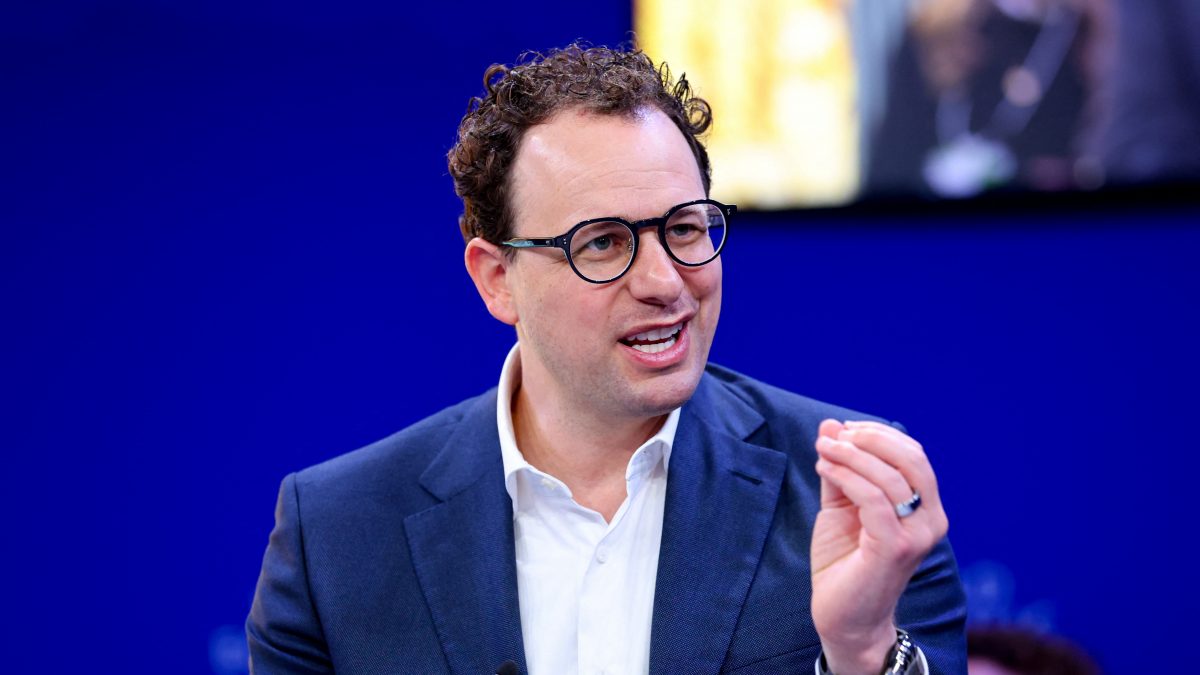
 "CEO and Co-Founder of Anthropic Dario Amodei (REUTERS/Denis Balibouse)")
Artificial intelligence may soon be smarter than us, and perhaps faster than we think. Dario Amodei, chief executive of Anthropic, said it is “possible, maybe even likely” that AI could one day outperform humans “at almost everything,” from digital tasks to physical-world applications.
Speaking on WTF Is, the show hosted by Nikhil Kamath, Amodei likened today’s AI revolution to “standing on a shoreline while a massive wave builds in the distance.” The transformation, he said, could reshape industries, career paths, and even education systems across the globe.
Amodei’s comments come as part of a broader debate on how quickly AI is advancing , and how unprepared most institutions are to deal with the disruption ahead.
Automation Anxiety: ‘We need to take it step by step’
Amodei argued that while AI already exceeds human ability in some areas, the story is more complex than simple replacement. Citing an example, he said, “Geoff Hinton predicted that AI will replace radiologists… and indeed, AI has gotten better than radiologists at doing scans.”
Yet the feared wave of job losses hasn’t fully arrived. “There aren’t fewer radiologists,” Amodei added. “The most highly technical part of the job has gone away, but somehow there’s still demand for the underlying human skill.”
Still, that balance might not last forever. “Perhaps, over time, AI will advance in areas where it hasn’t yet advanced, and maybe that’ll happen fast,” he cautioned. His approach remains empirical, “We should take it one step at a time and see what AI does today.”
His warnings align with the growing unease across industries. Recently, WiseTech Global announced plans to cut 2,000 jobs as it undergoes an AI-led overhaul, a signal that automation is no longer a distant concept but a present reality.
Quick Reads
View AllSimilar trends are surfacing across technology, media, and customer support sectors as companies rush to integrate AI-driven efficiencies.
Amodei is not alone in his assessment. Sam Altman has predicted that artificial general intelligence could soon surpass human capacity altogether, while Elon Musk has claimed this milestone could arrive as early as the end of this year.
Career advice for youngsters
Turning to career guidance, Amodei offered pointed advice for India’s young professionals. He urged them to build alongside AI rather than in opposition to it, explore opportunities in AI-linked supply chains and robotics, and sharpen their critical thinking, a skill he believes will be vital in an era of information overload.
He emphasised that while “coding is likely to be automated first,” broader disciplines like system architecture, design thinking, and user experience will continue to need human oversight for longer.
“Jobs involving interpersonal understanding or engagement with real-world contexts will remain more resilient than narrowly technical ones,” he said.
Amodei also outlined his idea of comparative advantage in an AI economy. Even if humans perform just “five per cent of a task” while AI does the rest, that contribution could still drive exponential productivity.
“As AI progresses from 95 to 99 per cent of capability, the human role narrows — but becomes even more important,” he said.
For India’s vast and youthful workforce, his message was pragmatic yet cautionary. The AI wave, he said, is building quickly, and the only way to stay afloat is to adapt deliberately, not resist change.
“The challenge isn’t to outcompete AI,” Amodei concluded. “It’s to figure out what uniquely human skills will matter most, and double down on them.”