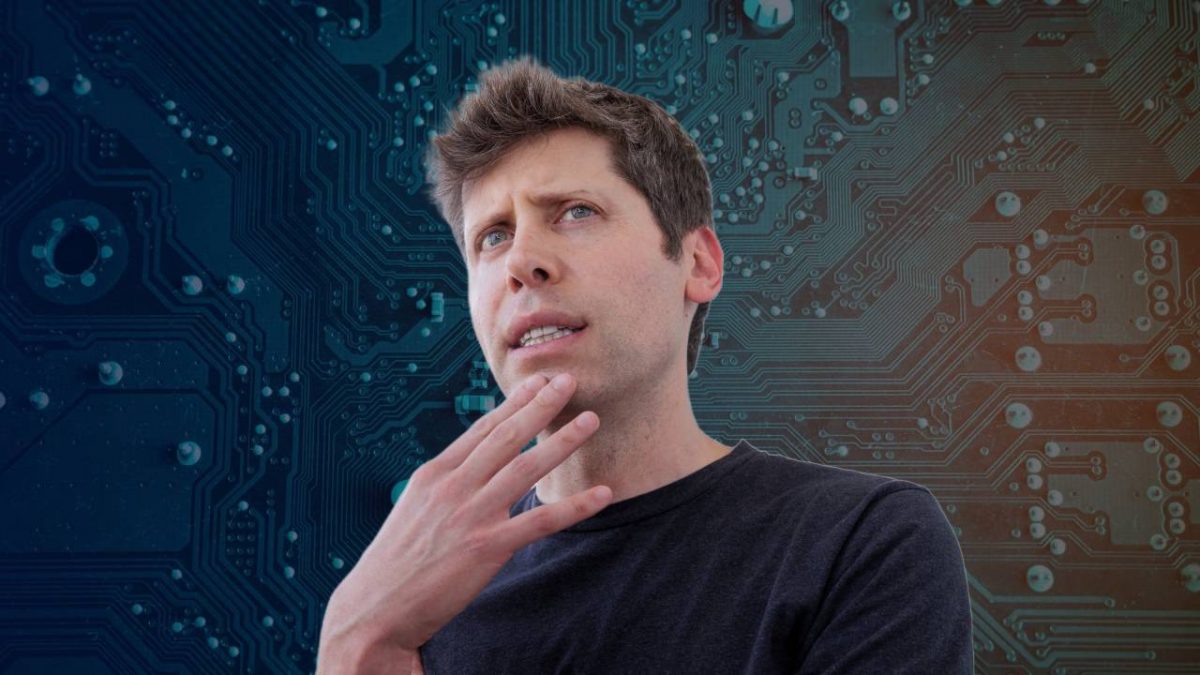
 "Sam Altman defends using gallons of water resource for AI")
During his visit to India last week, primarily for the India AI Impact Summit 2026, OpenAI CEO Sam Altman set off a storm after dismissing concerns about the environmental toll of artificial intelligence.
Speaking to The Indian Express, Altman said that claims circulating online about ChatGPT using gallons of water per query were “completely untrue, totally insane,” and had “no connection to reality.”
The remarks, quickly picked up across social media, drew both applause and outrage. Some argued Altman was right to call out misinformation, while others accused him of trivialising a complex issue at a time when data centres’ energy and water demands are surging worldwide.
How thirsty is AI really?
To understand the debate, it helps to know how water comes into play. AI models such as ChatGPT or Google’s Gemini run on massive data centres packed with servers that generate immense heat. These are typically cooled using water, a process that, while essential for performance, draws heavily on local water resources.
Altman’s frustration lies in the exaggeration of AI’s water footprint. In reality, the numbers are small per user query, though they scale massively when multiplied by millions of interactions.
Independent analyses estimate that a medium-length GPT-5 response, roughly 150–200 words, consumes about 19.3 watt-hours of electricity, translating to 25–39 millilitres of water depending on efficiency. A similar response from GPT-4o uses around 1.75 watt-hours, or 3.5 millilitres of water.
For comparison, Google’s Gemini model reportedly uses just 0.26 millilitres of water per text prompt, approximately five drops. These figures may sound negligible, but at global scale, the consumption quickly adds up.
A report from Xylem and Global Water Intelligence predicts that water used for data-centre cooling will triple by 2050 as AI adoption accelerates.
You can estimate AI’s water footprint yourself, in three simple steps:
Quick Reads
View AllStep 1 – Find credible data: Start by locating reliable research or disclosures about how much energy a model consumes per response. For example, a medium-length GPT-5 output (150–200 words) uses about 19.3 watt-hours, while a GPT-4o response uses 1.75 watt-hours.
Step 2 – Use a water factor: Industry studies suggest 1.3 to 2.0 millilitres of water per watt-hour as a reasonable conversion range. The lower figure reflects efficient data centres with modern cooling; the higher figure represents average sites.
Step 3 – Do the math: Multiply the energy number by the water factor:
Energy (Wh) × Water factor (ml/Wh) = Water used per query (ml)
So for GPT-5: 19.3 × 2 = 39 millilitres per response.
For GPT-4o: 1.75 × 2 = 3.5 millilitres per response.
Even with ultra-efficient facilities, that still comes to roughly 25 ml for GPT-5 and 2.3 ml for GPT-4o, per query. Multiply that by millions of prompts daily, and the environmental picture gets clearer.
Energy: AI’s real climate challenge
Altman acknowledged that while water usage may be overstated, energy consumption is the true concern. “Not per query, but in total, because the world is using so much AI,” he said, adding that the industry must “move towards nuclear or wind and solar very quickly.”
He also offered a provocative analogy: “People talk about how much energy it takes to train an AI model. But it also takes a lot of energy to train a human, 20 years of life, and all the food you eat before that time, before you get smart.”
The remark, equating AI training to human development, drew sharp criticism. Zoho Corporation’s co-founder Sridhar Vembu responded bluntly, “I do not want to see a world where we equate a piece of technology to a human being.”
Still, Altman’s argument pointed to a bigger theme: once trained, AI systems require relatively less energy to generate responses, known as inference, potentially rivalling human cognition in energy-per-task efficiency.
The sustainability paradox
Altman’s comments have reignited a broader question: can AI coexist with climate goals? Data centres already consume as much power as Germany or France, according to the International Monetary Fund, and that figure is climbing fast. Governments are scrambling to expand clean-energy capacity while communities push back against large-scale infrastructure projects.
Last week, the San Marcos City Council in Texas voted down a $1.5 billion data-centre project after public protests over electricity demand and water strain.
Meanwhile, companies like Microsoft are experimenting with zero-water cooling systems that circulate sealed liquid pipes directly across chips, drastically cutting evaporation losses. Others are testing immersion cooling, which submerges servers in non-conductive fluid, but these technologies remain costly and complex to scale.
AI’s climate equation isn’t settled yet
Altman’s defensive tone may have been an attempt to counter misinformation, but it inadvertently exposed a deeper truth, AI’s environmental footprint is still largely misunderstood. Even if per-query consumption seems small, the cumulative effect of billions of interactions each day is enormous.
AI can, in theory, help combat climate change, optimising power grids, forecasting weather, or improving carbon capture, yet its own appetite for power and water risks undermining those benefits.
The real test for Altman and the wider tech industry isn’t about whether AI drinks too much water, but whether it can learn to run cleaner, faster, and fairer before the planet runs out of time, and patience.
Unnati is a tech journalist with almost half a decade of experience. She has a keen interest to cull out unique story angle. She reviews the latest consumer and lifestyle gadgets, along with covering pop culture and social media news. When away from the keyboard, you might find her reading a fiction, at the gym or drinking coffee.