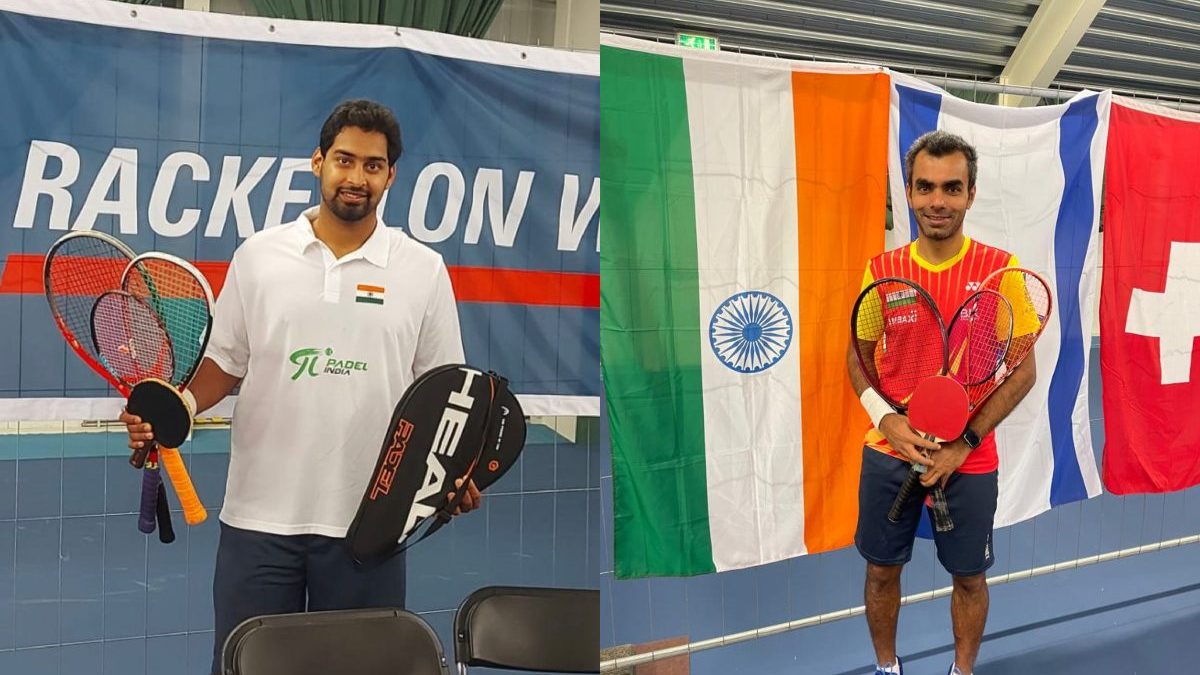
 "A racketlon match consists of one game of four raquet sports.")
India’s love affair with racquet sports is no secret. Sports like badminton, table tennis, lawn tennis and squash are played widely across the length and breadth of the country.
These disciplines have also produced some of the biggest global Indian sporting champions.
Each of these four sports (table tennis, badminton, squash and tennis) of course are so intense and require such high levels of fitness, skills and concentration that playing them at the highest international levels requires complete and absolute dedication to that one sport.
But what if you want to play all four at the highest level?
It might sound like an impossible dream, but there is in fact a fusion sport that combines all four of these racquet sports. A heady cocktail for those who have tasted it and one that requires players to play all the four disciplines as part of a single match, back-to-back. And no, it’s not played at some amateur club level - it is an international sport, complete with a global governing body, a ranking system, international level tournaments and a World Championship.
It’s called - Racketlon. A combination sport, like Triathlon, Decathlon or Heptathlon, but with four racquet sports.
The four different disciplines are played in this order - TT, badminton, squash and tennis, essentially moving from the smallest to the largest playing surface (squash courts are generally shorter but wider than badminton courts).
Before your head starts swimming, let’s quickly clarify that there are no sets or games like in the traditional racquet sports. Instead, one game of each sport is played till 21 points. The player scoring the most combined points after the four games wins the match.
Impact Shorts
More ShortsThis explains how one singles player or a doubles team can play all four racquet sports back-to- back without collapsing.
Check out the Racketlon rules in detail here:
Now, if you are thinking that this is a brand-new concept, think again.
“The sport originated somewhere in the Scandinavian countries - the exact origin is up for debate but it was either in Finland, Norway or Sweden. There it was played since the late 80s or early 90s,” said Varun Motasha, an IT professional and a Racketlon World Championship bronze medallist.
Traditionally India has not been a country where combination or fusion sports are really popular. If you conduct a spot poll, chances are most lay people would be able to name more single sport Indian athletes rather than say Heptathletes or Triathletes. That might have been one reason for the late entry and adoption of Racketlon in India. However, the sport’s USP overall makes it stand out from other combination sports. After all it is a fusion of four extremely popular racquet sports, which have hot beds and hubs across the country, with thousands of athletes involved in these sports, both at the amateur and professional levels.
In other words, if there’s an athlete who plays say badminton and tennis, then he or she is a good candidate for Racketlon, even though they might never have set foot on a squash court or played too much table tennis. With coaching in the ‘weaker’ sports and thanks to the scoring system, you don’t need to be a champion athlete in all 4 sports - something that is a utopian concept in any case. Remember, it’s the combined points that decide the winner. Which means that a player can lose one sport by a completely lop-sided scoreline and still go on to win the match.
“If you see the overall level of each individual sport compared to a pure sport you might feel it’s not that great, but when you take the average of all four, that is where the difference lies. You might be the best squash player, but that does not guarantee you a win in a Racketlon match. Case in point being the recent Nationals where my own doubles partner - Varun (Motasha), he lost the squash 0-21 and he still ended up winning the game,” Adit Patel, an India Racketlon player and General Secretary of the Indian governing body of the sport, the Racketlon India Sports Association, said.
It’s not just the adrenaline rush of being able to come back from the precipice of a crushing loss to vanquish your opponent that makes this sport an attractive proposition for athletes. The sport also allows athletes of a certain age category to continue to live their dream of representing the country on the world stage.
“My first Racketlon competition I was 37. So, typically in this sport you will also find that a lot of players are 30-plus. What I noticed when I started participating on the international circuit was that younger athletes are only focussed towards their primary sport - just like I was when I was growing up and playing badminton. Only once they semi-retire from their primary sport and start playing other racquet sports casually at club level is when they get introduced to this format of Racketlon. Very rarely will you see 25-year-olds participate in this format. It’s usually the 30-pluses and 35-pluses who are leading the tournaments globally,” Varun Motasha said.
Apart from allowing athletes of a certain age group to continue their love affair with sports, Racketlon also offers those racquet sport athletes who have had to take a break for some reason or the other a chance to return to the fold. I also spoke to the three-time reigning National Racketlon champion who works as an Income Tax Officer in Mumbai, Sidharth Nandal. He is a classic example of someone who found Racketlon to be the best option available to return to competitive racquet sports, and that too at the highest international level.
“I was playing badminton at the National level. I was the state champion, representing Haryana in the Nationals. I also played Table Tennis till state level. In 2019 I came to know about the sport (Racketlon) and I started training for squash and tennis. In 2019, in the first Nationals I went till the semis. I was in the top four, so I was selected in the Indian team. We then went for the World Championship and won it in 2019 itself…I am in a government job and when I was preparing for my exams, for a couple of years I was away from sports. I was not playing badminton (at that time), not even at state level. So, there was a long gap for me. And then when I was settled in the income tax department, I wanted to start playing sports again and I wanted to target the highest level. I wanted to go international. At 29, it wasn’t practical for me to start badminton again and go to that level. Since I had the advantage of playing multiple sports, I targeted Racketlon, because I knew I could go international in that and that happened in the very first year itself,” Sidharth said.
The sport globally though is trying to attract players of all age groups. Many of the tournaments are structured such that players from 10 upto 75 years old can send in their entries and play.
“International Racketlon events are happening 10 years onwards - 10, 13, 17, 19, 21 - then there are age categories from 40 to 75 in singles, doubles and mixed doubles. There are a lot of options. If you are not playing singles, you can play doubles or mixed doubles,” the president of the Indian governing body, the Racketlon India Sports Association (RISA), Kaushal Kumar Cheema told us.
The recurring theme though is that of athletes, who started playing one primary sport, while playing another one or two racquet sports on the side, switching to Racketlon at a certain point in time in their lives to ensure that the upward trajectory of their sports career continues.
“A friend of mine who went to college in the UK - Adit Patel - he played this sport in the UK and when he came back to India, he noticed that I was good at more than one racquet sport and he suggested that I give Racketlon a shot. And as part of the training for Racketlon I started trying my hand out at squash and lawn tennis - because those were the sports that I had played the least. I started competing here in the domestic circuit. Participating in tournaments and being successful in them got me a call-up to the India team. I represented India at the World Championships, last August. I also won a bronze medal in the singles - first time at a singles event - so that was a great achievement. And after all that success there is no looking back for me. Now I am deep into the sport. Looking forward to going to the World Championships again this August,” Varun Motasha said.
Varun’s enthusiasm is in many ways a reflection of just how appealing a sport Racketlon is for those who have given it a shot. And what makes it all worthwhile for these athletes is not just the opportunity to play sport internationally, but also to be able to win top honours both individually and for the country.
But, imagine what it takes for an athlete to change their mental make-up as many as four times for one match, to be able to switch from table tennis to badminton and then to squash and then tennis. That’s a whole bunch of different things - different playing surfaces, different equipment, different shoes, different strategies and different techniques, just to name a few.
“The first challenge of playing 4 racquet sports as opposed to one is adaptability, which is key. When you are playing one sport you have specific movements and specific skills which you need. For example, if I am playing lawn tennis, there is a specific muscle group which I play with, there is a specific technique which I use. Now let’s say in TT you start playing with the lower parts of your hand - your fingers, your wrists, then badminton is again your wrists. Then as you move to squash - it becomes your forearm, then when you go to tennis it becomes more of your shoulder. So, the adaptability is what you have to train for. When you are playing an individual sport - you can train in that one sport for 5 days a week, but when you are playing Racketlon you have to plan your coaching schedule because you can’t give 5 days a week to one sport,” Adit Patel pointed out.
Since Racketlon players have to essentially switch from one racquet sport to another seamlessly, their training schedules vis a vis time allocated for each sport have to be extremely precise. Imagine drawing up a schedule whereby you are not deciding how many hours a day you are going to train to focus on specific skillsets, but instead deciding which sport you are going to play how much of every day or every week. Most Racketlon athletes of course will have one or two ‘strong’ sports, which typically take a backseat when it comes to training, with the major focus being on the ‘weaker’ sports.
“I have seen most athletes in this discipline - they are always working on increasing the level of their weakest sport. In my case, I grew up playing badminton, so when I am training for Racketlon my least attention is on badminton. For me squash and lawn tennis were my weaker disciplines. Over the last 12-18 months I have signed up with personal coaches for both these sports and now I tend to play these sports more often in the week than the others. However, I make it a point to play at least one racquet sport at least every day of the week,” Varun Motasha told us.
“The people from India who are in the top 4/5/6 - those who have been playing on the world stage and performing there - they are all working people. So, it’s tough for them to spare 4-5 hours every day to train, because you need to train in 4 sports (regularly) or at least in three. If you have been playing one sport at (the) National level, you don’t need to train so much for that from the perspective of Racketlon. And you have to maintain fitness also,” Sidharth Nandal said.
Training for Racketlon also essentially means finding facilities or centres which have all four playing courts. And that is, in many ways, a challenge both for the players as well as the federation, because these facilities are needed not just for training and coaching but also to host Racketlon tournaments.
“Many clubs also have the facilities, but right now we are struggling because if we want to have an event in Mumbai, many of the clubs have one or two departments (sports facilities) committed during those dates. We had a lot of events at the Khar Gymkhana and other places. The problem was three departments would say - ‘ok we can spare the courts for three days’ and then one department would say that they can’t host. So, that is a practical difficulty right now,” the RISA president, Kaushal Cheema further added.
And needless to say, another huge challenge for both players and the federation is funding. Coaching classes for racquet sports is not cheap. Then there’s four different kinds of equipment, travel expenditure, accommodation etc. Racketlon players have to shell out quite a pretty penny out of their own pockets to keep their passion alive.
“I would say I spend about Rs. 2 - 2.5 lakh per tournament out of pocket. Sometimes they (tournaments) happen for 3 days, sometimes they happen for 5 days. If I go to Thailand that’s about Rs 1.5 lakh, but if I go to Finland or Germany, it might be Rs. 3 lakh. So, as an average I would say Rs. 2-2.5 lakh,” Adit shared.
Since most of the big World Tour events happen in Europe, for Indian players travel becomes very, very expensive. And missing out on these events in turn means their world rankings take a hit.
“The concern and the disadvantage for Indian players is that 80% of the tournaments happen in Europe. So, participation for Indian players in Europe is extremely rare, which is why you can have extremely talented players who can compete against the best in the world, but their ranking may not show that because they just haven’t participated in enough tournaments,” Varun said.
“Most Indian players we generally play the tournaments that happen in India, then we go to Thailand because it’s closer and it’s cheap. And then sometimes if you are in Europe on a business trip you could go play the German or the Swiss (Opens). But not every Indian player has the funds to go and play every tournament in the year. That’s another reason why we don’t have players in the world Top 10 or 15, even though we have potential, but the world rankings are dependent on how many of the World Tour events you play,” Adit added.
The federation and the players would really like more funding - private or otherwise. After all this might be labelled a ’niche’ sport, but it’s one that is being played internationally and where the players are representing the country. More exposure and media coverage of the sports and the athletes therefore is also crucial.
“In Europe also they have difficulties with big budgets. Though Racketlon was being played since the 1980s, it has come a big way now globally. Almost 30-40 international events are happening annually. In India also recently we had the Bombay Gymkhana international event. This year we are having an event at the Willingdon Club (Mumbai). So, people are coming forward, but the practical difficulty is that all the four departments have to create space for us in one slot. But it will pick up. We are hopeful that in 3 to 5 years this will be one of the most popular sports in the country,” Kaushal Cheema said.
As India climbs up the global Racketlon ladder, it was initially the Scandinavian countries which took the lead with this sport. Countries/regions with large scale sporting infrastructure like the United Kingdom also brought it into their sports fold quite early. And considering the majority of World Tour events are played in Europe, it’s not surprising to see how it’s an almost complete European domination in the world rankings.
Back in India, despite the financial hurdles and not getting the top ranks and considering how ‘young’ Racketlon still is as a sport in the country, it is truly remarkable to see how much Indian athletes have already achieved in the sport, globally.
The Indian Racketlon Federation - the Racketlon India Sports Association, headquartered in Mumbai, was set up in 2017. From then till now, Indian athletes have won a number of singles, doubles and team titles, across age categories.
RISA currently has about 2000 registered players.
“Recently we found that there are quite a few new players who have been added (registered). There have been players who played only one sport for a long time and over time it became monotonous for them to keep on playing only badminton or tennis, they wanted some change. So many of them are coming over to Racketlon via that route. Like Merwyn Fernandis, who is an ex-Olympian hockey player (part of India’s gold medal winning 1980 Olympics team) he has been regularly playing Racketlon events now. Nick Matthew, who is a squash legend (3 time squash World champion) has been playing Racketlon events in Europe. I was a badminton player myself. I have represented the country in badminton in the past. I was the National champion in 1967 and now I like to go and play Racketlon. Prakash Padukone who is a legend in badminton, he goes and plays squash sometimes, tennis sometimes. Racketlon has all 4 popular racquet sports and these people they meet across different sports,” Kaushal Cheema further said.
The common aim of all Racketlon players, whether in India or abroad is of course to shine on the World Tour stage.
The Racketlon World Tour is in many ways a mirror image of say the ATP or WTA tours in tennis. There are tournaments held through the year, where athletes enter as individuals and then there’s the World Championship, where the athletes represent their countries, much like the Davis Cup for men and the Federation Cup (now called the Billie Jean Cup) for women in tennis.
The World Championship is the holy grail. It is divided into three different levels or Cups - the bottom tier is called the Challenger Cup, then comes the Nations Cup and the top tier is the World Cup. India have so far won both the Challenger and the Nations Cups.
“In 2019, since India was fielding a team for the first time, we got entry in the Challenger Cup and we were able to win that Cup. Then there were no World Championships held for two years because of Covid. In 2022, since we had already won the Challenger Cup, we qualified for the Nations Cup and we were able to win that title also in Austria. And so, in 2023 we played in the World Cup - the highest level. In that we finished sixth. We couldn’t reach the semis because about 2-3 players were not able to accompany the team,” Sidharth Nandal shared.
All international Racketlon tournaments are divided into different categories. The full range of categories are something along these lines:
A - the Elite category, then B - Advanced category, C and D are the Amateur categories and E is Beginners. The number of categories per tournament depends on the size of the tournament and the number of entries. For a large tournament like the World Championship, you will find all categories, whereas for the smaller tournaments you might find only categories A and B or A, B and C, etc.
Every tournament has a fixed number of slots. So, for example if the World Championship A category has 64 slots and there are 70 entries for the top slot (Elite), then the 6 lowest ranked athletes (from the 70 who have sent their entries) will be pushed down to level B.
Similarly, if a tournament has say 16 slots open for the main draw or the top level/A (Elite) and they receive only 10 entries for this level, then the top 6 ranked players from level B will be pushed up to the Elite category. But all this is solely at the discretion of the tournament organiser.
The global Racketlon body - the Federation of International Racketlon (FIR), headquartered in Zurich, regulates the minimum number of entries per category in an international tournament.
The FIR also maintains the world ranking for players. Athletes also get Championship points for participation. Since most World Tour events happen in Europe, this means that a player who lives in Europe is likely to have more points than others, simply because she or he can afford to travel and play in many more tournaments, than say a player who lives in India.
The Racketlon India Sports Association (RISA) does not have Sports Ministry affiliation yet. But they do have private funding from the Mumbai based JM Baxi Group - one of India’s largest shipping service companies, which allows them to pay for part of the costs of the players who participate in the World Championship. Along with supporting the existing players, the aim now is to take Racketlon to the next level via world class infrastructure.
“(The JM Baxi Group) is a 100-plus-year old company and the Chairman of the company is Mr. Krishna Kotak. He is the founder and promoter of Racketlon in India and he has got great interest and vision for sports in the future. Post Covid we wanted to contribute in a big way to sports health. So, we identified an eight and a half acre land in Lonavala. This is totally privately funded by the JM Baxi Group. There we are setting up a badminton hall, squash courts, tennis courts, a TT hall…Our badminton hall capacity will be of 25-28 badminton courts, there will be 4 tennis courts with a roof cover, squash courts, the TT hall will have 6 tables. So, ours will be one of the National bodies with its own facilities and its own funding,” Kaushal Cheema said.
“It will also have a residential facility for 100 kids, with a cafeteria, gymnasium, open athletic track and other outdoor facilities. And within three years we are going to add another twelve acres there, where we will have facilities for other sports like wrestling, kabaddi, archery, rifle shooting. Right now, work is going on at Lonavala. We are hoping to complete it by December this year. We can have a World Tour event also at our centre and 3-4 events annually…If we get affiliation and recognition from the government, then their support also comes. But right now, we are happy with the stage we are at.”
The federation’s big aim of course is for more and more players to take up the sport. For any sport to grow exponentially, it’s important for it to permeate into the heart of the country - into the districts and small towns, into the zillas and the tehsils. It’s also equally important for the really young to take up the sport.
“For India to become a global force in Racketlon, you need to first popularise the game, especially in Tier 1 cities, because if you need to practice for Racketlon you need to have courts for all 4 sports in one place. I have seen many players who are good in at least two or three sports and when the tennis players don’t get to play in the rains (in Mumbai) for 3-4 months, they come and play badminton or they go and play table tennis. And by playing 2-3 months, they become better than average players in that sport, so the potential is huge in India for such players,” Sidharth Nandal said.
Racketlon might still be a ’niche’ sport and therefore have its own set of unique challenges, but the private funding that they have is a big boon. That coupled with the fact that it’s a sport that is a cocktail of 4 very popular racquet sports could well entice a whole generation of athletes to take up the sport.
“Indian players are extremely good in sports. They just need the opportunities. They need encouragement and they need to participate (in events). They are very self-motivated and they know the importance of sports in life and I’m sure Racketlon will contribute to Indian sports in a big way in the next 3-5 years. What we need is proper infrastructure, facilities, funding and encouragement and help the players to work in scientific ways,” Cheema said.
“We have individual players who have been doing very well at the world level, so India could be the next big story in Racketlon,” Sidharth added.
‘India - the new big story in Racketlon’. Let’s hope that’s what a news article headline reads someday.
Akaash is a former Sports Editor and primetime sports news anchor. He is also a features writer, a VO artist and a stage actor