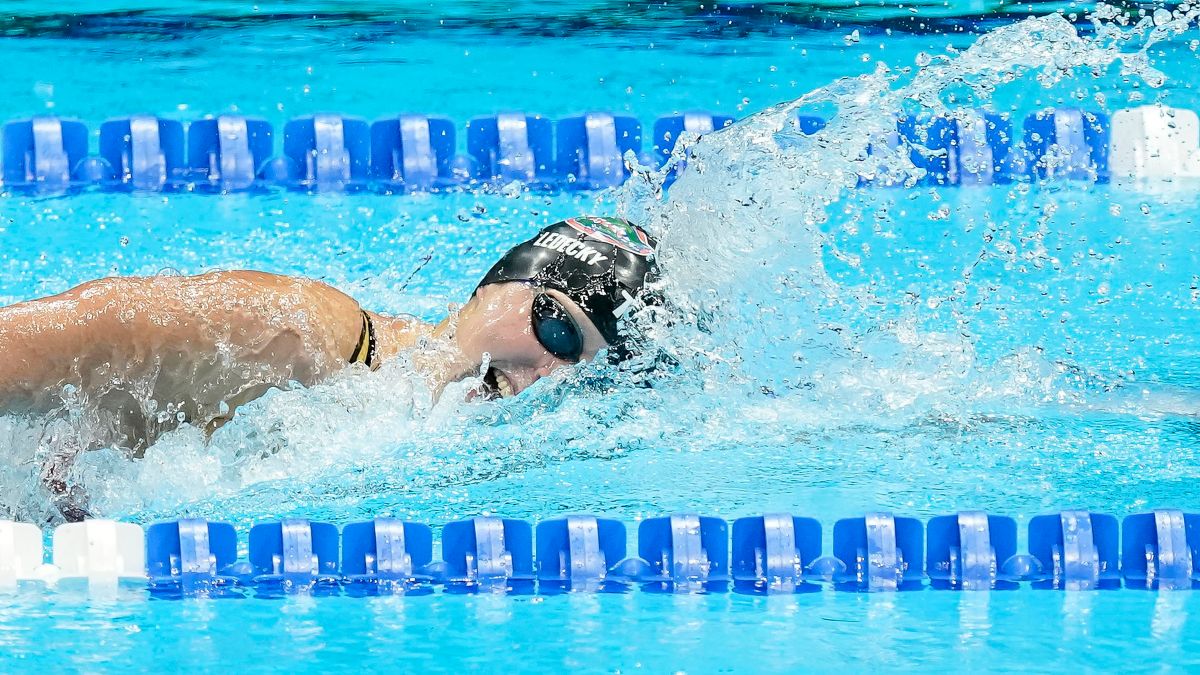
 "USA's Katie Ledecky is already counted among the greatest swimmers of all time and will be hoping to add to her six individual Olympic gold medals in Paris. Reuters")
While swimming as a competitive sport has been around since the ancient times, its development as a competitive sport began in the 19th century with the first swimming organisation having been formed in London in 1837.
Nine years later, the first swimming championship would take place in Australia with a 440-yard (400-metre) race. The Amateur Swimming Association, the governing body for swimming in Britain, would be formed in London in 1869, with national associations being formed in other parts of Europe and in the United States in the late 19th century.
Paris Olympics Complete Coverage: Click here for news, schedule, explainers and more
The Fédération Internationale de Natation Amateur (FINA), which was renamed to World Aquatics in 2023, was formed in 1909 and has been the global governing body for the sport ever since.
What is swimming’s history at Olympics?
Swimming is as integral to the Olympics as athletics and is among a handful of sports to have been part of each edition of the world’s biggest sporting event since the modern Olympic Games began in Athens in 1896. The sport was initially restricted to male athletes only, with women’s swimming making its debut in the 1912 Games in Stockholm. Swimming also has the highest number of medal events after athletics.
USA and Australia have been two of the most successful nations in swimming at the Olympics — although the Americans have by far been the most dominant nation, winning a total of 579 medals that’s more than twice as many medals as the 212 that the Aussies have won till date.
Impact Shorts
More ShortsWhat are the rules?
Swimming events are categorised according to the strokes as well as by the total distance covered. There are five strokes in competitive swimming — sidestroke, breaststroke, butterfly, backstroke and freestyle.
Sidestroke involves the swimmer bringing forth one arm with the other completely submerged, in order to move forward. The swimmer’s body turns to the side of the raised arm in this stroke. Breaststroke, which is believed to be the oldest of strokes, involves a wide pull of the arms combined with a symmetrical action of the legs. The athlete remains lying face down in the water, with the arms always remaining underwater.
Butterfly stroke is similar to breaststroke except for the fact that the arms are brought forward above the water. And while the legs spread apart in breaststroke, the swimmer’s feet remain together in butterfly.
Backstroke involves the swimmer floating on his/her back and using one arm at a time to create movement. The arm is raised above the water from one’s thigh towards the head and has to be in line with the shoulders at the time of touching water, with the palm outward and the little finger entering the water first. The swimmer also uses up-and-down leg movements to help with the movement.
As for freestyle, the arm action remains fairly similar to that of a sidestroke, but the legs perform a continuous fluttering up-and-down action — twice for each stroke. This stoke is considered the fastest in swimming and is often popular for swimmers covering large distances.
Who are the reigning champions?
Men’s Events:
50-meter freestyle: Caeleb Dressel, United States.
100 freestyle: Caeleb Dressel, United States.
200 freestyle: Tom Dean, Britain.
400 freestyle: Ahmed Hafnaoui, Tunisia.
800 freestyle: Bobby Finke, United States.
1,500 freestyle: Bobby Finke, United States.
100 backstroke: Evgeny Rylov, Russian Olympic Committee.
200 backstroke: Evgeny Rylov, Russian Olympic Committee.
100 breaststroke: Adam Peaty, Britain.
200 breaststroke: Zac Stubblety-Cook, Australia.
100 butterfly: Caeleb Dressel, United States.
200 butterfly: Kristóf Milák, Hungary.
200 individual medley: Wang Shun, China.
400 individual medley: Chase Kalisz, United States.
4x100 freestyle relay: United States.
4x200 freestyle relay: Britain.
4x100 medley relay: United States.
Women’s Events:
50 freestyle: Emma McKeon, Australia.
100 freestyle: Emma McKeon, Australia.
200 freestyle: Ariarne Titmus, Australia.
400 freestyle: Ariarne Titmus, Australia.
800 freestyle: Katie Ledecky, United States.
1,500 freestyle: Katie Ledecky, United States
100 backstroke: Kaylee McKeown, Australia.
200 backstroke: Kaylee McKeown, Australia.
100 breaststroke: Lydia Jacoby, United States.
200 breaststroke: Tatjana Schoenmaker, South Africa.
100 butterfly: Maggie Mac Neil, Canada.
200 butterfly: Zhang Yufei, China.
200 individual medley: Yui Ohashi, Japan.
400 individual medley: Yui Ohashi, Japan.
4x100 freestyle relay: Australia.
4x200 freestyle relay: China.
4x100 medley relay: Australia.
Mixed Event:
4x100 medley relay: Britain.
How many athletes have qualified in swimming?
A total of 854 athletes — 463 male and 391 female — from 187 nations besides individual neutral athletes and those who are part of the IOC Refugee Olympic team, will be taking part in swimming competitions at the upcoming Paris Olympics.
Who are the athletes to watch in swimming?
Katie Ledecky, United States: Already one of the greatest swimmers ever, the 27-year-old American heads to Paris looking to add to her six individual Olympic gold medals. The 800- and 1,500-meter freestyle are considered Ledecky’s best shots at victory. The two-time Associated Press female athlete of the year will be competing in her fourth Summer Games.
Léon Marchand, France: Swimming at home after leading Arizona State to an NCAA title under longtime Michael Phelps coach Bob Bowman, Marchand could be one of the biggest stars of the Paris Games. The Frenchman shattered Phelps’ 15-year-old world record in the 400 individual medley and also took gold in the 200 IM and 200 butterfly at the 2023 world championships in Fukuoka, Japan.
Kaylee McKeown, Australia: She captured three gold medals at the Tokyo Olympics and appears poised for another big performance after sweeping the women’s backstroke events at the 2023 worlds. McKeown is part of a powerhouse Aussie women’s team that also includes Ariarne Titmus, Emma McKeon and Mollie O’Callaghan. McKeon is competing in her final Olympics after hoarding seven medals — the most ever by a female swimmer — in Tokyo.
Caeleb Dressel, United States: The 27-year-old American was a standout at the Tokyo Olympics, capturing five gold medals, but burnout led him to walk away from the sport in the middle of the 2022 world championships. After an extended break, he failed to qualify for the 2023 worlds. Dressel is the sport’s most intriguing figure heading into the Paris Olympics.
Summer McIntosh, Canada: The 17-year-old McIntosh is expected to be a gold-medal contender in several events, including the 800 free that has been ruled for more than decade by Ledecky. The teenager snapped Ledecky’s 13-year undefeated run in that event at a sectional meet in Florida, posting a time that was faster than Ledecky’s gold medal-winning performance in Tokyo.
When and where will swimming take place at Paris Olympics?
The swimming competition, which is being held in a temporary pool at the Paris La Défense stadium, begins the morning of July 27 and has medal races every night through Aug. 4.
With inputs from AP