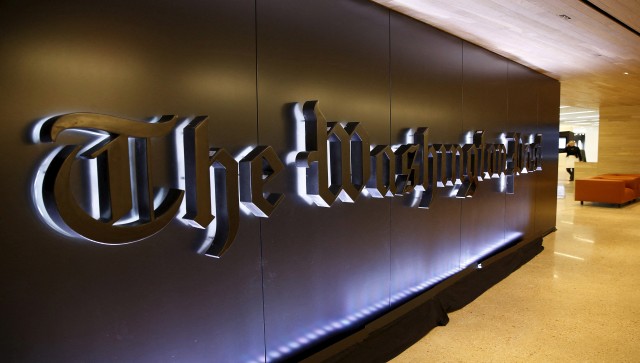
 "Why Washington Post, Intercept are openly pushing anti-India propaganda")
In a depressing economy, the union of workers at the Washington Post is negotiating for minimal percentage raises and went on a one-day strike of a scale unseen since the 1970s.
As the publication faces hard times, a majority of its staff staged a walk out on Thursday, December 7, accusing management of unfair payment tactics. Its reportage has, arguably, reflected its struggles.
As rating agencies continually hail India’s economic growth over the past decade, especially despite the pandemic years, the Democrat-supporting media house refuses to report on any Indian story without fear mongering about its people.
Usual keywords in the Post’s articles about the largest democracy club “Hindu nationalism” to echo the German socialist nationalism under the Nazi occupation. With no data to support this imagined menace as India managed to wipe out poverty, add millions of its previously unbanked population to not only banks but to corruption and leakage-free welfare schemes, the articles have depended upon reader ignorance and connotations of keywords to manufacture the threat.
The dislike of the world’s most popular Prime Minister, Narendra Modi, a statesman elected twice by his nation and enjoying the highest popularity rankings among global leaders even nine years into his governance, has allowed the American and European far-Left media a free hand to obfuscate Indian realities.
It has been easy to endanger Hindu citizens across the world by consistently equating the Bharatiya Janata Party with Hinduism and Hindutva, and then tie hatred against the BJP to outright Hinduphobia.
Hindutva, a pre-independence movement to defend against Islamic and missionary crackdown on Hindu expression, has been explicitly raised as a bogeyman by such publications to justify propaganda against one of the last remaining pagan people.
Quick Reads
View AllThe word that translates to “the essence of being Hindu” has been interchangeably used with Hinduism in furthering colonial era atrocity literature tropes, as seen during the “Dismantling Global Hindutva Conference” in 2021.
Consistently based on imagined and potential threats, and ignoring realities of the Hindus, the three-day conference saw thinly-veiled attacks on Hindus and their religion. As expected from an undisguised Hinduphobic platform that has refused to report on Hindu deaths while amplifying minor disturbances or virtual trolls as threats, the Washington Post jumped into the fray to report on the outrage generated by the obviously bigoted event, instead of against the anti-Hindu stance of the event itself.
As with many such publications, the Washington Post believes that using an Indian name and brown face will deviously offer an “inside perspective”. Often, audiences of such pieces are those who want to believe themselves informed about a non-English speaking nation halfway across the world, through English-language propaganda published in America.
One of these faces has recently been of Pranshu Verma, a Washington Post reporter called out by X influencer Jack Posobiec on December 9. The accusatory nature of the Washington Post reporter’s outreach was merely because the influencer in question had previously reshared Rudy Guilani-related information by an Indian OSINT (open-source intelligence) handle called Disinfo Labs.
While being unable to deny any of the claims made by Disinfo Labs, the lengthy hit piece by Pranshu Verma, co-authored by the perpetually pessimistic-on-India Gerry Shih, and intern Clara Ence Morse, attempted to “expose” the humans behind it.
Apparently run by an Indian intelligence officer, the handle has often cited George Soros as a powerful opponent of Indian democracy. Since India’s elected leader is not liked by the formerly Nazi-enabling billionaire, who was responsible for crashing England’s economy, and likely their then government, he has been vocal about his dislike.
George Soros has no qualms in admitting on a global level his disapproval, and to vowing to take all possible measures to oust Modi, while attacking India’s billionaire philanthropist Gautam Adani to hurt the Indian economy. Few have as much experience in single-handedly bringing down national economies and governments as the Hungarian-born billionaire, after all.
As a reminder, Soros is banned from entering Hungary, where he is a designated financial terrorist. Washington Post’s report chooses to portray Soros as a victim of his own stated desires, instead.
The report dropped on the heels of another frivolous piece by Pakistani-origin reporter Murtaza Hussain and Ryan Grim just before FBI Director Christopher Wray visited India in the midst of an intelligence-related tug-of-war between Canada and India.
The fray has gone on to now involving the USA due to the North American nations’ support of terrorist activities against the friendly democracy of India.
The “memo” in question reported on by Hussain and Grim has been clarified to be fake by India’s Ministry of External Affairs. Soon after, the Washington Post article did the rounds, and brought even more credibility to claims made by Disinfo Labs by citing sources easily discredited multiple times on public fora.
Examining the writeup by Verma, Shih and Morse, their first cry of dismay is that posts by Disinfo Labs are popular. They state that these are amplified by pro-Modi influencers, which may be construed as satirical if not written in seriousness — considering voting patterns in India, a very large number of influencers are likely to support the Prime Minister. This should hardly be a surprise, except to those who still bear the White Man’s Burden and intend to civilise Indians by imposing their version of what an elected leader should be.
Their second point of contention is that Disinfo Labs does not disclose its affiliations. Ironically, neither does the Washington Post. The article quickly cites three anonymous sources which it states as being “familiar with the establishment” of Disinfo Labs.
These unnamed sources say that the handle was set up to discredit “foreign critics of the Modi government”. This seems to be a stated pain point, however, as the Washington Post makes no attempts to hide that it is, in fact, an organised foreign critic of the Modi government.
The article then goes on to say that findings are shared by “right-wing Indians and Hindu nationalists”. The term is redundant since the Post does not differentiate between practising Hindus who vote for the BJP, and the “right wing”, which, in India, supports extreme welfarism and religious reform in the nation.
For the uninformed, however, the consistent use of “right wing” by far-Left publications such as Washington Post and The Intercept are reminiscent of Nazi Germany, and effectively create citation loops to validate Hinduphobia.
While American publications and digital platforms functioning as arms of the US State Department and intelligence without disclosing its affiliations are seen as credible, an Indian handle on X with a fraction of support and whose claims are yet to be factually disputed is portrayed as suspect.
While racism may be an obvious conclusion for the discrepancy in reportage, the reasons for such skewed analysis may go deeper.
Ex-US diplomat Mike Benz first spoke on a Spaces discussion where he detailed the US State Department taking measures to fund disinformation due to India under PM Modi being part of a “new non-aligned movement”.
He was then interviewed by The Sunday Guardian earlier in the year to discuss a sustained disinformation campaign against the current Indian government. When asked about his experience of active propaganda against the Modi government, he said, “In late 2018/early 2019, the US-UK foreign policy establishment began a campaign to paint Modi’s political success as being the result of ‘misinformation’ online.”
He called them “dirty tricks”, comparing them to what the American establishment executed in Brazil against Telegram, which was then forced to censor pro-Bolsonaro information.
According to Benz, the US State Department exerts influence through groups such as the Atlantic Council and USAID. They reinforce their own narratives by also funding mercenary “fact-checking” or “digital resilience” groups that label fact-based support for Narendra Modi’s government, or even of the country itself as misinformation, and asking for censorship. If The Intercept and The Washington Post are part of the US influence outreach via manipulated media, they are much too transparent, if the sources required to build their anti-India campaigns are of Pakistani origin, or backed directly by Soros.
For those unaware of the subcontinent’s geopolitics, Pakistani intelligence assets as well as media commentators are groomed to portray anti-India stances and validate them through powerful positions in the West.
When sources such as Pakistan’s ISI-backed Pieter Friedrich are quoted in the Washington Post to discuss India’s nationalist government, it is up to readers to reject unvarnished propaganda.
As Chris Blackburn posted, Disinfo Labs has linked several Jamaat fronts in the US as well. It is to the benefit of the US State Department to tackle radical Islamic fronts threatening terror and violence on its citizens, unless they are used as American intelligence assets at the risk of the American people.
Another quoted source is a professor at Indiana University, Sumit Ganguly. At a time when India and the Middle East enjoy the strongest relations in history, he co-authored an article about how Modi’s “Islamophobia is costing India partners in the Middle East”.
Another source cited is Joyojeet Pal of the University of Michigan, an academician studying “disinformation in India” who has consistently spoken about how smart India’s and PM Modi’s social media campaigns are and drawn parallels to President Trump’s.
If one wonders why these are supposed to be negative for a post-colonial nation like India, mired in poverty for decades, and finally breaking through on virtual media platforms, it may be due to the unsaid assumption that only nations subservient to Western interests are allowed that freedom. Articles drawn from biased sources are unlikely to provide unbiased analysis, and it is to the detriment of the Post’s readers to buy into Goebbelsian misinformation.
Throughout the article, the authors provide no information to counter a single connection laid out by the media handle they seek to attack – Disinfo Labs. They discuss its work building and a potential connect to Indian Intelligence, and hope that an accusatory tone suffices in seeding suspicion in their audience.
It states, “The Disinfo Lab has emerged as one of the more sophisticated players. In 28 reports it has published so far, the organisation has often painted a picture of an India under attack by a sprawling ‘nexus’ of conspirators funded by Pakistani intelligence, the Muslim Brotherhood and Soros.” As proven multiple times, and not denied by either Pakistan, Muslim Brotherhood or Soros, this is barely disputed.
All of these outfits would prefer to see a more malleable party at the centre, and have created media campaigns to that effect. That Soros donates to anti-Modi Congresswoman Pramila Jayapal is a matter of public record, and would be called out in unbiased reporting. It is, instead framed as an “allegation”, connoting an unproven vague link.
It also states that USCIRF is a “bipartisan organisation” while it thoroughly ignores the hundreds of Hindu deaths, coerced conversions and religious attacks on temples around the world, while promoting Christian missionary activism in India. The Commissioner of the advocacy group, David Curry, is also the President and CEO of Global Christian Relief.
Citing social media threads detailing verified influence operations by foreign agents on Indian soil are bound to be shared by those interested in protection against misinformation — that is not a Western prerogative. Naming government officials and a former R&AW chief as some among hundred who “retweeted” or commented on such information to make it sound like conspiracy is disingenuous, but the articles of late have hardly attempted to be anything but.
As India heads towards general elections next year, it is expected that the road to a peaceful democratic process will be hindered by foreign-funded protests and misinformation campaigns.
Since US attempts to coerce Bangladeshi officials are unlikely to work in the Indian scenario given India’s growing economic standing, social media campaigns have gained ground rapidly over the last half decade. In order to appeal to more than a niche population already inclined to vote against India’s present government, however, US-led influence operations would do well to base their propaganda on less exposed sources and on ISI-backed material.
The author is a columnist at several Indian publications such as NDTV, FirstPost and CNN-News18 and also hosts a podcast on geopolitics and culture. She writes about international relations, public policy and history. Views expressed in the above piece are personal and solely that of the author. They do not necessarily reflect Firstpost’s views.
Read all the
Latest News,
Trending News,
Cricket News,
Bollywood News,
India News and
Entertainment News here. Follow us on
Facebook,
Twitter and
Instagram.


 "'Indian food, our pride': $200k settlement in Palak Paneer case a moral victory against racism in the west")
 "India’s air dominance in Operation Sindoor forced Pakistan to seek ceasefire, European report says")
 "How Pakistan’s support may have led Bangladesh towards a very costly mistake")
 "India vs New Zealand Live Score 3rd T20: Kishan gone after IND cross 50 in just 3.1 overs")
 "'Indian food, our pride': $200k settlement in Palak Paneer case a moral victory against racism in the west")
 "India’s air dominance in Operation Sindoor forced Pakistan to seek ceasefire, European report says")
 "How Pakistan’s support may have led Bangladesh towards a very costly mistake")
 "India vs New Zealand Live Score 3rd T20: Kishan gone after IND cross 50 in just 3.1 overs")