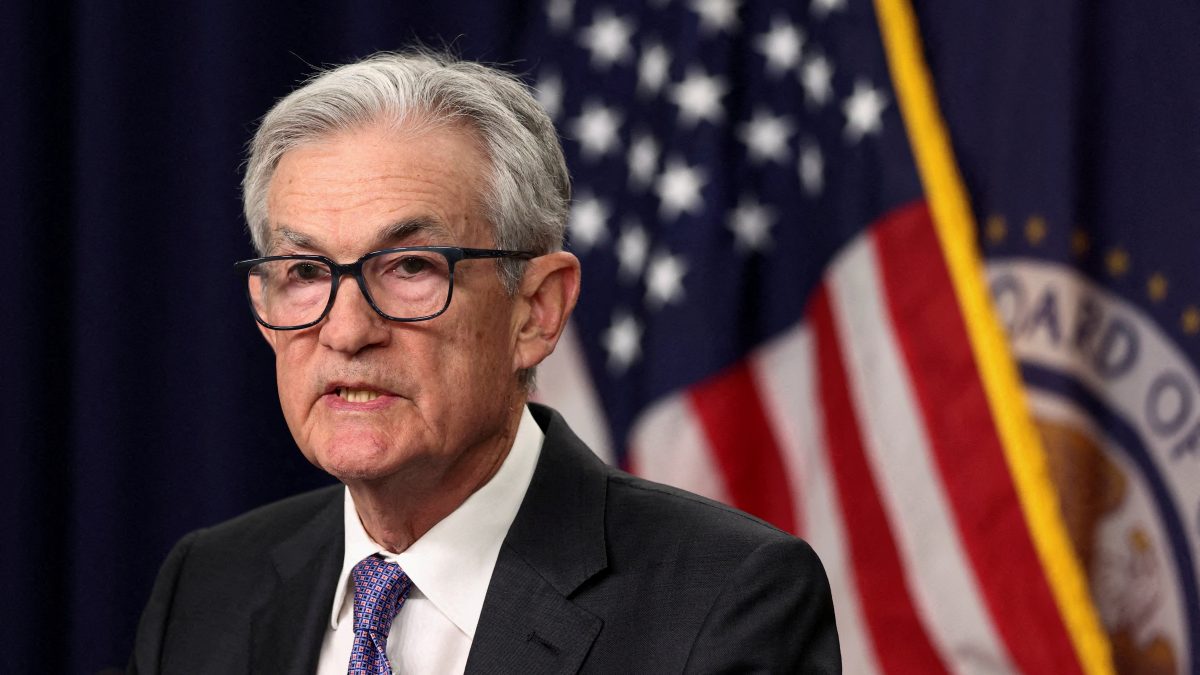
 "Why investigation of Jerome Powell signals a deeper threat to US Fed")
It is highly unusual for the head of a systemically important central bank to issue an unscheduled public statement. When it happens, it almost always reflects institutional stress rather than policy recalibration. That is why the recent statement by Jerome Powell, confirming that a criminal investigation is under way into his congressional testimony, has been read by markets and policymakers as a signal event.
The immediate trigger concerns the Federal Reserve’s $2.5 billion headquarters renovation and alleged inconsistencies in testimony before the Senate Banking Committee. But the chair’s own framing made clear that the underlying issue is not construction oversight. “The threat of criminal charges”, Powell said, “is a consequence of the Federal Reserve setting interest rates based on our best assessment of what will serve the public, rather than following the preferences of the President.” For a Fed chair to invoke independence so explicitly is itself evidence that normal guardrails are fraying.
President Donald Trump has denied knowledge of the investigation, but his broader objective has never been ambiguous. Over the past year, he has repeatedly argued that interest rates should be dramatically lower, at one point suggesting cuts of three percentage points from the 4.25–4.5 per cent range. He has publicly attacked the Fed’s competence, explored removing Powell but encountered legal constraints, attempted to remove another Fed governor (now the subject of a pending Supreme Court case), and nominated his Council of Economic Advisers chair to the Fed’s Board of Governors, an unusual move widely interpreted as an attempt to influence internal decision-making.
The economic context makes this pressure particularly consequential. The US economy is not in recessionary distress. Real GDP growth ran at an annualised 4.3 per cent in the third quarter of 2025, and even adjusting for tariff-related distortions, fourth-quarter growth estimates remain comfortably above 2 per cent. Unemployment, while edging up marginally, remains historically low. Inflation, though off its peaks, is still above the Federal Reserve’s 2 per cent target, in part due to tariff effects. In such conditions, aggressive rate cuts are difficult to justify on conventional macroeconomic grounds.
Against this backdrop, subjecting the Fed chair to criminal investigation has at least five identifiable implications for the United States.
First, inflation expectations and credibility. Modern monetary policy operates as much through expectations as through instruments. The Federal Reserve’s credibility anchors long-term inflation expectations, allowing it to stabilise the economy with relatively modest rate adjustments. When the central bank’s leadership is credibly perceived to be under political and legal intimidation, that anchor weakens. Even if near-term inflation prints remain contained, the risk premium embedded in long-dated inflation expectations can rise. Ironically, political pressure intended to force rate cuts can make easing riskier by threatening de-anchoring.
Quick Reads
View AllSecond, the sovereign term premium and borrowing costs. US Treasury yields reflect not only expected short-term rates but also an unusually low institutional risk premium. Investors have historically assumed continuity, predictability, and rule-bound monetary governance. Introducing legal uncertainty around the Fed chair raises the possibility that this premium could widen, particularly at longer maturities. Over time, higher term premia increase federal borrowing costs, undermining one of the administration’s own stated objectives of cheaper deficit financing.
Third, policy continuity and succession risk. Powell’s term as chair ends in May. The investigation complicates the succession process materially. As Senate Republicans themselves have warned, nominees could face confirmation hurdles until the matter is resolved. More importantly, any chair appointed under the shadow of an unresolved probe will face an immediate credibility deficit in markets. The rational inference will be that political alignment, rather than independence, was a decisive selection criterion. This weakens not just the chair but the collective authority of the Federal Open Market Committee.
Fourth, regulatory spillovers beyond interest rates. The Federal Reserve is also the primary supervisor of the US banking system. If political leverage succeeds in reshaping leadership norms at the Fed, the implications extend to stress testing, capital standards, and crisis management. Banks price regulatory credibility into balance-sheet decisions. Uncertainty about supervisory independence can tighten financial conditions independently of policy rates, dampening credit creation even in a growing economy.
Fifth, dollar credibility and external spillovers. The dollar’s dominant international role rests on deep markets and strong institutions, not coercion. Any sustained erosion of confidence in the Federal Reserve’s autonomy weakens one of the central pillars of dollar primacy. The immediate market response to the investigation – equities down modestly, the dollar softer, and gold surging to record highs above $4,600 an ounce – already shows early signs of an institutional risk trade. Reserve diversification is gradual, but marginal shifts compound over time.
Beyond economics, this episode is revealing of contemporary American politics. It highlights the erosion of informal institutional norms that have historically complemented formal law. Central bank independence in the United States is as much a convention as a statute. Once conventions are breached, legality alone offers limited protection.
It reflects the instrumentalisation of legal process. Even absent indictment, investigation itself becomes a coercive mechanism because of its asymmetry. This logic is increasingly visible across American institutions.
It signals a shift toward personalised economic governance, where policy disagreement is reframed as defiance rather than deliberation. This marks a departure from the post-war consensus that delegation to technocratic institutions strengthened, rather than weakened, democratic governance.
It also exposes a contradiction in economic nationalism. While the administration seeks to reinforce dollar dominance and market power, it simultaneously undermines the institutional foundations that sustain them.
Finally, it shows that the conflict is no longer simply about the appropriate level of interest rates. It is about who ultimately governs macroeconomic outcomes: rule-bound institutions operating under law or executive authority asserting direct control.
The market reaction so far has been contained. Institutional damage, however, is rarely priced immediately. Central bank credibility is accumulated slowly and can be lost abruptly. Whether this episode proves to be a temporary shock or a structural turning point will depend on how firmly the boundary between politics and monetary governance is defended in the months ahead.
(The author (X: @adityasinha004) writes on macroeconomic and geopolitical issues. Views expressed in the above piece are personal and solely those of the author. They do not necessarily reflect Firstpost’s views.)


 "High alert ahead of Republic Day as intelligence flags Khalistani, Bangladesh-linked terror threats: Report")
 "The Nobel meet: Trump gets the medal not honour, Machado has the title not power")
 "Trump says in 'talks with Nato' on acquiring Greenland, reiterates his national security rhetoric")
 "Iran protests revive the 2011 Arab Spring question: Does regime change improve livelihoods?")
 "High alert ahead of Republic Day as intelligence flags Khalistani, Bangladesh-linked terror threats: Report")
 "The Nobel meet: Trump gets the medal not honour, Machado has the title not power")
 "Trump says in 'talks with Nato' on acquiring Greenland, reiterates his national security rhetoric")
 "Iran protests revive the 2011 Arab Spring question: Does regime change improve livelihoods?")