Firstpost
  • Video Shows
    Vantage Firstpost America Firstpost Africa First Sports
  • World
    US News
  • Explainers
  • News
    India Opinion Cricket Tech Entertainment Sports Health Photostories
  • Lifestyle
Trending Donald Trump Narendra Modi Elon Musk United States Joe Biden

Sections

  • Home
  • Live TV
  • Videos
  • Shows
  • World
  • Entertainment
  • India
  • Explainers
  • Opinion
  • Sports
  • Cricket
  • Lifestyle
  • Health
  • Tech/Auto
  • Web Stories
  • Business
  • Impact Shorts

Shows

  • Vantage
  • Firstpost America
  • Firstpost Africa
  • First Sports
  • Fast and Factual
  • Between The Lines
  • Flashback
  • Live TV

Events

  • Putin in India
  • Bihar Election
  • Raisina Dialogue
  • Independence Day
  • Champions Trophy
  • Delhi Elections 2025
  • Budget 2025
  • Firstpost Defence Summit
Trending:
  • Trump at Davos
  • Bangladesh drops out of T20 WC
  • Board of Peace
  • Greenland standoff
  • Beckham family feud
fp-logo
Why India must tread cautiously on EU free trade agreement
Whatsapp Facebook Twitter
Trending

Sections

  • Home
  • Live TV
  • Videos
  • Shows
  • World
  • Entertainment
  • India
  • Explainers
  • Opinion
  • Sports
  • Cricket
  • Lifestyle
  • Health
  • Tech/Auto
  • Web Stories
  • Business
  • Impact Shorts

Shows

  • Vantage
  • Firstpost America
  • Firstpost Africa
  • First Sports
  • Fast and Factual
  • Between The Lines
  • Flashback
  • Live TV

Events

  • Putin in India
  • Bihar Election
  • Raisina Dialogue
  • Independence Day
  • Champions Trophy
  • Delhi Elections 2025
  • Budget 2025
  • Firstpost Defence Summit

Why India must tread cautiously on EU free trade agreement

Ninad D Sheth • March 3, 2025, 15:27:03 IST
Whatsapp Facebook Twitter

India might be much better off instead to strike a side-deal with France and Germany, nations that together account for 40 per cent of the bloc’s GDP, thereby securing a more tailored and potentially advantageous arrangement

Advertisement
Subscribe Join Us
+ Follow us On Google
Choose
Firstpost on Google
Why India must tread cautiously on EU free trade agreement
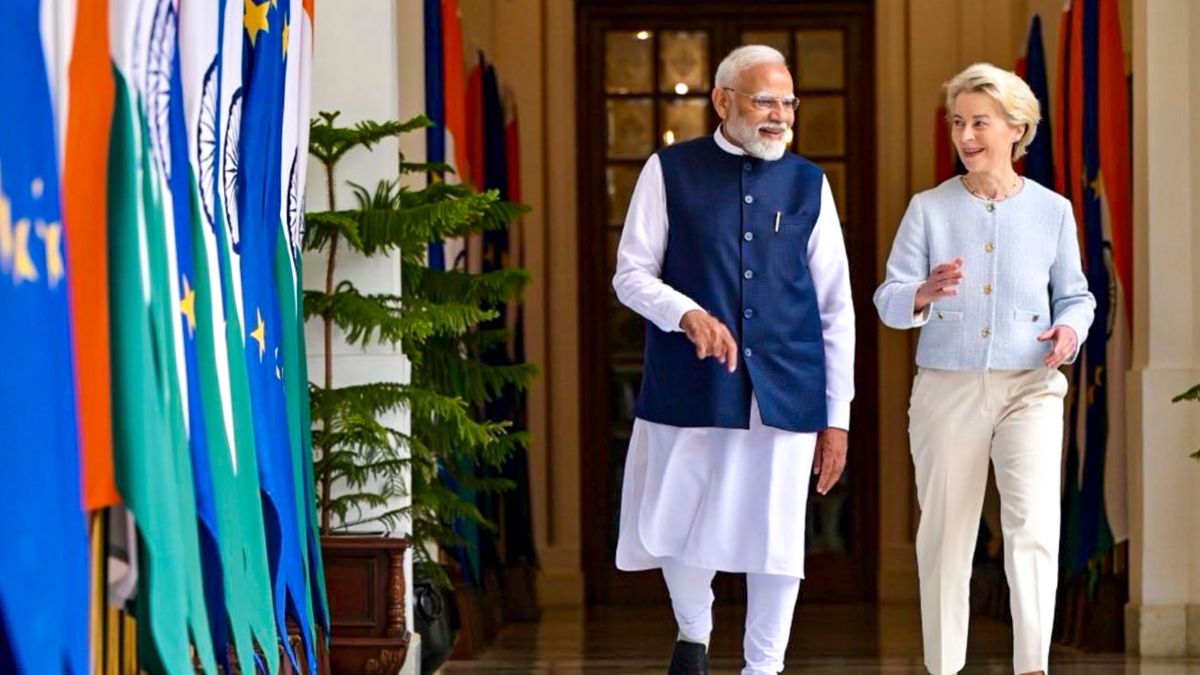
Prime Minister Narendra Modi with European Commission President Ursula von der Leyen prior to a meeting at Hyderabad House, in New Delhi, on Friday. PTI

Like ancient Greek envoys treading the rocky slopes of Mount Parnassus—each wary of the other’s hidden dagger—India now faces negotiations with the European Union that are as delicate as they are consequential.

India’s bilateral trade in goods with the EU was $137.41 billion in 2023-24. Significant exports to the EU were $75.92 billion, with imports of $61.48 billion. A fat yearly trade surplus.

The stakes are high: while the allure of a win-win deal—a standout, headline-making arrangement—beckons, prudence demands that India limit its free trade ambitions to a measured, selective engagement.

STORY CONTINUES BELOW THIS AD

In recent remarks, Ursula von der Leyen, the EU commissioner, said that as the two countries look to wrap up the free trade agreement (FTA) in 2025, she wants her negotiators to ‘surprise’. If New Delhi is not both careful and calibrated, this could be a nasty surprise. This sentiment encapsulates the current zeitgeist: rather than embracing a comprehensive liberalisation that risks overexposure, India should pursue a smaller deal that focuses on sectors where mutual gains are more clearly defined. Key among these are electric vehicle (EV) batteries and technology, where collaboration could unlock growth and efficiency gains. In parallel, a liberal regime for the free movement of skilled labour emerges as a vital counterweight to restrictions imposed by Washington. For Europe, a younger, better-trained workforce willing to integrate is a bonus.

More from Opinion
‘Madman diplomacy’: Trump didn’t break the system, he exposed it ‘Madman diplomacy’: Trump didn’t break the system, he exposed it Iran is not fighting for liberalism: How feminism is misreading the moment Iran is not fighting for liberalism: How feminism is misreading the moment

Yet not all sectors share this optimism. The Indian automotive centre, long a symbol of domestic ingenuity, is particularly vulnerable. The EU’s insistence on opening markets will hurt Indian, Japanese, and Korean competitors and threatens to undermine local strengths. They are lobbying hard against this. Moreover, the carbon tax championed by European policymakers will stifle the growth in India. It is a tariff barrier, and India must not agree to it. In these contexts, India must play a good hand, carefully calibrating concessions to avoid ceding critical strategic ground.

Perhaps the most thorny challenge lies in agriculture—a sector where India’s competitive strengths have historically lagged behind the EU, which has massive agriculture subsidies even bigger than India’s. Dutch horticultural techniques and precision in the production of vegetables, dairy products, and cut flowers present a formidable contrast to the more diffuse strengths of Indian farming. India, therefore, cannot afford to open up too broadly in agriculture; instead, it might selectively allow market access for wine and spirits, where the cultural cachet and demand dynamics differ markedly. In this way, India can protect its domestic agriculture while still reaping the benefits of selective liberalisation.

Quick Reads

View All
When power knows no bounds: How Trump’s imperial ambition is upending rule-based global order

When power knows no bounds: How Trump’s imperial ambition is upending rule-based global order

India is a ‘dharma democracy’ but this doesn’t make it any less democratic or liberal: Salvatore Babones

India is a ‘dharma democracy’ but this doesn’t make it any less democratic or liberal: Salvatore Babones

Geopolitics, even the uninvited partner at the negotiation table, will further constrain any comprehensive deal. India could well leverage its strategic relationship with the US, convincing Washington to slow the reduction of tariffs as a quid pro quo for limiting the scope of the EU agreement. In a twist of realpolitik, India should actually bypass the cumbersome EU machinery altogether. India might be much better off instead to strike a side-deal with France and Germany, nations that together account for 40 per cent of the bloc’s GDP, thereby securing a more tailored and potentially advantageous arrangement.

STORY CONTINUES BELOW THIS AD

Ultimately, the challenge is to negotiate a pact that maximises strategic sectors for both camps while safeguarding vulnerabilities, a task that requires both finesse and an unyielding sense of purpose. As negotiations draw to a close, one is reminded of the ancient Greek parable of Diogenes and his lantern—searching in the daylight for honesty in a world shadowed by mistrust. In this modern contest of wills, India must illuminate the path forward, giving concessions for sure but securing the areas of strength even as both sides remain ever cautious in the dim light of mutual suspicion.

The writer is a senior journalist with expertise in defence. Views expressed in the above piece are personal and solely those of the author. They do not necessarily reflect Firstpost’s views.

Tags
European Union India
  • Home
  • Opinion
  • Why India must tread cautiously on EU free trade agreement
End of Article
Latest News
Find us on YouTube
Subscribe
  • Home
  • Opinion
  • Why India must tread cautiously on EU free trade agreement
End of Article

Quick Reads

When power knows no bounds: How Trump’s imperial ambition is upending rule-based global order

When power knows no bounds: How Trump’s imperial ambition is upending rule-based global order

President Trump has shown disregard for international law and seeks to expand presidential power, facing little resistance from US institutions or global actors. His aggressive foreign policies and unilateral actions have alarmed smaller nations and challenged the existing global order. Despite his ambitions, US history shows that unchecked power and military interventions often fail to achieve lasting success.

More Quick Reads

Top Stories

UAE to host first 'trilateral' talks between Ukraine, US and Russia, says Zelenskyy

UAE to host first 'trilateral' talks between Ukraine, US and Russia, says Zelenskyy

Trump finds new raid target? Report says US actively seeking regime change in Cuba by 2026-end

Trump finds new raid target? Report says US actively seeking regime change in Cuba by 2026-end

Power shift in Hanoi: Vietnam party list hints PM and president losing clout

Power shift in Hanoi: Vietnam party list hints PM and president losing clout

Can Trump’s Board of Peace replace the United Nations?

Can Trump’s Board of Peace replace the United Nations?

UAE to host first 'trilateral' talks between Ukraine, US and Russia, says Zelenskyy

UAE to host first 'trilateral' talks between Ukraine, US and Russia, says Zelenskyy

Trump finds new raid target? Report says US actively seeking regime change in Cuba by 2026-end

Trump finds new raid target? Report says US actively seeking regime change in Cuba by 2026-end

Power shift in Hanoi: Vietnam party list hints PM and president losing clout

Power shift in Hanoi: Vietnam party list hints PM and president losing clout

Can Trump’s Board of Peace replace the United Nations?

Can Trump’s Board of Peace replace the United Nations?

Top Shows

Vantage Firstpost America Firstpost Africa First Sports
Enjoying the news?

Get the latest stories delivered straight to your inbox.

Subscribe
Latest News About Firstpost
Most Searched Categories
  • Web Stories
  • World
  • India
  • Explainers
  • Opinion
  • Sports
  • Cricket
  • Tech/Auto
  • Entertainment
  • Photostories
  • Lifestyle
NETWORK18 SITES
  • News18
  • Money Control
  • CNBC TV18
  • Forbes India
  • Advertise with us
  • Sitemap
Firstpost Logo

is on YouTube

Subscribe Now

Copyright @ 2024. Firstpost - All Rights Reserved

About Us Contact Us Privacy Policy Cookie Policy Terms Of Use
Home Video Quick Reads Shorts Live TV