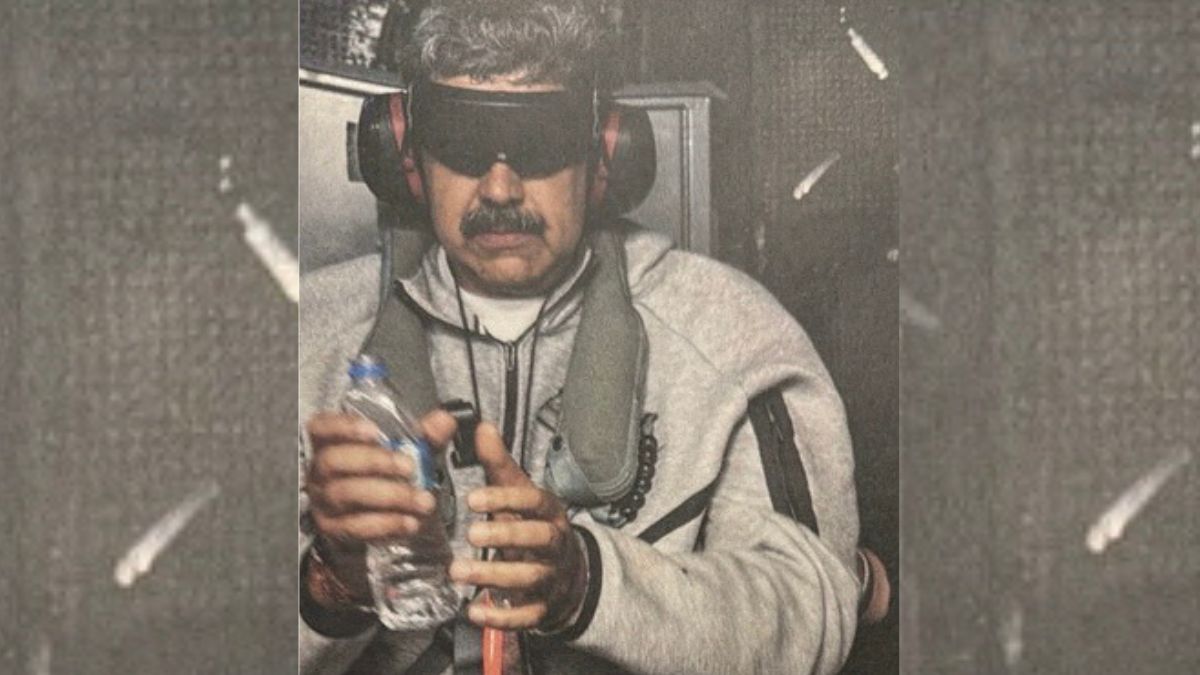
 "This image posted on US President Donald Trump's Truth Social account on January 3, 2026, shows Venezuela's President Nicolas Maduro onboard the USS Iwo Jima after the US military captured him on January 3, 2026.- AFP")
The New Year has delivered the final blow to the so-called American-led “rules-based” global order. On January 3, 2026, the administration of Donald Trump launched a military raid in Caracas, abducting Venezuelan President Nicolás Maduro and his wife, Cilia Flores, and forcibly extraditing them to the United States. The operation was conducted without congressional authorisation and with outright contempt for the United Nations.
Washington justified the raid by branding Maduro a “narco-terrorist”. Thus, a new chapter has been added to America’s endlessly malleable “war on terror” — this time rebranded as a ‘war on narco-terror’. The logic remains the same: any leader who obstructs American strategic interests can be criminalised, removed and replaced, international law notwithstanding.
In a grimly ironic sense, however, Trump deserves credit for honesty. Unlike his predecessors, he has dispensed with the ritualistic invocations of democracy, human rights and liberal values. He did mention Maduro’s drug links and the Venezuelan administration’s lack of democratic credentials, but he made no serious attempt to disguise the real motive. Trump openly resurrected the Monroe Doctrine — renamed the “Donroe Doctrine” — to justify US hegemony in the Western Hemisphere. He even suggested that the United States would seize Venezuela’s oil reserves and supervise its political transition. Imperialism, stripped of pretence, has rarely been articulated with such brazenness, especially since World War II.
The implications are seismic. The Caracas raid did not merely violate international norms; it announced their extinction. The United Nations, long reduced to a stage for empty speeches, has now been rendered entirely irrelevant. If a sovereign head of state can be kidnapped by a permanent member of the Security Council without consequence, then the post-1945 order has definitively collapsed. The world today is more anarchic than at any point since 1945 — and the United States is its chief arsonist.
Why would Washington torch the very order it once created and enforced? Because it no longer controls it. The United States remains powerful, but it is no longer dominant enough to dictate terms globally. Faced with this erosion, it has chosen not to adapt but to sabotage. Unable to command the entire ship, America now prefers to sink it and retreat to a smaller vessel it believes it can still steer — the Western Hemisphere — while also preserving its interests in the other hemisphere as much and for as long as it can.
Quick Reads
View AllSeen through this lens, the Venezuela raid is not a display of confidence but an admission of strategic decline. The United States remains the strongest military power, but it is no longer unchallengeable. It faces rising resistance from China, renewed defiance from Russia, and an increasingly autonomous geostrategic posture from Bharat. Venezuela is not a victory parade; it is a strategic retreat.
The real target of the raid was not Nicolás Maduro. It was China. Venezuela sits atop the world’s largest proven oil reserves, and Beijing has spent years embedding itself in Caracas through energy deals, infrastructure investments and diplomatic backing. That is why, just hours before the raid, Maduro was meeting a high-profile Chinese delegation—one that reportedly remained in the capital during the operation. Trump’s invocation of a hemispheric doctrine banning “outside interference” is not ideological; it is territorial. The United States is drawing a line, declaring Latin America its exclusive preserve because it can no longer dominate everywhere else.
This reading gains further credibility when one examines Trump’s approach to Russia. His willingness to accommodate nearly every Russian demand on Ukraine has left Kyiv abandoned and Western Europe paralysed. The pattern suggests a crude but deliberate trade-off: Ukraine for Venezuela.
This is not speculation. During the Trump impeachment inquiry in 2019, Fiona Hill, former senior director for Europe and Russia at the US National Security Council, revealed that Moscow had openly floated a “swap” arrangement during the Venezuela standoff. The Russians signalled that if Washington insisted on enforcing a Monroe Doctrine in Latin America, Moscow would assert its own sphere of influence in Ukraine. The message was unmistakable: “You know, you have your Monroe Doctrine. You want us out of your backyard. Well, you know, we have our own version of this. You are in our backyard in Ukraine.”
That deal now appears to be taking shape. Russia consolidates control over Ukraine. The United States reasserts dominance in Venezuela. The language of sovereignty, democracy and international law is discarded in favour of naked great-power bargaining.
Oil is central to this strategy, but it is not the entire story. Controlling Venezuela also allows Washington to eject China from a critical energy supplier. Beijing was one of the largest importers of Venezuelan oil, alongside Iranian crude. This raises an obvious question: where does Trump move next? Tehran increasingly appears to be the answer.
Trump’s calculation may be aided by domestic dissatisfaction within Iran. The Iranian population has grown weary of clerical rule, and figures such as Reza Pahlavi — the son of the deposed Shah, historically aligned with Washington — are gaining visibility. A successful operation against Iran would further constrict China’s energy lifelines and delay, if not derail, its rise as a global challenger.
Paradoxically, however, this strategy may also signal a tacit American acceptance of China’s dominance in East Asia. If Washington is willing to prioritise the Western Hemisphere and strike bargains over Ukraine, it may also be prepared to accommodate Beijing elsewhere. Such a move would leave allies such as Taiwan — and perhaps even Japan — dangerously exposed. A China facing energy constraints and strategic humiliation may grow more desperate to absorb Taiwan, and Trump may be tempted to look the other way in order to placate Beijing.
This evolving landscape places Bharat in a precarious position. Trump, reportedly aggrieved with Bharat for both personal reasons and policy disagreements — especially post Operation Sindoor — may seek to persuade his administration that New Delhi is no longer indispensable. By retreating to the Western Hemisphere and trading influence with Russia and China, Washington could push Delhi and Beijing into intensified rivalry across South and Southeast Asia.
Yet this is where Trump’s strategy risks collapsing under its own contradictions. The United States cannot afford to totally abandon South Asia, West Asia and the Indo-Pacific. Allowing China to dominate these regions would elevate Beijing to unprecedented power. And if Washington wishes to retain influence there, it will once again require capable allies — and Bharat inevitably returns to the equation.
This may explain Bharat’s cautious response to the Venezuela raid. New Delhi expressed concern but stopped short of condemnation. Looked at closely, the Venezuelan crisis may actually open strategic space for Bharat. Any effort that constrains Beijing works, indirectly, in Delhi’s favour. Moreover, an end to the Ukraine war would be welcomed in Bharat, reducing global instability and energy shocks.
In the Venezuela crisis, therefore, there may be an opening for New Delhi. Whether Bharat can exploit it will depend on diplomatic agility and strategic patience. Dealing with Trump will never be easy. But then, the road to greatness never is.
(Views expressed in the above piece are personal and solely those of the author. They do not necessarily reflect Firstpost’s views.)
The author is Opinion Editor, Firstpost and News18. He can be reached at: utpal.kumar@nw18.com