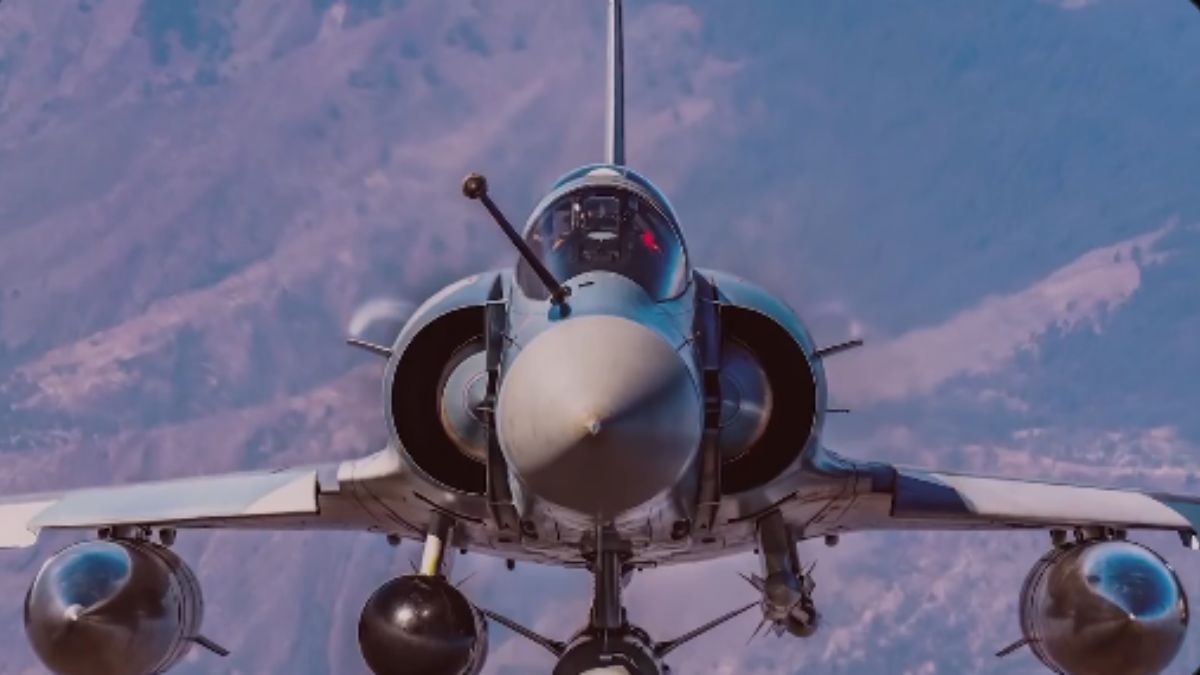
 "Did the IAF bomb Pakistan’s Kirana Hills during Op Sindoor? A video suggests…")
Pakistan’s Kirana Hills are in the limelight again. Questions have re-emerged about whether India struck the mountain range, which is believed to house a nuclear missile storage facility.
The buzz about Kirana Hills gained traction after the Indian Air Force (IAF) posted a video on Republic Day that demonstrated its prowess during Operation Sindoor. In the clip, Indian strikes were also seen hitting Pakistan’s nuclear base in Sargodha. This has again raised questions about whether India had targeted Kirana Hills.
We take a look.
IAF’s video raises questions
The IAF’s video on Republic Day has once again brought Pakistan’s Kirana Hills to the spotlight. The clip featured footage of Indian jets, such as Rafale, Sukhoi, Jaguar, and Tejas, along with the tagline “the enforcers of peace.”
The video displayed images of the Nur Khan base and other Pakistani military assets being targeted during Operation Sindoor last May.
With Mahisasura Mardini’s music playing in the background, the IAF showed the jets in Sindoor formation and said: “I (fighter jet) stand as the unbreakable guarantor of peace. Should malevolent eyes dare and attempt to break this tranquillity, I rise as the fierce enforcer of peace. Infallible, Impervious, Precise.”
The video contained various shots of sites in Pakistan destroyed by the Indian strikes.
#IAFSindoorFormation
— Indian Air Force (@IAF_MCC) January 26, 2026
Standing shoulder to shoulder with our sister services, the Sindoor Formation on #RepublicDay2026 underscored the #IndianAirForce’s role in shaping military outcomes through precise and time-sensitive air operations.
Music credits : Mahisasura Mardini… pic.twitter.com/P5tUHQS3lS
It also gave a peek into rare images of the IAF’s super-advanced weaponry placed on its advanced fighter jets. The video showed the hardpoint of a Rafale armed with two Meteor missiles; indigenous air-to-air missile, Astra, loaded onto a Sukhoi fighter; a BrahMos cruise missile on another Sukhoi and short-range air-to-air missile ASRAAM loaded onto a Jaguar deep penetration strike aircraft. Another missile, Rampage, was also seen on a Rafale fighter jet.
The IAF, however, has continued to maintain that it did not strike the Kirana Hills last year.
“We still stand by the official version,” an IAF official told Times of India (TOI), without elaborating.
When Kirana Hills made news last year
Speculations about whether India hit Pakistan’s Kirana Hills first began in May last year during Operation Sindoor.
India had struck nine terror bases in Pakistan and Pakistan-occupied Kashmir (PoK) in the aftermath of the April 22 Pahalgam attack. It fired around 15 BrahMos missiles and other precision weapons on the night of May 9-10, targeting key Pakistani airbases.
The counter-attack came after Pakistan targeted Indian military and civilian areas with mortar shells, drones and missiles. This led to retaliation by the IAF that struck 11 military sites deep inside Pakistan. The targets included critical airbases in Rafiqui, Murid, Nur Khan, Rahim Yar Khan, Sukkur, Chunian, Pasrur, and Sialkot, according to the Ministry of Defence.
Soon, rumours began to swirl on social media that India had also targeted a site called Kirana Hills that reportedly houses a nuclear storage facility.
Located in Pakistan’s Sargodha district, Kirana Hills is a vast rocky mountain range. The heavily fortified area is believed to consist of an underground nuclear weapons storage facility. It was also used as a site for nuclear research and testing, including subcritical nuclear tests conducted in the 1980s, as per TOI.
Kirana Hills are strategically significant due to the radar stations and tunnels, supposedly for military purposes, located there.
India denies hitting Kirana Hills
India did not hit Kirana Hills, Director General Air (Operations) Air Marshal Awadhesh Kumar Bharti said during a briefing on Operation Sindoor last May.
“Thank you for telling us that Kirana Hills houses some nuclear installations. We did not know about it,” the officer said with a smirk when asked about rumours on social media about India hitting the mountainous region in Pakistan. “We have not hit Kirana Hills, whatever is there. I did not brief in my briefing yesterday.”
However, two months after India’s denial, imagery from Google Earth, captured in June, indicated that a missile hit the strategically sensitive site in Pakistan’s Sargodha district.
The satellite images were analysed and shared by well-known satellite imagery expert and geo-intelligence researcher Damien Symon on X. “Imagery update from Google Earth of the Sargodha region, Pakistan, captured in June 2025, shows — 1. The impact location of India’s strike on Kirana Hills in May 2025; 2. Repaired runways at Sargodha airbase post-India’s strikes in May 2025,” he posted.
Imagery update from Google Earth of the Sargodha region, Pakistan, captured in June 2025, shows -
— Damien Symon (@detresfa_) July 18, 2025
1 - the impact location of India's strike on Kirana Hills in May 2025
2 - repaired runways at Sargodha airbase post India's strikes in May 2025 pic.twitter.com/BLOXYB9fKP
The proximity of the Kirana Hills to the Sargodha airbase, now renamed Mushaf airbase, adds to its strategic importance.
Responding to an X user’s question on whether the Indian missile strike “indicates that the explosion was deep inside and whether this place which was struck a point of significance like an entrance or an exit”, Symon said, “No, this along with earlier imagery, neither indicate any subterranean impact or penetration, its just one side of a hill with nothing of value in its immediate vicinity, must’ve been a warning strike on India’s part, tunnels etc are further away & don’t show any damage.”
With inputs from agencies


 "Economic Survey 2026 Live Updates: Economic Survey 2026 Live Updates: ‘Trade no longer reciprocal, markets no longer neutral’")
 "Robust growth, record demand and low inflation: Key takeaways from Economic Survey 2026")
 "Pakistan: PTI's Imran Khan in 'good health' after eye surgery")
 "10-20% chance of 2008-like global financial crisis in 2026: Economic Survey")
 "Economic Survey 2026 Live Updates: Economic Survey 2026 Live Updates: ‘Trade no longer reciprocal, markets no longer neutral’")
 "Robust growth, record demand and low inflation: Key takeaways from Economic Survey 2026")
 "Pakistan: PTI's Imran Khan in 'good health' after eye surgery")
 "10-20% chance of 2008-like global financial crisis in 2026: Economic Survey")