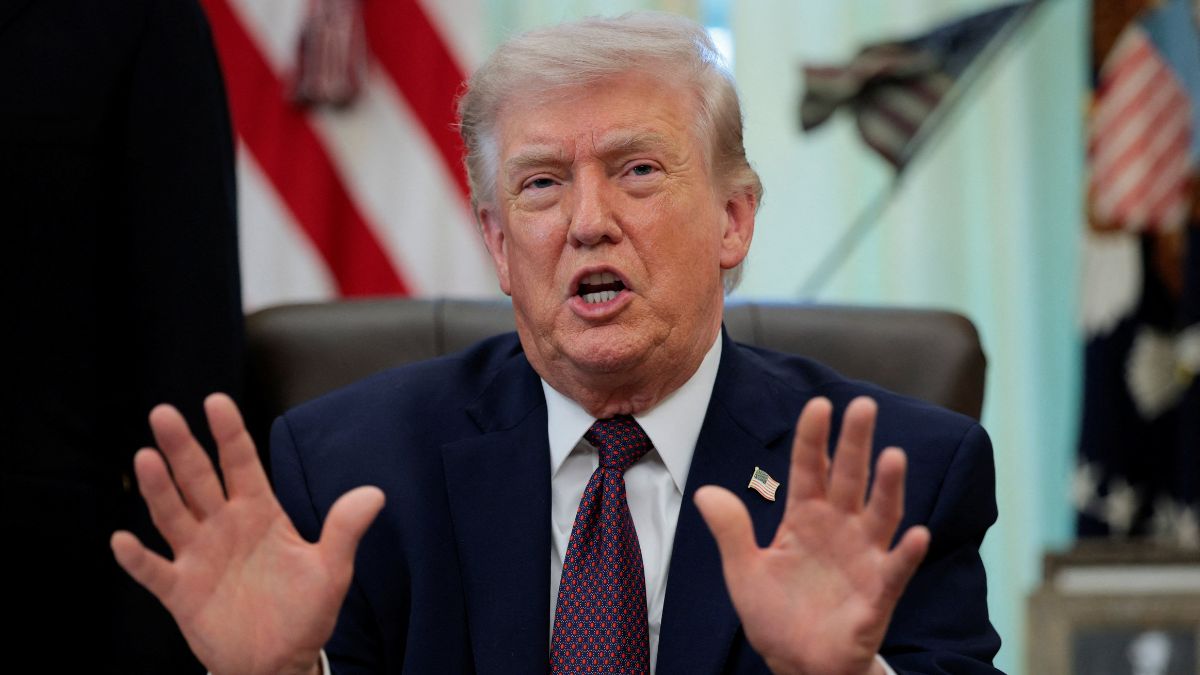
 "Iran has caught Trump in a trap; the US President now must harvest the fruits of his folly")
It has been over 35 days. Exactly why Donald Trump decided to attack Iran still remains a mystery. I woke up early on April 2. Like many around the world eager to know from Trump’s primetime address (US time) the reason behind his kinetic action against Iran – an explanation he owes to the American public – I came away with a nothingburger. It was abundantly clear that not only the entire world, but even Trump doesn’t know why he is waging the war.
Let’s ponder over that for a moment.
There was an expectation, even apprehension that Trump might announce any of two strategies. One, he may declare premature victory with exaggerated claims, cut his losses, leave Strait of Hormuz to its fate and walk away. The markets were clearly betting on that possibility. Trump has been signalling consistently that freeing the narrow chokepoint isn’t his job. The crisis is already increasing his pain points, global economy is tiptoeing towards a recession, and it isn’t clear how long Trump might push forward with a war that’s unpopular even among his base.
The second possibility, given the way troops and aircraft carriers are being deployed in the West Asian theatre, was that Trump might announce a ground offensive to achieve what has turned into two core objectives: forcing Iran to open the Hormuz strait and extracting the enriched uranium. American media has been reporting about a “risky commando plan” to seize the nuclear material.
Trump did neither. In fact, two days since that address, it’s unclear what exactly was the point of that address other than the possibility that a White House intern, pressed for time or disinterested in the speechwriter’s job, copy-pasted Trump’s Truth Social posts for the President to read it aloud before primetime TV.
Quick Reads
View AllThroughout 19 minutes of droning and meandering bluster, Trump sounded defiant, confused, contradictory, and dithered between negotiation and escalation. “We are on track to complete all of America’s military objectives shortly, very shortly… We are going to hit them extremely hard. Over the next two to three weeks, we’re going to bring them back to the stone ages, where they belong. In the meantime, discussions are ongoing.”
It appears that the US President is torn between escalating and getting caught in the clusterfuck, or withdraw in humiliation, in which case he would face severe attack for exiting even more pointlessly an utterly pointless war. His dilemma is apparent.
During his address, Trump claimed “The United States imports almost no oil through the Hormuz Strait and won’t be taking any in the future. We don’t need it. We haven’t needed it, and we don’t need it… And the countries of the world that do receive oil through the Hormuz Strait must take care of that passage. They must cherish it. They must grab it and cherish it. They can do it easily. We will be helpful, but they should take the lead in protecting the oil that they so desperately depend on.”
And yet on Friday, in another of his Truth Social posts, the US President wrote: “With a little more time, we can easily OPEN THE HORMUZ STRAIT, TAKE THE OIL, & MAKE A FORTUNE. IT WOULD BE A “GUSHER” FOR THE WORLD??? President DONALD J. TRUMP”
This isn’t a complicated chess move. This is Trump being Trump. He has walked into this war not because of any grand American strategy but led by an antiquated notion of power married to an irresistible urge as a reality TV star to remain perpetually in the headlines and score “wins”.
As Heather Penatzer of Princeton University writes in Unherd, Trump belongs to “an aging generation of leaders whose perceptions of America’s relative power are stuck in the halcyon 1980s and ’90s; and whose yearning for the war spectacles of old is now fulfilled by short online clips, long-term strategic considerations be damned.”
Trump, who has the attention span of a goldfish, starts his mornings as commander-in-chief with daily briefings that consist of short video clips such as TikTok or Instagram reels of battlefield successes and “stuff blowing up”, carefully curated to hold his attention.
Little wonder that Trump cannot reconcile what he is being fed by aides with the larger reportage that reflect that his war is not going according to the plan, if there’s a plan at all. In a widely cited article, Time magazine reports that it has fallen on Susie Wiles, the White House chief of staff, to give Trump a dose of reality.
“Wiles, according to two White House sources, was concerned aides were giving the President a rose-colored view of how the war was being perceived domestically, telling Trump what he wanted to hear instead of what he needed to hear. She had urged colleagues, the officials say, to be ‘more forthright with the boss’ about the political and economic risks.” The report adds that the “President was left frustrated by the predicament, at odds with some of his own officials, and fuming at the negative impressions of the war.”
Trump can neither afford to wind down the conflict without a tangible gain, nor can he risk riding an escalation spiral that promises no quick redemption. This predicament arises from a fundamentally flawed core issue. Trump launched the war with calamitously vague objectives, lured by the seductive notion that a one-and-done operation will be enough to subdue Iran just as it did Venezuela. Perhaps he thought that eliminating Iran’s nuclear threat could cement his legacy. If that was the plan, there’s little to show for it.
There is no doctrinal justification for the war, and Trump seemingly jumped into it without a clear understanding of his goals, a possible end-state or even the nature of solution that he is seeking through kinetic action. So, I return to my earlier point. What prompted Trump to wage it?
If we look back at Trump administration’s National Security Strategy released in November last year, it is mystifying how within months of publishing a strategy document that deprioritizes Middle East, downgrades it from a primary theater of conflict to a secondary arena of “managed stability,” Trump went ahead and bombed Iran.
The document mentions Iran just three times, and remarkably, the first mention is with reference to a claim that Trump has successfully negotiated “peace” between Israel and Iran. Either Trump didn’t read his own administration’s strategy document, or it’s not worth the paper it is printed on.
According to the NSS, “Iran—the region’s chief destabilizing force—has been greatly weakened by Israeli actions since October 7, 2023, and President Trump’s June 2025 Operation Midnight Hammer, which significantly degraded Iran’s nuclear program. The Israeli-Palestinian conflict remains thorny, but thanks to the ceasefire and release of hostages President Trump negotiated, progress toward a more permanent peace has been made.”
What cataclysmic event occurred between November 2025 and February 2026 that “permanent peace” transformed into an existential need to launch a war against a “greatly weakened” adversary? What was the trigger? Iran certainly posed no new or overwhelming threat.
What’s even more interesting is that the NSS frames American objectives in the region through the lens of ‘strategic realism’ and ‘burden-shifting.’ The NSS makes it clear that reversing half a century’s policy of prioritizing Middle East as the “prime theater of superpower competition”, the Middle East will henceforth be demoted in order of importance because earlier “dynamics no longer hold” and “with the United States once again a net energy exporter”, “superpower competition has given way to great power jockeying, in which the United States retains the most enviable position…”
What’s more, the document issues a pragmatic revision in America’s regime change obsession, clarifying that “We should encourage and applaud reform when and where it emerges organically, without trying to impose it from without. The key to successful relations with the Middle East is accepting the region, its leaders, and its nations as they are while working together on areas of common interest.”
So, going by the NSS, the US has achieved a level of ‘geopolitical insulation’ that allows it to decouple its core national security interests from the chronic volatility of Middle East. This shift promised a fundamental pivot in priorities, where the Middle becomes a theatre of ‘diminishing strategic returns’ compared to the high-stakes competition in the Indo-Pacific or the immediate security needs of the Western Hemisphere. And it eschews the need to cast the region in its own image, the core motivation that drives America’s liberal hegemony.
Therefore, in light of his own strategy document, Trump’s subsequent actions become even more inexplicable, given the claims that Iran is weakened, has reached a compact with Israel and the US isn’t interested in forever wars. So, what happened?
To me, this question lies at the very heart of Trumpian disorder. I turn to Francis Fukuyama to explain what may explain America’s recent motivations. “The truth of the matter is that the United States’ behavior can best be explained not in terms of a set of principles or hierarchy of priorities, but by the personal interests and preoccupations of the man who happens to be president today. Trump’s head is full of resentments, anger, anecdotes, made-up facts, things he heard on Fox News, and outright lies that he has convinced himself are true.”
The deviation from doctrine is due to the deeply personal nature of policymaking where the commander-in-chief does not take measured decisions informed by underlings from various wings of his administration, but adopts unilateral positions based on “feeling in my bones” or “my own morality” that is then implemented by the system. This reversal of roles has resulted in the unfolding chaos.
Trump’s bombing campaign against Iran last year, that met with very little pushback, may have given him a false sense of invincibility. He wasn’t keen on it, and had even chastised Netanyahu at the beginning, but ultimately couldn’t resist the temptation of grabbing headlines and ‘winning’ by dropping bombs from above.
The kidnapping of Maduro may have further lured Trump into believing that he has at his disposal the most efficient and powerful military in the world, that may be used as a private militia to bring him personal glory. His exaggerated sense of self-importance and overestimation of own abilities have brought Trump into a situation on Iran where he has no good options.
As Vali Nasr of Johns Hopkins University and a former US State Department advisor told Stanly Johny of The Hindu in an interview, Trump started “a war anticipating that it would be quick. There would be a quick victory. Either the Islamic Republic would fall or that the Islamic Republic post-Khamenei would be something like Venezuela [where] the new leadership would come to terms with America. He had not anticipated this war, and right now he has no solution for the chokehold that Iran is putting on global markets. So, he can escalate at a great risk or sit down and negotiate with Iran, which is not going to be easy, or he can just abandon the war, which still does not relieve pressure on the global markets.”
The situation right now is such that Trump, desperate for an exit strategy, is bombing bridges, health centres, universities and historic institutions such as Pasteur Institute to force Iran back to the negotiating table. That the US must commit war crimes to win a ‘deal’, says everything about Trump’s predicament.
Tehran is in no hurry to play ball. According to latest media reports, Iran has rejected America’s bid for a 48-hour ceasefire and officially told Pakistani mediators it isn’t willing to meet US negotiators in Islamabad because it finds US demands “unacceptable.”
What Iran, in effect, is doing is constricting Trump’s choices. The US President has three broad options. To cut losses and withdraw, escalate by either decimating more civilian infrastructure, commit even more war crimes or cut a deal with Iran over Strait of Hormuz. By rejecting Trump’s overtures, Iran is pushing the American president to either escalate or walk away. Both carry bigger risks for Trump than cutting a deal.
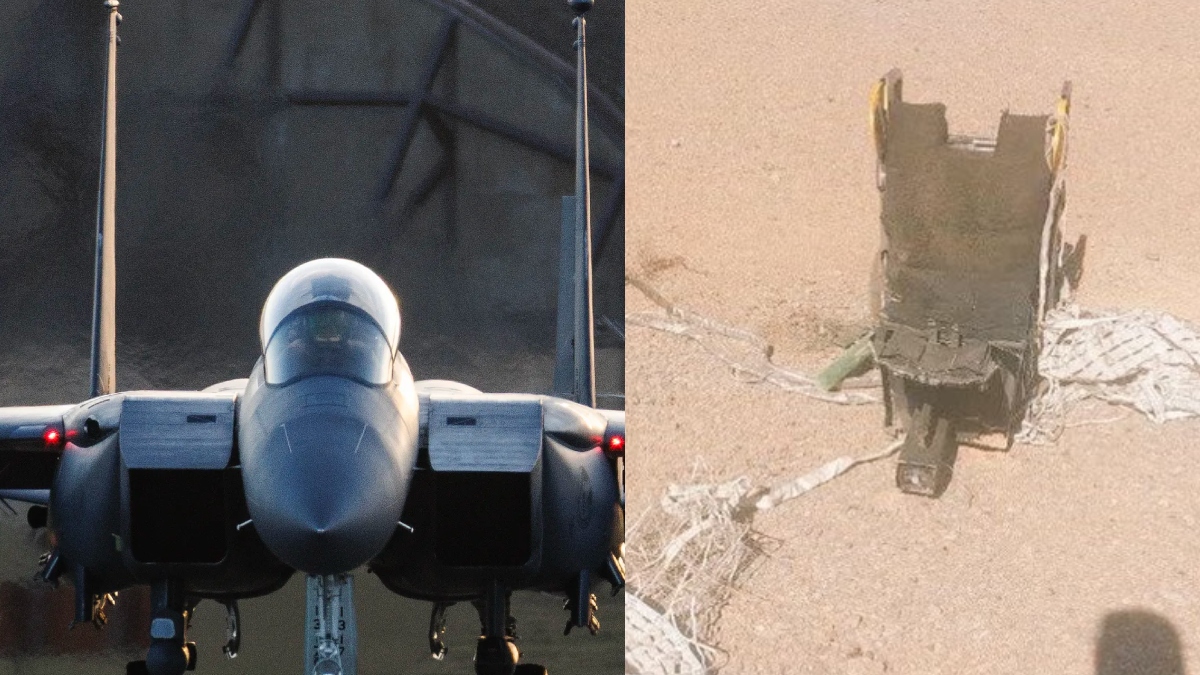
The war became even more complicated with news emerging on Friday that the US has lost four air assets (two F-15 fighter jets, HH-60G Pave Hawk chopper out on a search mission for missing pilots in Iran, MQ-9B drones and A-10 Warthog). These losses belie Trump’s claim that America enjoys total domination over Iranian airspace.
In a telephone call with Time magazine, Trump apparently sounded bewildered that the Iranians aren’t calling him for a deal or appearing at the table. “Trump told TIME that Iran was eager to make a deal to end the fighting. ‘Why wouldn’t they call? We just blew up their three big bridges last night”.
Trump underestimated Iran’s resolve and capabilities, went into an asymmetric war without clear objectives and showed tragic ineptitude in trying to bomb his way to glory, ignoring the fact that weaker adversaries that face existential crisis have boundless motivation to prevail. Trump is trapped. It’ll be interesting to see what he does from here.
(The views expressed in this piece are personal and solely those of the author. They do not necessarily reflect Firstpost’s views.)

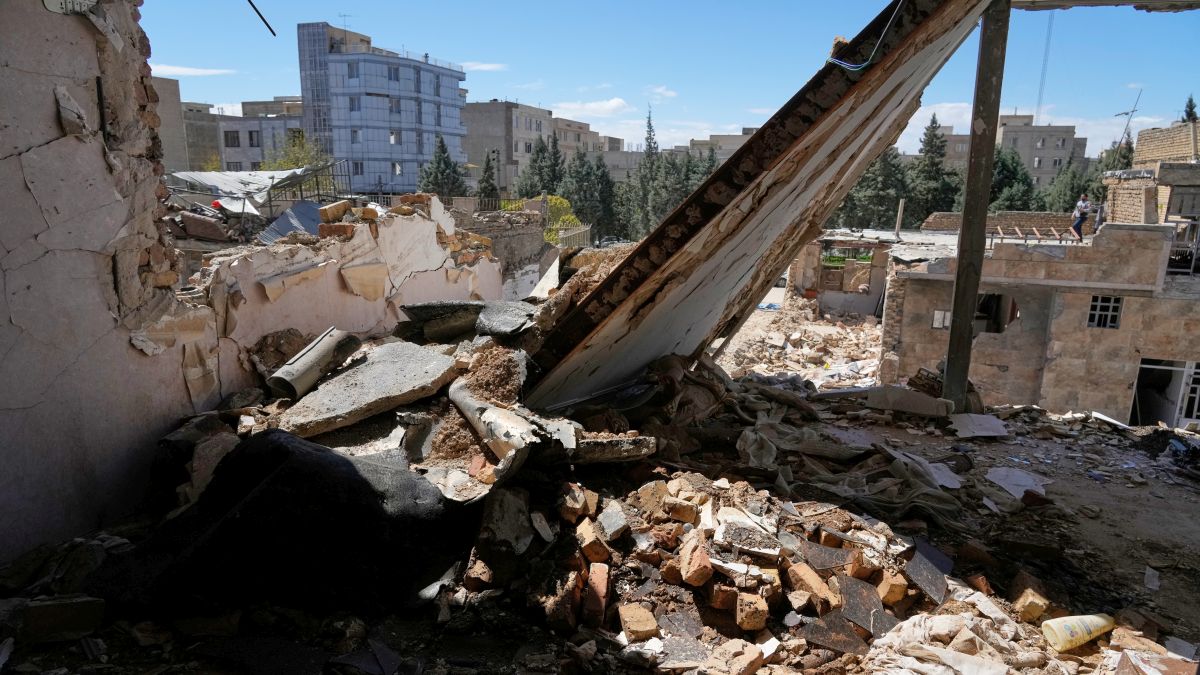 "Iran Israel War Live News: At least 1 dead in Tehran after Israeli strikes hit residential area")
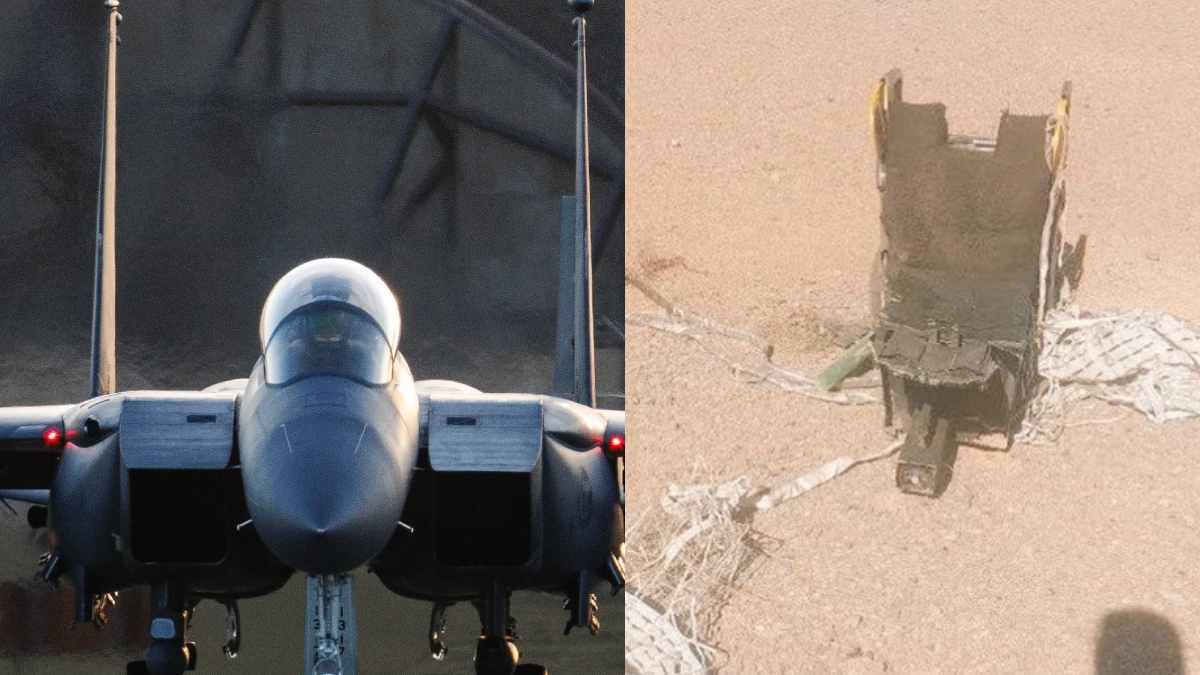 "One of two US crew members rescued after F-15E jet shot down over Iran, race to hunt second ongoing")
 "Seventh India-flagged LPG tanker crosses Strait of Hormuz")
 "This Week in Explainers: How India won the war against 'Red Terror'")
 "Iran Israel War Live News: At least 1 dead in Tehran after Israeli strikes hit residential area")
 "One of two US crew members rescued after F-15E jet shot down over Iran, race to hunt second ongoing")
 "Seventh India-flagged LPG tanker crosses Strait of Hormuz")
 "This Week in Explainers: How India won the war against 'Red Terror'")