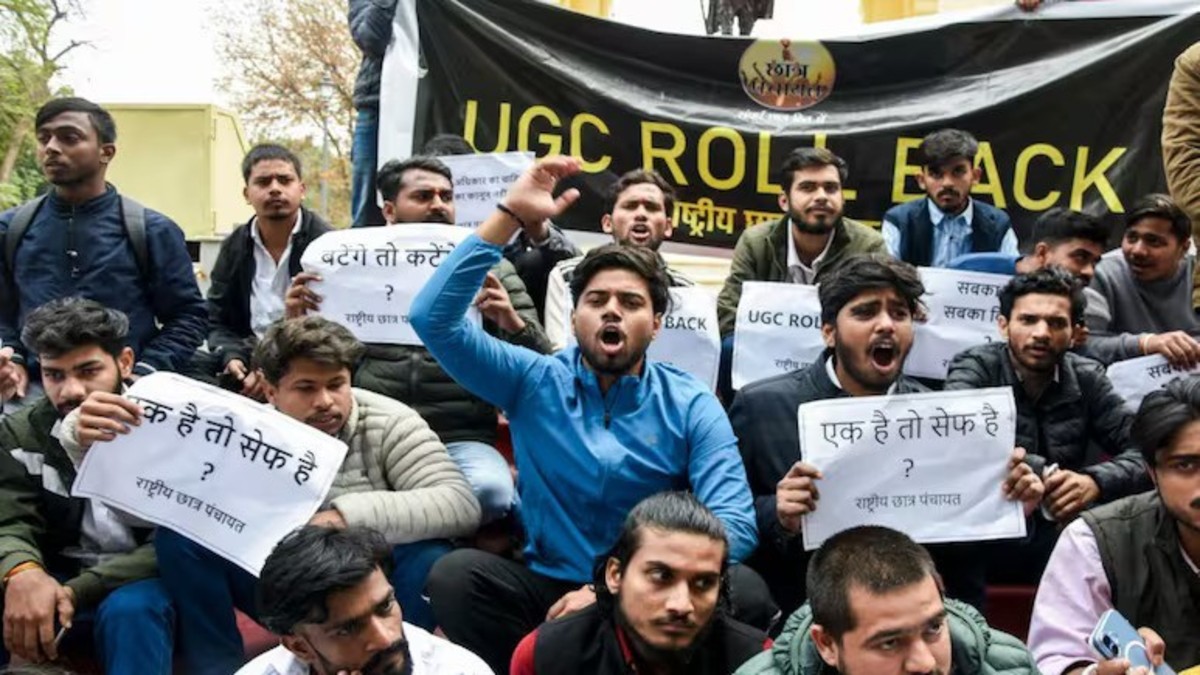
 "UGC episode exposes why Bharat must reclaim its history, decolonise civilisational narrative")
The UGC controversy has raised troubling questions on multiple fronts. At one level lies the obvious question distressing many minds: how could something so deeply discriminatory and divisive find its way into an institutional framework meant to unify and uplift? But at a deeper level, there is an even more disturbing question: what if it was not an accident at all?
If deliberate, such an episode is tragic for a country reawakening to its civilisational self after centuries of setbacks — and it’s politically suicidal for a party that claims to oppose divisive, casteist politics while advancing a broader politico-cultural unity rooted in Hindutva. The Hindutva worldview, at its core, seeks to transcend internal social fractures by foregrounding a shared Sanatani inheritance. Anything that reopens old wounds through imported ideological lenses undermines that very project.
What complicates matters further is a growing tendency among certain sections within the corridors of power to grow uneasy with the rapid awakening of the masses to Bharat’s civilisational core and historical consciousness. There is no denying that the political establishment has indeed played a role in creating space for the Hindu worldview in public discourse. Alongside this, however, has emerged a fear of the scale, speed and autonomy of this Hindu awakening.
Perhaps the anxiety is that the shift in Sanatani consciousness is too swift and revolutionary to be neatly channelled or controlled by any particular institution or party. Even more troubling is the possibility that the dharmic ecosystem itself may be quietly infiltrated by the Marxist, colonial and woke frameworks that it was originally meant to resist.
This concern is not abstract but rooted in lived experience. On more than one occasion following the publication of my book Eminent Distorians: Twists and Truths in Bharat’s History, I received unsolicited advice from influential figures entrenched in post-2014 Lutyens’ Delhi. The suggestion was revealing: why criticise someone like Romila Thapar so vehemently? She is, after all, an institution. Surely, even if she erred, she should be treated gently.
Quick Reads
View AllThe argument stunned me. When truth is deliberately distorted, when history is weaponised to malign an entire civilisation and its people, why should criticism be softened out of deference to academic stature? Exposing fallacies is not vandalism; it is intellectual honesty. Book burning and violence must always be rejected, but civility cannot become a euphemism for silence. Romila Thapar and her ideological cohort have not merely “erred”; they have systematically deconstructed the civilisational idea of Bharat while absolving foreign aggressions of their historical consequences. This was not scholarship; it was ideological warfare disguised as academia.
And now, astonishingly, that same woke-Leftist-divisive worldview is being repackaged and injected into policy through institutions like the UGC. At the heart of this lies the caste question — a subject that has been deliberately stripped of complexity and weaponised beyond recognition. The woke-Left framework that dominates Indian academia today cannot function without a permanent oppressor-oppressed binary.
Let there be no ambiguity: addressing discrimination against Dalits, tribals, or any marginalised group is morally necessary and non-negotiable. But invoking past injustices to indict entire communities in the present is not justice. It is ideological vengeance — more so when an unbiased examination of Bharat’s history reveals a far more nuanced and humane social reality than what is routinely presented.
Discrimination did exist in ancient times; no society in human history has been entirely free of it. But to claim that the Sanatana civilisation was founded on cruelty, exclusion, and systemic abuse is not history; it is propaganda.
The repeated obsession with Manusmriti exemplifies this intellectual dishonesty. Manusmriti is not a constitution, not a divine commandment, and definitely not a universal code imposed uniformly across time and geography. It is a prescriptive text reflecting social management concerns of a specific era. To lift verses selectively, strip them of context, and project them as timeless Hindu law is as much ignorance as it is malice.
What is never acknowledged is that the so-called “upper” varnas were burdened with the harshest disciplines and the severest moral expectations. The Brahmin’s life, as prescribed, was one of restraint, poverty, self-denial and relentless self-policing. Deviations invited disproportionate punishment. Shudras, by contrast, were granted greater latitude in personal conduct, with fewer ritual and behavioural constraints. Privileges did exist for Brahmins, but they came at the cost of immense duties and obligations. If today anyone were offered a choice to live strictly according to Manusmriti norms, few would willingly choose the life of a Brahmin. And even fewer would be able to comply with those rigorous rules.
Historical evidence further punctures the myth of an unbridgeable caste tyranny. Kalhana’s Rajatarangini, for instance, recounts an incident from seventh-century Kashmir, during the reign of King Chandrapida. This was the era that has been universally condemned by our eminent distorians — read RS Sharma’s book Indian Feudalism — for witnessing the worst excesses of the caste system and the feudal order.
As Kalhana’s story goes, a Chamar (a tanner by profession) living in the capital city of seventh-century Kashmir refused to vacate his hut, which obstructed the construction of a temple. When the matter was reported to the king, he considered his own officers to be at fault, not the tanner. He told them to stop the construction “or have it erected elsewhere” if the tanner couldn’t be convinced. The tanner himself came to the king and said: “Since my birth this hut has been to me like a mother, witness of good and evil days. I cannot bear to see it pulled down today.” Still, he agreed to give up his hut “if His Majesty would come to his dwelling and ask for it in accordance with propriety”. As soon as the king heard this, he went to the tanner’s house and asked for the hut.
Such episodes are not anomalies in Bharat’s history. They are reminders that lived social realities were far more flexible than later narratives suggest.
Equally ignored is the fact that the majority of Scheduled Castes historically remained deeply embedded within the Hindu fold. There are recorded incidents of Chamars in Bihar employing Maithil Brahmins as their priests. They actively participated in Hindu reform movements and followed saints like Ravidas and Kabir, and sects such as the Satnamis and the followers of Shri Narayana. In fact, as late as the fifteenth century, there is a story of a person hailing from the Mochi community (engaged in leatherwork and shoemaking) building a Vishnu temple in Raipur. There are numerous such stories of mutual respect and co-existence, but a few instances to the contrary are disproportionately highlighted to mischievously paint the image of a highly unequal and divided society.
It was during the medieval period, particularly after the prolonged struggle against marauding Muslim invaders from the west, that caste proliferation intensified dramatically. As eloquently brought out by Prof KS Lal: “It was during the medieval period under Muslim rule — 712 to 1707 CE — that many castes and sub-castes of SCs, STs and OBCs came into being, to become more than 2,330 enumerated today. For sure, tribal population increased rapidly under Muslim rule to become the 70-million-strong tribal community of India today. It is the largest population of this kind in the world.”
So, far from being evidence of Hindu cruelty, this fragmentation should be interpreted as a social defence mechanism — a chemotherapy of sorts — against violent invasions, forced conversions, and political instability. Where caste networks were strong, conversions were fewer. This phenomenon also contradicts the oft-made claim that lower castes eagerly embraced invading faiths.
Colonialism, however, proved far more destructive, and the British both promoted and weaponised the caste system to push their interests. Dharampal’s book The Beautiful Tree not only demolishes the myth that pre-British India lacked educational infrastructure but also that these educational institutions were confined to the so-called upper castes. British surveys from Bengal, Madras, and Punjab reveal that there were schools in every village — as per the Bengal report, for instance, about 100,000 village schools existed in Bengal and Bihar around the 1830s — educating children from virtually all castes, including those now labelled “untouchable”. Even teachers, as Dharampal notes, hailed from all castes. Ironically, missionary schools catered to far fewer lower-caste students than indigenous institutions.
The British used their censuses to further fossilise caste identities, turning fluid social categories into rigid administrative boxes. Nowhere was this more damaging and arbitrary than in the creation of “criminal” tribes. Nomadic and pastoral communities such as the Bauria, Banjaras, Bazigar, Barad, Bangala, Gandhila, Nat and Sansi, including their numerous sub-groups, were branded criminal by birth. The Criminal Tribes Act of 1871 subjected entire communities to surveillance, forced settlement and collective punishment.
The book ‘Criminal’ Tribes of Punjab: A Socio-Anthropological Inquiry, edited by Birinder Pal Singh, describes how “these nomadic communities were forced to settle on government lands or on the peripheries of villages and towns. They were also issued identity cards which they were required to carry whenever they moved out of their settlement. For instance, Bauria males were made to carry a chittha, an identity card contained inside a metallic pipe. Its absence was an unbailable offence for which one could be arrested on the spot without warrant. These people were roll-called three times a day by the local chowkidar, lambardar or at the police post. They could move out of their settlement only after furnishing full details of their destination and purpose of movement”.
It was an institutionalised apartheid unleashed by the British, the scars of which remain till today.
When Independence came, Bharat understandably sought to uplift those left behind. Reservations were born of consensus and compassion. What is rarely acknowledged, however, is that Hindu society, despite its flaws, was historically far less unequal and brutal than its European counterparts. Feudal Europe subjected nearly 90 per cent of its population to hereditary serfdom for centuries. Yet, far from offering any quotas, modern Europe faces no moral reckoning for this past, nor do its intellectuals carry a perpetual guilt narrative.
Bharat never had this sort of institutionalised discrimination and oppression.
And yet, it is Bharat that is endlessly lectured — often by the very heirs of colonial exploitation — with these charges legitimised by Leftist scholars whose ideological obsession killed millions of people in countries such as Russia and China. Worse, many within Bharat have internalised this sense of victimhood, uncritically accepting Western-Leftist templates to judge the Sanatana civilisation.
The UGC episode is a warning — a warning that unless Bharat intellectually decolonises itself fully and fearlessly, it will continue to sabotage its own civilisational resurgence. You cannot build unity on imported self-loathing. You cannot correct history using frameworks designed to delegitimise you.
The choice before Bharat is stark: either we reclaim our narrative, or we allow others — foreign as well as domestic — to write it against us. There is no middle path any more. Until this is done, UGC-like incidents will keep repeating themselves. And every time, society may not be as vigilant as it was this time.
(Views expressed in the above piece are personal and solely those of the author. They do not necessarily reflect Firstpost’s views.)


 "India, Israel elevate ties to special strategic partnership; PM Modi calls it ‘reflection of aspirations of both nations’")
 "India vs Zimbabwe LIVE Score, T20 World Cup 2026: Kishan falls for 38 after Abhishek completes fifty")
 "Who is Borge Brende, World Economic Forum chief who quit over Epstein files?")
 "US-Iran tension: Third round of nuclear talks begin in Geneva — can it avoid war?")
 "India, Israel elevate ties to special strategic partnership; PM Modi calls it ‘reflection of aspirations of both nations’")
 "India vs Zimbabwe LIVE Score, T20 World Cup 2026: Kishan falls for 38 after Abhishek completes fifty")
 "Who is Borge Brende, World Economic Forum chief who quit over Epstein files?")
 "US-Iran tension: Third round of nuclear talks begin in Geneva — can it avoid war?")