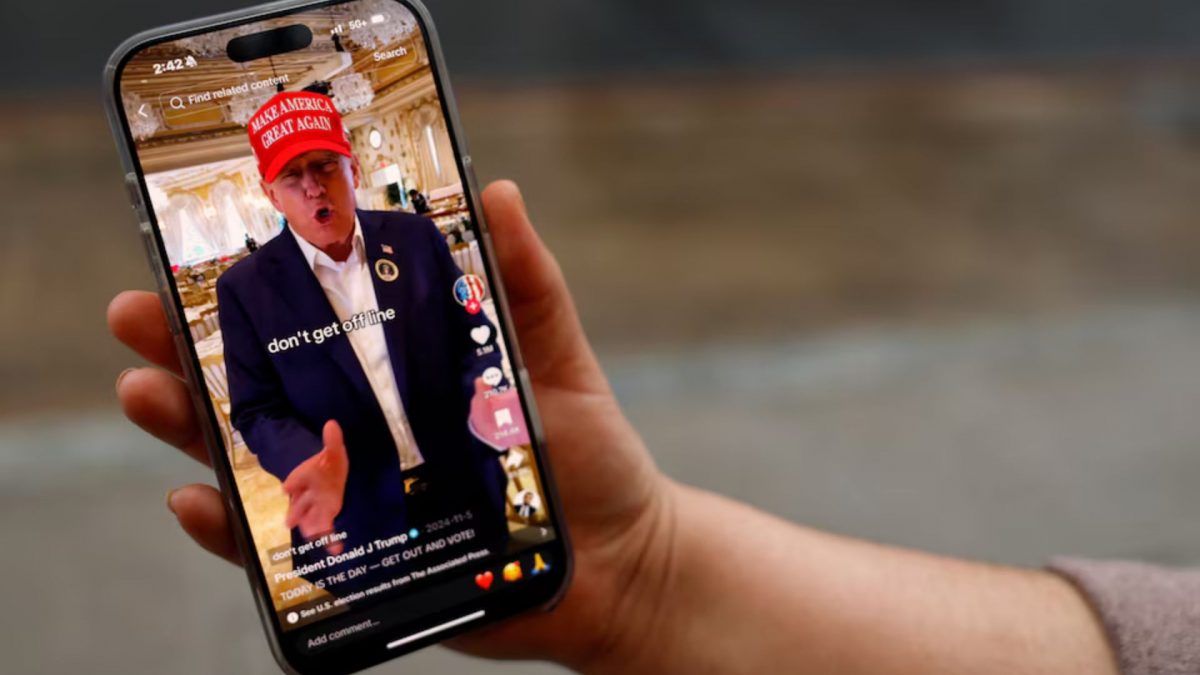
 "TikTok: A Chinese trojan horse in democracies")
Even though China debarred global social internet sites like Google, Facebook, Instagram, Twitter, Yahoo, and others more than a decade ago, the issue of proscription of Chinese-owned TikTok by the United States government has raised a major controversy that threatens to engulf geopolitics, global power transition, data security, influence operations, perception management, personal freedom, and creativity.
The US Congress, with bipartisan support, imposed a ban on TikTok last year on national security grounds that would have started Monday, and the Supreme Court had refused to stop the ban, as it did not violate the First Amendment. However, President-elect Donald Trump, who took office on January 20, had promised to provide a three-month extension to the company. Trump began his second term with an executive order to delay the ban by 75 days. Trump also utilised TikTok during the recent election campaign. With over 170 million US users, TikTok is exploiting chinks in the liberal world order, even though, in China, most global networks are blocked.
In fact, China assiduously secured its web by excluding global social networking sites and created an intra-net. The Great Firewall, “wumao” [50 cent] internet soldiers, hired influencers, infusing jingoism, periodic weeding out of the external content, or even monitoring the VPN market have all restricted access for Chinese citizens of global news and entertainment. Moreover, the 2017 National Intelligence Law can compel any company in China (including foreign companies or personnel) to part with data. In other words, China’s communist party wants to secure and keep its flock together and retain its cyber sovereignty but mines real-time data abroad for its influence operations. Level-playing is not a communist tactic.
The TikTok content is creative and decentralised with rich and diversified linguistic content and once had a billion active users, mostly in India, Indonesia, Brazil, the US, and other countries. It attracted hundreds of millions of users abroad, especially the younger cohort, even though back home in China it is impossible for it, or its parent organisation ByteDance, to show the real conditions of Chinese workers, Tibetans, Mongols, or Uighurs. It is not surprising that TikTok’s local version in China, the Douyin, is mostly in sync with the communist party’s objectives of political control, shaping public perceptions and narratives, while exposing gaps abroad.
The algorithmic manipulation is to curate China’s peaceful intentions, glorify China’s developmental experience, blunt criticism of the communist party, and promote tourism in China while painting others as declining powers, aggressors, or even incompetent. During the spread of the Covid-19 pandemic, for instance, China castigated democracies for poor relief measures. On the other hand, China did not allow any objective investigation into how the Covid-19 virus originated.
Quick Reads
View AllIndia banned TikTok and over 200 Chinese IT apps on June 29, 2020, days after the Galwan incident that killed 20 Indian soldiers. After eight months, China released a figure of four of its soldiers dead and arrested at least three of its journalists for questioning the official figure. TikTok remained silent on the matter of how China’s government obfuscated the whole issue and mobilised troops in violation of written agreements between the two governments since the 1990s. TikTok’s local version Douyin did carry videos of the Galwan clash but showing Indian soldiers in poor light. China could thus manipulate domestic perceptions through algorithmic selections.
India’s ban was linked primarily to data security, as TikTok was subscribed to by over 200 million Indians. Misinformation, propaganda, and creating social unrest were other considerations. What is interesting is that soon after the Indian ban, many countries followed suit with selective or total bans, including Austria, Australia, Belgium, France, Canada, Taiwan, the Netherlands, New Zealand, Norway, Senegal, Somalia, the UK, and others, while many countries have imposed restrictions on TikTok.
National security considerations, risk to privacy and security, and other reasons were mentioned for the restrictions on TikTok. On the other hand, some countries like Indonesia and Pakistan banned TikTok but soon restored it after assurances from TikTok to mend fences. For many countries, it is one step forward but two steps backward in data protection and national security.
Four decades of uninterrupted flow of trillions of dollars and an influx of hundreds of thousands of US and its allies’ companies and their technological upgradation of China created conditions of not economic interdependence but asymmetric responses. In the 1950s, Mao Zedong wanted to approach the American public directly but failed due to the prevailing anti-communist atmosphere. Now, with so much of Western technology flowing, China is able to reach out to an alienated American public, as with other global audiences, through its slick, albeit politico-ideological, content.
While many tech giants globally are accused of manipulating data and selling data for commercial or strategic considerations, China’s companies have been outsmarting them in their own game. Specifically, TikTok was criticised abroad for exacerbating religious, caste, and communal cleavages in the society, spreading violence and adult content, and, through algorithmic processes, manipulating narratives in targeted audiences. However, in the US, it was caught in the power transition trap with China.
The author is Dean of School of International Studies at Jawaharlal Nehru University. Views expressed in the above piece are personal and solely those of the author. They do not necessarily reflect Firstpost’s views.

 "UAE to host first 'trilateral' talks between Ukraine, US and Russia, says Zelenskyy")
 "Trump finds new raid target? Report says US actively seeking regime change in Cuba by 2026-end")
 "Power shift in Hanoi: Vietnam party list hints PM and president losing clout")
 "Can Trump’s Board of Peace replace the United Nations?")
 "UAE to host first 'trilateral' talks between Ukraine, US and Russia, says Zelenskyy")
 "Trump finds new raid target? Report says US actively seeking regime change in Cuba by 2026-end")
 "Power shift in Hanoi: Vietnam party list hints PM and president losing clout")
 "Can Trump’s Board of Peace replace the United Nations?")