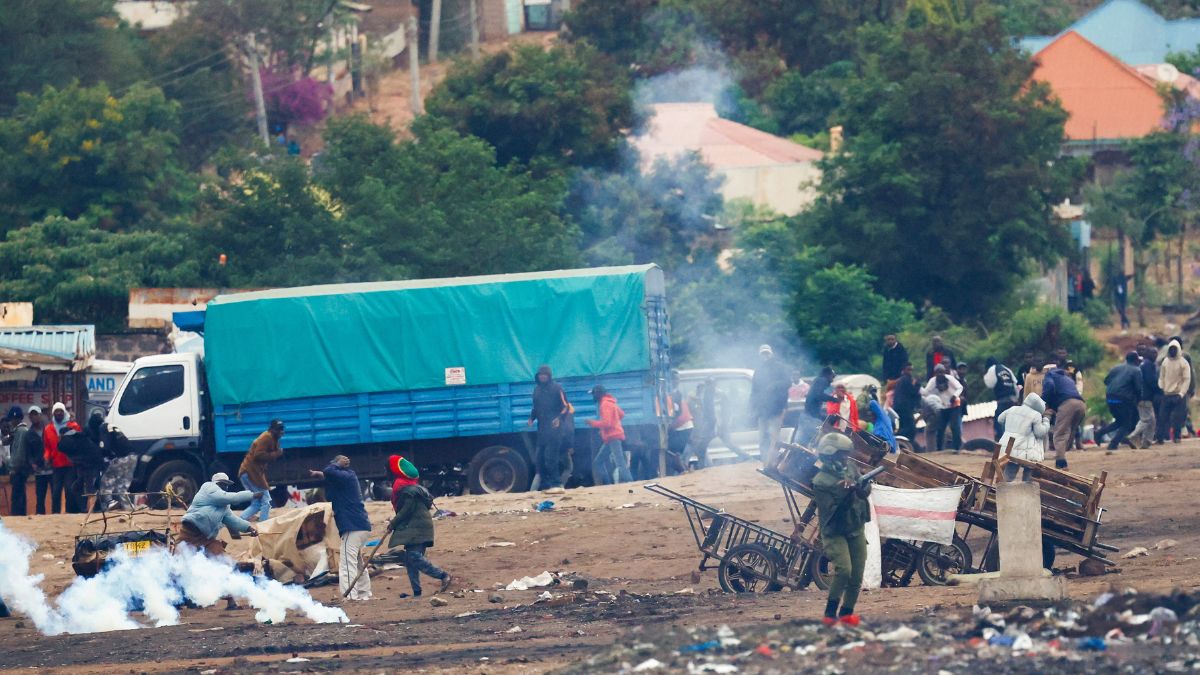
 "Demonstrators react as Tanzania's riot police disperse them during a protest a day after an election marred by violent demonstrations over the exclusion of two leading Opposition candidates at the Namanga border crossing point between Kenya and Tanzania on October 30, 2025. (Photo: Thomas Mukoya/Reuters)")
Tanzania, once known for its stability amid continental turmoil, plunged into its darkest political moment during its recent 2025 general elections. The current crisis demonstrates a critical saturation point, triggering unprecedented protests following alleged electoral manipulation favouring Samia Suluhu Hassan, the country’s first-ever elected and the continent’s second serving female president.
The government’s brutal response to the protests—characterised by heavy state repression, including an internet blackout and reportedly close to 3,000 deaths—exposes the deeply entrenched neo-patrimonial realities where elite patronage trumps democratic norms and public will. This electoral breakdown, fuelled by digital activism, emerged from a restless youth and civil society demanding accountability and genuine political reform amid mounting domestic fury and global condemnation.
President Hassan won a staggering 98 per cent of the votes on an improbably high turnout, sparking allegations of rampant rigging that ignited massive youth-led protests across the country.
Neo-Patrimonial Iron Grip on Tanzania
At the heart of Tanzania’s turmoil lies neo-patrimonialism, a hybrid governance model where formal democratic institutions coexist with informal elite networks that dominate political power and control state resources. In post-independent Tanzania, the power monopolisation of Chama Cha Mapinduzi (CCM), despite the 1992 shift to multiparty politics, resulted from a system where real authority rested in patronage channels while formal institutions provided only a façade of democratic legitimacy.
This arrangement was visibly consolidated during President John Magufuli’s tenure from 2015 onward, as he prioritised a regime built on personalised party discipline and control. Famously referred to as the “Bulldozer”, he controlled appointments, reshuffled officials along ethnic and loyalist lines, dismissed critics, and subordinated key state institutions to his personal authority. His era entrenched a zero-sum politics in which power was not shared but accumulated in one hand, cracking down on opposition rallies and dissent while also ignoring the global Covid-19 crisis.
Samia Suluhu Hassan’s constitutionally mandated ascent in March 2021, following Magufuli’s sudden death, arrived amid cautious optimism. As Tanzania’s first female president, she inherited a polarised nation and quickly unveiled reversal policies to balance Magufuli’s governance. Although her new position was contested by both the opposition and CCM factions, it was crucially secured with the backing of the country’s top defence officials, signalling that elite and military support—not popular mandate—remains the core currency of power.
Quick Reads
View AllLeveraging her prior vice-presidential experience, she introduced the 4R doctrine: reconciliation, resilience, rebuilding, and reform to advance national unification and constitutional reforms. She lifted the political rally ban, reversed Covid denialism by launching a vaccination drive that spiked immunisation rates, and loosened the state’s grip on media, signalling a hopeful attempt at distancing her administration from the excesses of the previous regime. Yet this reformist glow faded by the time the election year arrived, completing a full circle with intensified repression.
Entrenchments: Reversals of the Reforms
Samia Suluhu Hassan’s official rise to power through the 2025 elections continues to entrench the same neo-patrimonial architecture. The opening of political space was eventually closed, as major opposition parties were banned from contesting elections. In April 2025, Chadema, the main opposition party, was barred from contests, and its leader Tundu Lissu was jailed on treason charges after rally speeches demanding electoral reforms.
Similarly, ACT Wazalendo’s Luhaga Mpina faced disqualification weeks before the polls, restricting genuine political competition. This repression intensified with the arrest of Chadema deputy John Heche—first near the Kenya border en route to Raila Odinga’s funeral, then rearrested in Dar es Salaam on terrorism charges. Outrage, amplified by viral social media clips among youth, highlighted the readiness of Samia’s regime to criminalise dissent.
Moreover, President Hassan’s reformist commitments unravelled soon after the elections, with protest crackdowns prioritising regime survival over public welfare. What began as demonstrations morphed into riots, met with live fire, mass detentions, and a five-day internet shutdown. While she appointed a nine-member inquiry commission to examine the electoral violence, the escalating disappearances of activists—including Kenyans and Ugandans—deepened scepticism, amid President Hassan’s claims of “foreign interference” behind the unrest.
Digital Fire Amid the Gen Z Uprising
Tanzania’s youthful Gen Z has shattered the silence of past generations. Social media platforms buzzed with videos exposing polling irregularities, beatings, and calls for accountability. But this soon devolved into reciprocal attacks on freedom of speech and media, culminating in a five-day internet shutdown during the elections and an ongoing ban on ‘X’ since May, costing over $238 million to the Tanzanian economy.
A shocking turn of events emerged with Captain Tesha, a self-proclaimed air force officer who went viral urging military-backed demonstrations against corruption, hinting at cracks within the security apparatus long seen as the CCM’s bedrock. Historically, African militaries under neo-patrimonialism intervene when civilian elites falter, recalibrating patronage. These fissures signal a generational rupture with major repercussions for Tanzania’s image on both regional and global fronts.
Regional and International Responses
The turning point of the present crisis lies in regional and international responses, transcending the borders of East Africa’s economic spine. As a linchpin of the North–South Corridor, Tanzania’s Dar es Salaam port—vital for landlocked Malawi, Zambia, and Zimbabwe—halted mid-election, reflecting intra-regional trade issues and the fragility of regional supply chains reliant on Tanzanian infrastructure. It erodes Tanzania’s political and economic goodwill among neighbours, prompting them toward alternatives and weakening Dodoma’s leverage. Kenya, its top market, weighs economic distancing amid solidarity protests against Tanzanian authorities by its civil society, echoing diplomatic strain.
At the regional level, the Southern African Development Community (SADC) condemned the disputed elections in Tanzania, with its Electoral Observation Mission citing flawed processes, pre-election media curbs, and irregularities. Globally, backlash intensified. The United Nations human rights chiefs and the International Commission of Jurists (ICJ) decried human rights violations. The European Union criticised the opacity, cutting $179.46 million in 2026 aid, while the US Senate demanded inquiries that will shape future collaboration, amid aid cuts and tariffs.
Hassan admits the “battered image”, preparing citizens for challenging times as loans dry up and donors pivot away. Tanzania’s 2025 election firestorm tests whether patronage can withstand the blaze of youth-led protests. Early optimism around President Samia Suluhu Hassan’s tenure has soured, isolating the regime amid domestic legitimacy crises, regional trade disruptions, and plunging international support.
India and Tanzania continue to strengthen their strategic partnership, especially in trade and maritime cooperation under the Africa-India Key Maritime Engagement (AIKEYME). During recent talks in April 2025, both countries reaffirmed their goal of raising bilateral trade to $10 billion, focusing on ICT, agro-processing, pharmaceuticals, automotive manufacturing, and infrastructure. Tanzania remains an important gateway for India’s trade and investment in East and Southern Africa, supported by India’s $4.08 billion FDI presence. Bilateral ties received a major boost after President Samia Suluhu Hassan’s state visit to India in 2023.
Yet recent political unrest in Dodoma, including youth-led protests and disruptions at ports, poses risks to India’s economic interests and its wider multipolar outreach in the region. As global and regional criticism mounts over the Tanzanian crisis, New Delhi may have to carefully balance its strategic stakes, particularly with plans for the next India-Africa Forum Summit on the horizon. Meanwhile, Tanzania stands at a crossroads: suppressing the unrest through entrenched patronage tactics, responding to youth demands for genuine reform, or risking deeper instability as tensions escalate between the government and the youth. The outcome will shape the country’s overall regional and global standing.
(Nandini Khandelwal is a Research Analyst at the Indian Council of World Affairs [ICW]. Views expressed in the above piece are personal and solely those of the author. They do not necessarily reflect Firstpost’s views.)