

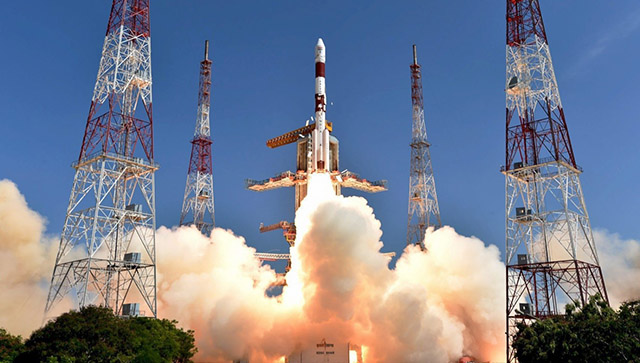
 "Space the ultimate vantage point: Need to secure India’s assets")
As India’s Chandrayaan 3 sets its course for the moon, it marks another step towards harnessing space for the benefit of mankind. Space, the ultimate vantage point, has become a facilitator of all forms of activities on planet Earth. Satellites support economic activities, communications, navigation, surveys, and enhance the quality of life and livelihood. Militaries around the world utilise space to support air, surface, and sub-surface operations. Consequently, there is a need to secure our own assets and interests in space. In effect, this also implies some form of militarisation of space, involving the placement and development of military resources in outer space. In the mid-20th century, the United States and the Soviet Union initiated this process by developing space-based offensive technologies and ballistic missiles. Since then, outer space has been utilized for various military applications. Evolution of space weapons In the early 1960s, the United States and the Soviet Union began developing anti-satellite weapons. These weapons took the form of directed-energy lasers for satellite decapitation or kamikaze satellites for hard-kill purposes. The Inter-Continental Ballistic Missiles (ICBM), with their very long range, spent significant time in sub-orbital flight and were best intercepted in space. The initial US ‘Nike-Zeus’ programme envisioned firing Nike nuclear missiles against incoming ICBMs, while Project ‘Defender’ aimed to destroy Soviet ICBMs at launch with satellite weapon platforms orbiting over Russia. However, both programmes were later abandoned. The ‘Sentinel’ and ‘Safeguard’ programs sought to use Anti-Ballistic Missiles (ABM) to shoot down incoming ICBMs. Initially, the plan was to use a nuclear-tipped interceptor missile, but as accuracy improved, hit-to-kill ABMs evolved. In 1983, US President Reagan proposed a space based Strategic Defence Initiative (SDI) to protect the United States from attack by strategic nuclear missiles. In the 1960s, the Soviets developed a “co-orbital” system, which approached space targets using radar guidance and then exploded a shrapnel warhead close enough to destroy them. They also evolved a low-earth orbit Fractional Orbital Bombardment System (FOBS) for targeting Earth-based objectives, which would de-orbit for the attack. However, the SALT II agreement of 1979 prohibited the deployment of FOBS systems. The Polyus orbital weapons system was an anti-satellite weapon equipped with nuclear space mines and a self-defence cannon. The Soviets also considered the space shuttle as a single-orbit weapon that could evade existing anti-ballistic missile sites, attack targets, and return to Earth. Additionally, the Soviets experimented with large, ground-based Anti-Satellite (ASAT) lasers, which reportedly temporarily “blinded” several US spy satellites. They also utilized a modified MiG-31 as an ASAT launch platform. With the end of the Cold War, new players like China, Japan, the European Union, and India developed their own space systems. Spy satellites continue to perform C4ISR (Command, Control, Communications, Computers, Intelligence, Surveillance, and Reconnaissance) missions. They provide early warning of missile launches, detect nuclear detonations, and observe preparations for clandestine or surprise nuclear tests. In Operation Desert Storm, early-warning satellites were used to detect tactical missile launches. Weaponisation of space Space weapons can be classified into those that attack targets in space (anti-satellite), attack ground targets from space, or attack targets passing through space (anti-ballistic missile). It is technically possible to position conventional or nuclear missiles in space to reach ground targets, but such an approach could be expensive, difficult to maintain and service, and have limited advantages over aircraft and submarine-launched weapons. Russia has reportedly resumed ASAT research under President Putin to counter the renewed US strategic defence efforts following the ABM Treaty’s termination. Russia has also tested space-to-space kinetic weapons. In late 2017, a Russian satellite demonstrated the ability to approach another satellite closely and fire a high-velocity projectile. In March 2018, Russian President Vladimir Putin showed a graphic of the RS-28 Sarmat heavy ICBM placing a nuclear warhead on an orbital trajectory and descending towards Florida. In late 2019, a similar Russian satellite manoeuvred provocatively close to a US government satellite in Low Earth Orbit (LEO), and in July 2020, the same satellite was observed firing a projectile. The NASA-Boeing X-37, known as the Orbital Test Vehicle (OTV), is a reusable robotic spacecraft, akin to a space version of an Uninhabited Aerial Vehicle, and is operated by the United States Space Force. Its mission durations have been increasing, with the most recent mission launched on an Atlas V on 17 May 2020 and concluded on 12 November 2022, spending a total of 908 days in orbit. The PLA’s 2013 Science of Military Strategy publications suggest that China has conducted the intellectual groundwork for deploying space-to-Earth weapons to gain asymmetric advantages. International space treaties limit or regulate the positioning of weapons or conflicts in space. So far, no human casualties have resulted from conflicts in space, and no ground target has been successfully neutralized from orbit. Earth-based space weapons Research is ongoing into directed energy weapons, including a nuclear-explosion-powered X-ray laser. The AGM-69 SRAM carried on a modified F-15 Eagle, was successfully tested in September 1985, targeting a satellite orbiting at 555 km. In February 2008, the US Navy fired a standard ABM to act as an ASAT weapon to destroy an ageing hydrazine-laden US satellite. Russia has reportedly restarted the development of a prototype laser system called ‘Sokol Exhelon’. Israel’s Arrow 3 (Hetz 3) anti-ballistic missile, equipped with an exo-atmospheric interceptor, has been repeatedly tested and has a range of 2,400 km. Russia has also deployed Earth-to-space weapons, such as communication, radar, and GPS jammers. In April 2020, Russia tested a direct ascent ASAT. Furthermore, in 2018, Russia began fielding a mobile ground-based laser weapon. In January 2007, China successfully destroyed a defunct Chinese weather satellite in polar orbit at an altitude of about 865 km using a kinetic warhead of the SC-19 Anti-Satellite (ASAT) missile. The warhead destroyed the satellite in a head-on collision at an extremely high relative velocity. The US National Missile Defence (NMD) program does not have weapon stations in space but is designed to intercept incoming warheads at a very high altitude, where the interceptor travels into space to achieve the intercept. The US is also working on Earth-to-space weapons that could rapidly reach Low Earth Orbit (LEO) to defend US satellites or threaten adversary satellites there. However, space-based weapons would be required to defend assets in Geostationary Orbit (GEO) and other orbits. China’s space programme Once shrouded in secrecy, it is now a well-publicised space programme. It includes lunar and Mars missions, a permanent space station, and ASAT capabilities. China has launched an increasing number of rockets in recent years. The Long March series of launchers can carry heavy loads and are continuously improving. The Long March 5 (LM-5) can place 25,000 kg in LEO and approximately 14,000 kg to GEO. When it flies for the first time around 2030, the Long March 9 will have a payload capacity to LEO of around 140,000 to 150,000 kg. China is also working on hack-proof satellites. China’s BeiDou Navigation Satellite System is fully operational with 35 satellites. China claims that it is more accurate with millimetre-level precision through post-processing. The system boasts the largest fleet of satellites, compared to the US GPS (31), Russian GlOSNASS (26), European Galileo (26), and India’s NaviC (planned 11) satellites. China claims to have shipped millions of BeiDou receivers to nearly 120 countries. China is estimated to spend around $11.94 billion in 2022 on its space program, albeit still a fraction of the American US$ 61.97 billion, but many-fold more than India’s US$ 1.93 billion. The large manned space station, Tiangong, is in place and will be completed by 2024. In December 2015, China launched the Dark Matter Particle Explorer. In 2017, it launched the Hard X-ray Modulation Telescope to search for black holes. Eighteen Chinese astronauts have now been into space, including a woman. The Chinese Satellite Aolong 1 (Roaming Dragon) has a robotic arm that can grab another satellite and guide it to burn up in Earth’s atmosphere. Officially, it is to remove space debris from orbit, but it could be used as a weapon, bringing down a rival’s satellite. China could very well be in a position to land astronauts on the moon by 2030. India’s space capabilities The Indian Space Research Organization (ISRO) has the world’s largest constellation of remote-sensing satellites and operates the GAGAN and IRNSS (NavIC) satellite navigation systems. It has sent three missions to the Moon and one to Mars. The Mars orbiter mission successfully entered Mars orbit on 24 September 2014, making India the first nation to succeed on its first attempt. The Launch Vehicle Mark-3 (LVM3), equipped with a cryogenic engine and boosters, is the heaviest rocket in operational service with ISRO. It can put a payload of 8,000 kg in LEO (Low Earth Orbit). LVM3 is expected to carry India’s first crewed mission to space and will be the testbed for the SCE-200 engine, which will power India’s heavy-lift rockets in the future. ISRO is actively expanding its satellite fleet, aiming to land a rover on the Moon, send humans into space, develop a semi-cryogenic engine, conduct more uncrewed missions to the Moon, Mars, Venus, and the Sun, and deploy more space telescopes. Also in the plans are the development of reusable launchers, heavy and super heavy launch vehicles, deployment of a space station, exploration missions to planets like Jupiter, Uranus, Neptune, and asteroids, and crewed missions to moons and planets. On 15 February 2017, ISRO launched 104 satellites in a single rocket, PSLV C-37, creating a world record. India has a fast-evolving Small Satellite Launch Vehicle (SSLV) program to launch small satellites at much lower costs and short notice. ISRO’s launch and satellite systems remain at least cost to orbit. India’s space-based military applications India’s space programme, aimed at peaceful exploitation of space, has military offshoots. These include remote sensing satellites of the IRS series, with some having a spatial resolution of one meter or below. There are others equipped with panchromatic cameras, synthetic aperture radars, and satellites providing scene-specific spot imagery for cartographic and military applications. Additionally, satellites support military communications, networks, navigation, and targeting, among other functions. India’s nearly 15 operational satellites include at least five dedicated to military use (GSAT-7, GSAT-6, GSAT-7A, GSAT-7B, EMISAT). The HySIS and Microsat-R satellites are dual-use satellites. All the IRS satellites are placed in polar sun-synchronous orbit, providing data in various spatial, spectral, and temporal resolutions. The Radar Imaging Satellite 2 (RISAT-2) has an Israeli synthetic aperture radar (SAR), providing a day-night, all-weather monitoring capability with a resolution of one meter. The CARTOSAT-2 carries a state-of-the-art panchromatic (PAN) camera. The highly agile CARTOSAT-2A is a dedicated satellite for the Indian Armed Forces, while CARTOSAT-2B offers multiple spot scene imagery. CARTOSAT-2E was launched in June 2017. In the aftermath of the 2020 China-India skirmishes, the Indian security establishment has been working on an additional four to six satellites with high-resolution sensors and cameras to monitor individuals and small objects on and across the Line of Actual Control. India’s ASAT and Ballistic Missile Defence Programme On 27 March 2019, India conducted a test of an anti-satellite weapon (ASAT) operation code-named Mission Shakti. It successfully targeted a satellite in Low Earth Orbit (LEO) using the kinetic kill vehicle, Prithvi Defence Vehicle Mark-II. This test positioned India as the fourth country, after the United States, Russia, and China, to have demonstrated an ASAT capability. Additionally, this test showcased India’s capability to intercept an intercontinental ballistic missile (ICBM). India’s ballistic defence program comprises a multi-layered system, incorporating two interceptor missiles: the Prithvi Air Defence (PAD) missile for high-altitude interception and the Advanced Air Defence (AAD) missile for lower-altitude interception. These missiles have the capability to intercept incoming missiles launched up to 5,000 kilometres away. PAD was successfully tested in November 2006, while AAD achieved success in December 2007. Consequently, India became the fifth country to possess an Anti-Ballistic Missile (ABM) system, joining the ranks of the United States, Russia, China, and Israel. On 6 March 2009, India successfully tested its missile defence shield by intercepting an incoming missile at an altitude of 75 km. The ‘Swordfish’ radar used in the Ballistic Missile Defence (BMD) system has a range of 1,500-2,000 km. Moreover, India is currently developing two new anti-ballistic missiles to intercept Intermediate-Range Ballistic Missiles (IRBMs), with a coverage range of up to 5,000 km. In addition, India is also planning to deploy a laser-based weapon system to destroy ballistic missiles during their boost phase. Space situational awareness As of May 2023, there were 7,702 active satellites in space. Of these, 12 per cent were in Geostationary Orbit (GEO), 3 per cent in Medium Earth Orbit (MEO), and 84 per cent in Low Earth Orbit (LEO). Out of the total, 3,135 satellites are used for communications, 1,052 for earth observation, and the rest serve various purposes, including navigation, among others. The United States leads the way with 2,926 satellites, followed by China in second place with 493 satellites, while India lags further behind with 58 satellites. Almost 72 per cent of active satellites fall into the small satellite category. Additionally, an estimated 130 million objects smaller than 1cm and 34,000 objects larger than 10cm are traversing in orbit at speeds of thousands of kilometres per hour. This includes a significant number of defunct satellites and debris still present in orbit. The tracking and management of all these objects are crucial for collision avoidance. In response to this challenge, India has established a Directorate of Space Situational Awareness and Management, and it closely collaborates with other space agencies, particularly the USA. Defence Space Agency The Defence Space Agency (DSA) is a tri-service agency of the Indian Armed Forces, headquartered in New Delhi. Its primary role is to operate India’s space warfare and satellite intelligence assets. The agency is envisaged to be transformed into a full-fledged tri-service military command in the future. Under the DSA, both the Defence Imagery Processing and Analysis Centre in Delhi and the Defence Satellite Control Centre in Bhopal operate. The DSA collaborates closely with the Indian Space Research Organisation (ISRO) and private industry to enhance its capabilities. It conducts realistic space-related exercises and is actively involved in the development of a joint space warfare doctrine. The agency’s main responsibility is to craft a space warfare strategy. The Defence Space Research Agency (DSRA) is the scientific organization tasked with developing space-warfare systems and technologies for the DSA. Comprised of scientists, the DSRA conducts research and development in close coordination with the Integrated Defence Staff. Aerospace commands The US Air Force Space Command was established in September 1982, encompassing all operational space assets. In December 2019, the newly created United States Space Force (USSF) merged with its sister branch, the U.S. Air Force, and became part of the Department of the Air Force. They collaborate closely for technology development and command and control of the domains. The United Kingdom Space Command (UKSC) was founded in April 2021, functioning as a joint command organized under the Royal Air Force, and led by an RAF officer. The French Air Force transitioned into the French Air and Space Force in September 2020, and the French Space Command is now an integral part of it. On August 1, 2015, the Russian Air Force and the Russian Aerospace Defence Forces amalgamated, forming the Russian Aerospace Forces. The Indian Air Force (IAF) outlined the Defence Space Vision 2020, further expanded upon in the IAF Doctrine 2022, with the aim to utilize satellite resources to significantly enhance India’s defence preparedness. To turn this space vision into practical operational outcomes, an Aerospace Command with the required space expertise and authority is imperative. The impressive capabilities developed by ISRO need seamless integration with the air, surface, and sea-based systems of the Armed Forces. Early establishment of an Aerospace Command is necessary to achieve space deterrence and safeguard space assets, offering significant potential to leverage space as both a weapon and a shield. Way forward for India India’s economic progress has accelerated the space programme. Conversely, the satellites have greatly supported the economy due to better communications and imaging. Space exploration has also brought national pride and self-confidence. For some years now, India has been offering space launches to other countries. ISRO is getting ready for the first manned space flight, and the nation is eagerly looking forward to the operationalization of India’s satellite navigation system. Future plans include the development of The Unified Launch Vehicle (ULV), whose core objective is to design a modular architecture that could eventually replace the PSLV and GSLV with a single family of launchers. Additionally, there are plans for developing a reusable launch vehicle. India has a nearly ready-to-deploy Ballistic Missile Defence (BMD) system and all the building blocks necessary to integrate an anti-satellite weapon. Noted strategist Guilio Douhet once said, “Victory smiles upon those who anticipate the changes in the character of war, not upon those who wait to adapt themselves after the changes occur.” The Air Force Counter-space Operations Doctrine proposes the concept of “space campaigns,” covering offensive and defence actions. India needs early warning satellites to monitor ICBM launches and even for tactical airspace as an important military asset. Ground/space-based lasers to disable enemy satellites or destroy/degrade attacking ICBMs are part of the ASAT capability. There is also a need to develop Directed Energy Weapons. India requires a permanent space station and must gradually move towards having tri-services Space Command. Space is the future for all action and capabilities, the real force multiplier. The time to invest and prepare is now. The writer is Director General, Centre for Air Power Studies. Views expressed are personal. Views expressed in the above piece are personal and solely that of the author. They do not necessarily reflect Firstpost’s views. Read all the Latest News , Trending News , Cricket News , Bollywood News , India News and Entertainment News here. Follow us on Facebook, Twitter and Instagram.
Space is the future for all action and capabilities, the real force multiplier
Advertisement
End of Article


 "Russian drones over Poland: Trump’s tepid reaction a wake-up call for Nato?")
 "As Russia pushes east, Ukraine faces mounting pressure to defend its heartland")
 "Why Mossad was not on board with Israel’s strike on Hamas in Qatar")
 "Turkey: Erdogan's police arrest opposition mayor Hasan Mutlu, dozens officials in corruption probe")
 "Russian drones over Poland: Trump’s tepid reaction a wake-up call for Nato?")
 "As Russia pushes east, Ukraine faces mounting pressure to defend its heartland")
 "Why Mossad was not on board with Israel’s strike on Hamas in Qatar")
 "Turkey: Erdogan's police arrest opposition mayor Hasan Mutlu, dozens officials in corruption probe")



