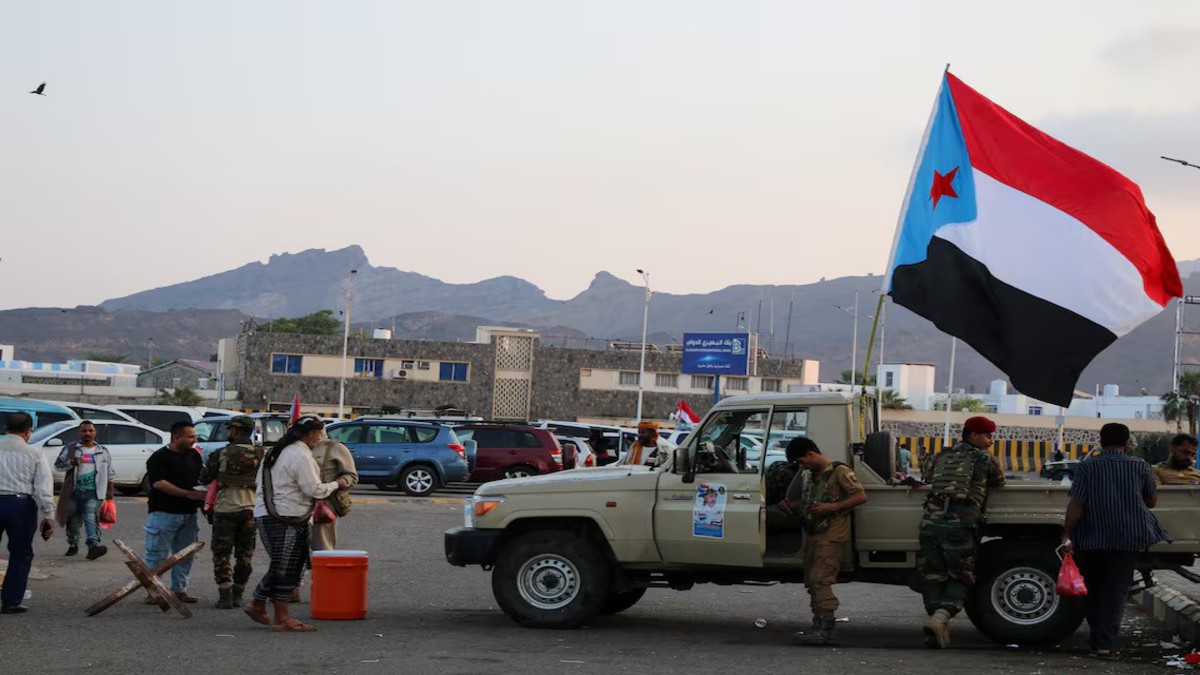
 "How Saudi-UAE fallout in Yemen raises fears of wider regional conflict")
The New Year has ushered in yet another conflict in a region already teetering on the edge; Yemen’s rapidly evolving situation is raising alarm bells. Today, a decade after Saudi Arabia and the UAE led a joint military campaign to curb Iran’s influence in the country, the two allies now find themselves pitted against each other over Yemen, a strategically located and impoverished nation with a history of internal divisions and civil wars driven by ideological differences that have plagued it for over a century.
The separatist Southern Transitional Council (STC), which grew out of the Southern separatist movement that predates the civil war and controls areas in the Southwest around and including Aden, has recently seized territory in the governorates of Hadramaut and Al-Mahra.
Hadramout represents an economic hub for Yemen with its oil and gas resources and related infrastructure and has a vital border crossing with Saudi Arabia. Saudi Arabia says the STC, which is now pushing to declare the independence of a breakaway state, poses a direct threat to the Kingdom’s national security and regional stability.
While the world continues to place hopes on diplomacy and de-escalation, there is growing concern that Yemen may be inching toward a dangerous regional conflagration. At the heart of this anxiety lies the Coalition to Restore Legitimacy in Yemen (a military alliance led by Saudi Arabia, established to counter Houthi rebels and restore the internationally recognised Yemeni government led by the Presidential Leadership Council)’s unwavering commitment to preserving territorial unity and preventing the rise of extremist safe havens that could destabilise not just Yemen, but the broader region and beyond.
Quick Reads
View AllIt would be naive to view developments in Southern Yemen in isolation. The parallels with Sudan, where the Rapid Support Forces have left a trail of devastation and a massacre, cannot be ignored. This serves as a caution of what could unfold in. Incidentally, in recent years Sudan and Yemen have emerged as the two major contesting grounds where Saudi Arabia and the UAE are backing the opposing sides.
Saudi Arabia has drawn a clear red line when it comes to its own national security but acknowledged the just and historically rooted nature of the Southern issue. Yet, it has also made clear that any resolution must emerge from consensus among Yemen’s diverse components around the negotiating table, not on the battlefield. A military solution would only unravel years of painstaking efforts by the coalition and the internationally recognised Yemeni government to foster calm, even engaging with the Houthis in pursuit of a durable peace.
There is an opinion that while those in the South have a right to advocate for independence based on their historical and geographic claims, this cannot come at the expense of other Yemenis who believe in a united nation.
The Main Parties in Yemen
The Houthis, formally known as Ansar Allah, are a Shia Islamist movement in the northwest of the country. In 2014, they orchestrated a swift takeover of Sana’a, with some popular backing, seizing control of the government. With sustained Iranian arms supplies and support, they emerged as Yemen’s most cohesive military and political entity, controlling most of the country’s northwestern border with Saudi Arabia and holding the critical Red Sea coastline, including access to vital maritime corridors. They endured a prolonged Saudi-led military campaign, which ultimately failed and led to the Houthis securing a de facto truce in 2022. Over time, they have evolved into one of Iran’s most disruptive proxies, along with Hamas and Hezbollah.
The Presidential Leadership Council (PLC) was established in 2022 to unify fragmented factions against the Houthis; it commands a loose coalition of regular military remnants, tribal militias, and Sunni Islamist groups in the centre and south of the country. It is Yemen’s internationally recognised government, operating backed by Saudi Arabia. Its forces hold a patchwork of strongholds, primarily in the central province of Marib and parts of Taiz and Aden in the south. However, the PLC is divided into two factions, each loyal to one party in this conflict. The difference had been simmering for years away from the spotlight until it exploded publicly recently.
The Southern Transitional Council (STC) is a UAE-backed separatist body in Southern Yemen founded in 2017 to advocate for the restoration of the southern Yemeni state, which ceased to exist in 1990. Militias aligned to the group have played a crucial role in battles in recent weeks.
Looking Back in Time
Historically, Yemen has been a unified and federated entity, from the Himyarite, Rasulid and Qasimid dynasties. The division of Yemen was not indigenous but imposed by colonial powers, notably the British in the South, who ruled through a patchwork of emirates and sultanates, while the Ottomans held sway in the North. Even the city of Dhale was once under the rule of the Zaydi Imams.
North Yemen gained independence from the Ottoman Empire after 1918, while South Yemen remained under British control until its independence in 1967. Also known as the Yemen Arab Republic (YAR), North Yemen existed from 1962 until its unification with the People’s Democratic Republic of Yemen (commonly known as South Yemen). The two states remained divided until their unification in 1990, followed shortly by a civil war in 1994, in which Southern separatists were defeated, leaving unaddressed grievances that contribute to ongoing conflicts.
Yemen’s civil war began in 2014 when Houthi insurgents with links to Iran and a history of rising up against the Sunni government took control of Yemen’s capital and largest city, Sana’a. Following failed negotiations, the rebels seized the presidential palace in January 2015, leading to the resignation of President Abd Rabbu Mansour Hadi and his government.
In March 2015, a coalition of Gulf states led by Saudi Arabia launched a campaign of economic isolation and air strikes against the Houthi insurgents, with US logistical and intelligence support. This intervention in Yemen’s conflict, including Iran and Gulf states led by Saudi Arabia, also drew the country into a regional proxy struggle along the broader Sunni-Shia divide.
The Saudi-led coalition of regional forces, including the UAE, fought against the Houthis and salvaged an internationally recognised government. The Houthis, supported by Iran, held their ground and even attacked Saudi oil installations as well as drone and missile attacks in Abu Dhabi. They attacked Israel and the US shipping in the Red Sea, disrupting the maritime commercial shipping at will.
Though not fully overcome or abated, an uneasy quiet was secured with the Saudis and Americans cutting a deal with them as rapprochement between Riyadh and Tehran has continued to hold. In 2019, seeing that the objectives of the war were leading nowhere, the UAE took a pragmatic decision and decided to pull out while retaining its stakes in Southern Yemen, which has some of the most strategic ports.
Over the years, disagreements surfaced between rival Yemeni factions whose competing agendas unintendedly exposed a rift between the two Middle Eastern allies, Riyadh and Abu Dhabi.
Since then, the UAE has been working closely with and supporting the Southern Transitional Council (STC), led by Aidarus al-Zubaidi, which fell out with the internationally recognised government supported by Saudi Arabia.
Now after years of stalled efforts to end the civil war, UAE-backed forces launched a rapid offensive in early December, seizing control of oil-rich provinces from Saudi-backed forces, leading to deadly clashes. Tensions peaked when Saudi-led coalition airstrikes targeted a UAE shipment of vehicles at Southern Yemen’s Mukalla port, accusing Abu Dhabi of endangering Saudi national security.
On January 2, Saudi warplanes bombed camps and military positions held by the STC in Hadramout province as Saudi-backed fighters tried to seize the facilities, as per reports. Meanwhile, on January 3, the UAE announced that it had completely withdrawn all its troops from Yemen.
The Paramount Concerns
After nearly a decade of war, rapidly shifting conditions on the ground are raising new concerns. The Yemen conflict initially symbolised Gulf unity. Over time, however, it revealed differences. Saudi Arabia approached Yemen primarily through a security and border-stability lens, viewing outcomes through the prism of territorial integrity and internal security. The UAE, while committed to coalition objectives, focused more sharply on maritime security, port infrastructure, counter-extremism, and influence through local partners aligned with its strengths.
To allow any group to redraw borders through armed force and foreign patronage is to invite catastrophe. It is worth recalling that these were precisely the conditions that sparked the last war, when the Houthis, backed by external actors, toppled the legitimate, UN-recognised government.
The question is: “If the STC is granted the right to establish a new state in the Arabian Peninsula under the banner of self-determination, what then of the Iran-aligned Houthis? They command a sizable following and control the historic capital. Will they then dictate terms?” Going forward, will the international community and the US in particular accept the emergence of a Houthi-Iranian state in Northern Yemen?
Further, is the world prepared to bear the consequences of a prolonged war that threatens global shipping lanes, energy supplies, and regional stability, especially given the strategic importance of the Bab Al-Mandab Strait and the Red and Arabian seas?
Recent history offers a grim verdict: uncoordinated secessions without broad domestic consensus or clear international legal frameworks rarely yield stable states. Instead, they unleash prolonged chaos and institutional collapse and open the door to armed groups and external meddling. Sovereignty becomes a mirage, replaced by a vacuum that breeds perpetual conflict.
In Yemen, the stakes are even higher. The country sits astride one of the world’s most vital maritime chokepoints, through which a significant share of global trade and energy supplies pass. A security vacuum would expose this artery.
Moreover, such a vacuum would be a magnet for militant groups, whether terrorist networks or regional proxies, creating a new axis of instability stretching into the Gulf and threatening the security of maritime corridors.
Conclusion
Recurring conflicts have left Yemen, which is strategically located south of Saudi Arabia with access to key maritime corridors, heavily impoverished, highly unstable and well-armed, as regional powers vie for influence.
The Houthis, who have been targeted by some of the region’s most powerful nations, will view the divisions among their enemies as advantageous. The group, which launched missile and drone attacks on Abu Dhabi and Riyadh in the past, had endured a years-long Saudi-led coalition blockade and airstrikes and are likely to view the growing rift between two of their principal adversaries with considerable advantage, as they observe former coalition partners who jointly fought but failed to defeat them now turn against one another.
No wonder Saudi Arabia’s Foreign Ministry has called for Yemen’s Southern factions to attend a “dialogue” in Riyadh, after the dramatic turn of events which has brought them into an unprecedented direct confrontation with the UAE.
There is no doubt that the implications for regional stability and for Yemen’s already fragile political landscape are profound; hence, the path forward must be paved with dialogue, not division. Independence does not seem an alternative, as it can lead to an implosion.
(The author is a retired Major General of the Indian Army. Views expressed in the above piece are personal and solely those of the author. They do not necessarily reflect Firstpost’s views.)

 "US-Venezuela tensions LIVE: Maduro to be produced in New York court as Trump warns Rodrigues of 'a very big price'")
 "Is Trump handing over Venezuela to ‘anti-American socialists’ he loathes?")
 "From Maduro to Saddam, a look at foreign heads of state taken into US custody")
 "How Venezuela’s Nicolas Maduro became a follower of Indian godman Sathya Sai Baba")
 "US-Venezuela tensions LIVE: Maduro to be produced in New York court as Trump warns Rodrigues of 'a very big price'")
 "Is Trump handing over Venezuela to ‘anti-American socialists’ he loathes?")
 "From Maduro to Saddam, a look at foreign heads of state taken into US custody")
 "How Venezuela’s Nicolas Maduro became a follower of Indian godman Sathya Sai Baba")