

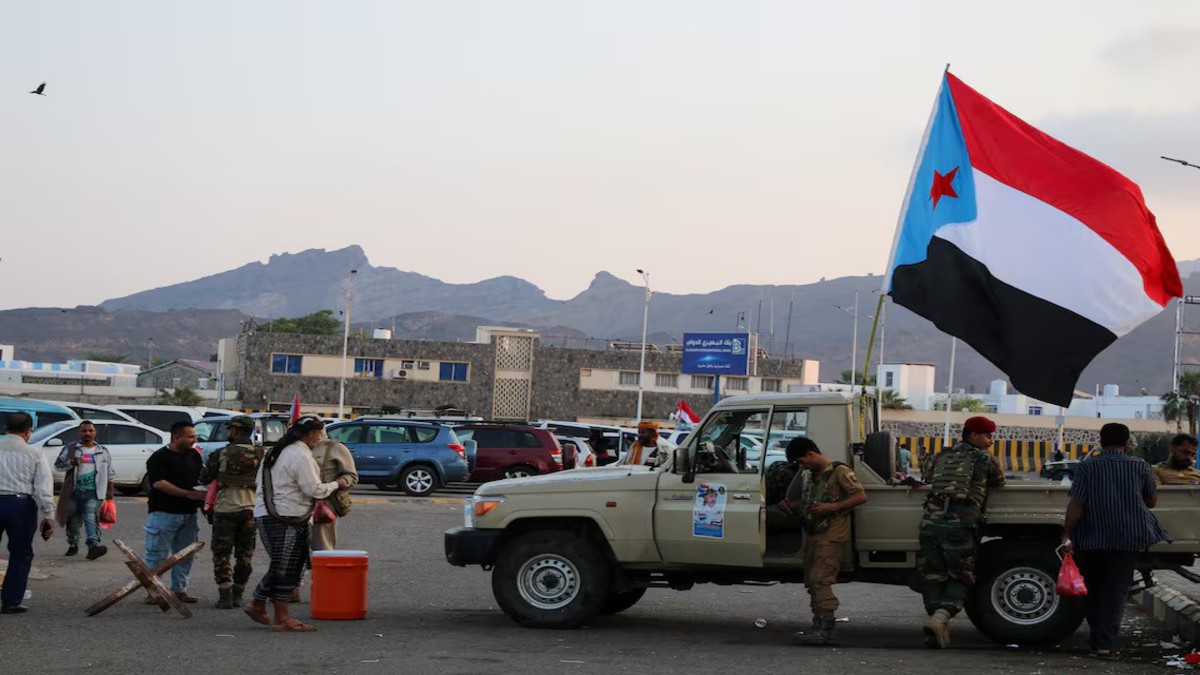
 "How Saudi-UAE rivalry in Yemen could impact already fragile West Asia")
The strategic rivalry between Saudi Arabia and the United Arab Emirates (UAE) has escalated into a full-scale conflict in the Yemeni theatre. The year 2026 opens with an unsavoury chapter of conflict between two consequential players in the Gulf countries in a different geography where they exercise influence. The simmering tension between the two has metamorphosed into a military confrontation.
The southern port of Mukalla has become the epicentre of confrontation. The Saudi forces carried out a targeted airstrike on the port of Mukalla on December 30, 2025. The ships were targeted and were alleged to have carried weapons and been dispatched for the Southern Transitional Council (STC). The UAE was accused of having sent the ships loaded with ammunition to be delivered to STC. STC’s separatism focuses on the autonomy and independence of southern Yemen.
The UAE, on the other hand, has denied these accusations and asserted that the shipment consisted of humanitarian aid and standard supplies for its forces stationed in southern Yemen. A volley of accusations and counteraccusations ensues, making the matter even more tense.
Other developments that took place following this conflict are Yemen’s Saudi-backed Presidential Leadership Council (PLC)’s cancellation of the defence pact with the UAE and the PLC’s accusation against the UAE of encouraging internal strife. Saudi Arabia issues an ultimatum to withdraw UAE forces from Yemen.
Reasons for Rivalry
The Saudi-UAE rivalry is not unfounded. It has strong grounds to antagonise each other. Both countries are wealthy and hold significant influence in the region. Apart from Iran, Turkey, Qatar, Saudi Arabia, and the UAE are important players in the region, and they attempt to exert their economic influence to assert their hegemony.
In the context of Yemen, geography is both an asset and a liability. Yemen’s chronic instability largely emanates from its geography. Strategically, it is positioned on the Bab el-Mandeb Strait, which connects the Red Sea and the Gulf of Aden. Yemen is located on the southwestern tip of the Arabian Peninsula and shares borders with Saudi Arabia to the north and Oman to the east. The western part of Yemen touches the Red Sea and the Arabian Sea in the south. It shares the most critical geography that links the Red Sea with the Gulf of Aden.
Quick Reads
View AllThe Red Sea trade is very vital, as it handles 12 per cent of global trade, connecting Asia with Europe via the Suez Canal. Critical global commerce takes place here. Houthis target and disrupt the trade network, making the region’s geopolitics tense and exerting their influence. It is a critical supply chain network and an extremely sensitive zone where East Africa and West Asia come into close proximity, separated by the Red Sea.
Moreover, the Horn of Africa is a highly unstable region. The region is largely conflict-ridden. Sudan, Eritrea, Djibouti, and Somalia, located on the African side of the Red Sea, and Yemen, on the other, remain entangled in an irresolvable conflict. The game of great powers takes place there, and it is challenging for smaller players to assert their autonomy. Instability is a permanent reality.
Given these geographical, geopolitical, and geostrategic factors, Saudi interests in Yemen are primarily focused on security, geoeconomics, and geopolitics. A unified Yemen helps Saudi Arabia to protect its southern border and disable the Houthis’ influence. Saudi Arabia has Jeddah Port along the Red Sea to facilitate its export-import activities, but the UAE does not share a geographic border with the Red Sea. The trade route through the Gulf of Aden and the Red Sea is crucial for the UAE in terms of its export and import activities.
The UAE supports STC forces in exercising their autonomy in southern Yemen. This gives Abu Dhabi strategic control over the maritime route and ports in the region. The Southern Yemeni ports are the Port of Aden, Mukalla, Balhaf, Bir Ali, Shokra and Socotra. They play a crucial role in managing trade and logistics within the supply chain network of the Arabian Peninsula. The UAE extends its interests to STC to gain geopolitical and geostrategic advantage and secure its influence in the region.
Export and import are core interests of the UAE. Its economy depends on this. It cannot remain inactive given the critical developments in the region. The UAE and Saudi Arabia are the middle powers in the Middle East. They compete for greater diplomatic, geostrategic, and geopolitical influence in the region. They also guard their interests by all means.
Hadhramaut
Hadhramaut is a significant region in southern Yemen, renowned for its rich history, ancient kingdoms, diverse heritage, frankincense trade, mud-brick architecture, Bedouin culture, ancient trade routes, mountainous terrain, and traditions. STC is accused of having advanced into the Hadhramaut and Mahra provinces. This has spiralled into a new wave of conflict. Riyadh views this region as critical for its national security.
Moreover, this region is resource-rich, and around 80 per cent of Yemen’s oil reserves are located here. Control over this territory gives STC economic and political control. The region’s energy assets are the bone of contention between STC and PLC.
In addition, the geostrategic importance of the region makes the place more vital for STC’s depth in the region. Whoever occupies the place gives it the bargaining power. STC’s control over Hadhramaut will make the southern project complete and weaken the PLC. It helps STC to project power.
STC’s leverage in the region will be amplified. It will impact the Yemeni government, the Houthis, and Saudi Arabia. The demand for self-rule will be solidified once this region comes under STC control. Therefore, Saudi Arabia feels rattled. The region is critical and invites irresolvable tension and conflict. This region also bifurcates the Saudi and UAE interests.
Houthi Factor
The Houthis in Yemen are a critical factor. The Iran-backed Shia militant group exercise their influence in northern and western Yemen. The capital, Sanaa, Sa’dah, provinces bordering Saudi Arabia and the Red Sea coastline largely come under its control. It is difficult to determine the extent of terrain it controls. It is no less than a third of the country that is under its control, governing around 70-80 per cent of the population.
In a fractured country ravaged by multi-sided conflict, the Saudi-UAE conflict gives fuel to Houthi forces to consolidate power and express their aggression against targeted groups. The growing opposition between Riyadh and Abu Dhabi is likely to strengthen the Houthis’ influence in the region.
Southern Transitional Council
The Southern Transitional Council (STC) is a powerful force in Southern Yemen. It holds nearly 52 per cent of Yemen’s territory. It demands an independent South Yemeni state. It believes in a two-state solution and protection of Southern Yemen from Houthi militancy and extremism. It fully supports its military wing, Southern Armed Forces. It is a secessionist military and political organisation. Its focus remains on Southern Yemen.
The UAE reportedly supports STC in expanding its geopolitical, geostrategic, and geoeconomic interests in the region. STC pushed “Operation Promising Future” in December 2025 to exercise control over all eight southern governorates. The intentions of annexing Hadhramaut and Al-Mahrah were on the priority list, recognising their critical importance for STC’s rise to power and autonomy. This rattled Saudi Arabia and PLC, who swung into action. The current crisis in Yemen is rooted in the above reason.
STC controls major resources and infrastructures in Southern Yemen, most importantly the PetroMasila oil company. Aidarus al-Zubaidi is an STC leader. He occupies a seat in the Presidential Leadership Council (PLC) of the central government. The recent action suggests the sidelining of the central government, taking the conflict to a different level. The military response from Saudi Arabia has complicated the situation.
STC accuses Saudi Arabia of an air blockade. Landing permissions were denied to the Saudi delegates at Aden International Airport. The Aden Airport is reportedly closed. Meanwhile, the agreement that has come seems fragile. Saudi-backed National Shield Forces have reportedly been allowed to observe the area seized, but the push for withdrawal from those seized provinces bordering Saudi Arabia has not been agreed upon.
Presidential Leadership Council
PLC is an executive body that has been internationally recognised. The current Saudi-UAE rivalry has raised questions about their supposed unity. The factionalism in PLC has made it a metonymy of irreconcilability. PLC Chairman Rashad al-Alimi leads the pro-Saudi faction. STC chief Aidarus al-Zubaidi leads the pro-UAE faction.
The rivalry between the two has intensified. This rivalry has escalated into an unfolding antagonism between Saudi Arabia and the UAE. Chairman Alimi from Riyadh has cancelled Yemen’s defence agreement with the UAE. He has also declared a 90-day national emergency. These declarations have dented the power-sharing framework and consensus-based governance.
Given these developments, it is difficult to assess the conditions in Yemen and the nature of the Saudi-UAE rivalry. The conditions look convoluted and deeply concerning. Fragility in the Middle East continues. The conflict will not end so soon. The Houthis’ actions may erupt at any time and could exacerbate volatility in the region. Yemen’s geographical proximity to the Red Sea and the Gulf of Aden may impact the resilience of its trade network and supply chain. Yemen’s instability may lead the region into a vicious circle of unending tension and disturbance.
(Jajati K Pattnaik is a Professor at the Centre for West Asian Studies, School of International Studies, Jawaharlal Nehru University, New Delhi. Chandan K Panda is an Assistant Professor at Rajiv Gandhi University (a Central University), Itanagar. Views expressed are personal and solely those of the authors. They do not necessarily reflect Firstpost’s views.)

 "Venezuela-US tensions LIVE: Allies angry, Europe cautious as Maduro's capture splits world into two")
 "'Deep concern': India closely monitoring Venezuela situation after Maduro’s capture, says MEA")
 "Who is Cilia Flores, Nicolas Maduro’s wife also captured by US?")
 "'Uphold international law': Starmer responds to Maduro's capture, clarifies UK 'wasn't involved' in military op")
 "Venezuela-US tensions LIVE: Allies angry, Europe cautious as Maduro's capture splits world into two")
 "'Deep concern': India closely monitoring Venezuela situation after Maduro’s capture, says MEA")
 "Who is Cilia Flores, Nicolas Maduro’s wife also captured by US?")
 "'Uphold international law': Starmer responds to Maduro's capture, clarifies UK 'wasn't involved' in military op")



