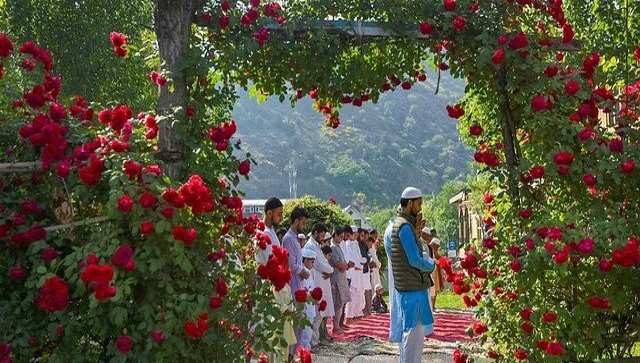
 "Paradise on Earth: How beautiful roses, lavenders can be an economic miracle for Kashmir")
Why would a scientist be interested in roses – or for that matter lavender? The fact is that these flowers when taken through a gentle process known as hydro steam distillation, yield aromatic oils that have considerable commercial benefit. Indeed these substances are the key to successful perfumery industries in other countries.
The fragrant rose or botanically speaking Rosa damascena was originally grown in India and Egypt where it was used to make rose water. A favourite scent of the Romans, it has been used for cosmetics, fragrances, edibles, and even – with some help from bees – to make honey.
France was typically the leader in rose and lavender oil production in earlier times. From the 1920s, however, another country, tucked away in a distant corner of Europe, began to enter this business. Bulgaria is a small country with a GDP of $86 billion (nominal, 2022). However, in recent years it has overtaken France to become the world leader in lavender and rose oil production. The exports of these aromatic oils account for around 7% of the overall Bulgarian GDP, which is substantial. A region in the central part of the country in the foothills of the Balkans mountain range, with a mild four season climate, has come to be known as Bulgaria’s Rose Valley. This small area of around 100 sq km, with very particular microclimate characteristics has been found to yield flowers with an extraordinary propensity to yield oils that are prized the world over.
Considering the diversity and yet, inscrutable way in which Nature choses to bestow its gifts on us, many of the climatic, soil and water characteristics of central Bulgaria are approximated in a small area of southern Kashmir, notably Pulwama district, and in Bhaderwah, Doda and Kishtwar districts in the Jammu region of the Union Territory.
Amidst the stunning landscapes of Kashmir and the fields of Bulgaria, a beautiful story unfolds—a tale of fragrant blooms that transcend borders and captivate our senses. Let’s embark on this aromatic journey, exploring the intertwined stories of these two places. The climate and soil in Kashmir being much like in central Bulgaria, it is found that the constituents of the aromatic oils in both these regions are very similar. Key ingredients like citronellol and rose oxide, which gives rose oil its unique scent, are nearly the same in both, with Kashmir at 35.7% and Bulgaria at 40.6%. Other components like geraniol (30.2% in Kashmir and 20.5% in Bulgaria) and its isomer nerol (8.8% in Kashmir and 5.8% in Bulgaria) also match up closely.
Quick Reads
View AllA technical point is relevant. The human nose is a far more sensitive detector of fragrances than the most advanced analytical spectrometers. Any particular aromatic oil is prized in the commercial market because of greater and lesser amounts of minor constituents (not just the above four major compounds). This is why natural oils smell different from oils that are made by merely mixing synthetic citronellol, rose oxide, geraniol and nerol in the above ratios. The striking similarity between Kashmiri and Bulgarian oil is brought out by the additional fact that even at the level of barely detectable microconstituents, the oils are comparable.
At this stage, the two stories diverge. Bulgaria has a 100 year lead time over Kashmir in terms of standardizing its aromatic oil industry, establishing cooperatives, putting in place regulatory measures and maintaining strict quality control measures. It could do all of this despite its widely different forms of government over the past century. Because of this head start, it is today able to sell branded products that command prices as high as Rupees 1 crore for a single kilogram of rose oil extracted from say 30 to 40 quintals of rose petals. In contrast, the Kashmir product is just the oil in its raw form that is sold as such in the open market by individuals. Because it is not branded, and little effort is put into quality control, prices are much lower.
Pulwama district is at the heart of our aromatic oil production effort. The production of 80 to 100 kilograms of rose oil each year has transformed the local economy. This success has attracted a diverse group of entrepreneurs, hill farmers, and job-seekers who have been drawn in by the magic of rose cultivation. The ‘Aroma Mission’ or ‘Purple Revolution’ launched by the Council of Scientific and Industrial Research has brought lavender into the national spotlight. CSIR’s Indian Institute of Integrative Medicine Jammu (IIIM) has been implementing various farmer and industry oriented hand holding projects for production, collection and post-harvest processing. Its Field Station in Bonera in the above mentioned Pulwama district is spread over 80 hectares and has significantly extended CSIR’s outreach into the region. Despite all this, and because of the lack of competitive commercialisation, as employed in Bulgaria, a single litre of lavender oil from Bonera sells for just Rupees 10,000, with one hectare of land yielding around 50-60 liters of oil. How do we make the Bharatiya rose and lavender smell sweeter than the Bulgarian ones, in terms of the commercial and social benefit? This is the question.
One answer may be found in Bulgaria’s rise to prominence in the aromatic oil industry. It overtook France a century ago because labour costs were lower there. It is here that Kashmir could become competitive with our labour costs being even lower than in Bulgaria. At present the labour costs in France, Bulgaria and Kashmir are (in Indian rupees), 3500, 600, and 400. We also need to improve our yield to match the Bulgarian oil content of 0.057% to 0.058%. If these factors are understood and controlled, and also the procedures made more systematic, Kashmir has the makings of becoming the world leader in lavender and rose oil production. But it is a long and difficult road for us.
Other factors also come into play. The name Pulwama has altogether different connotations for most Indians, and any large scale effort to draw the local population into an internationally competitive industry is bound to have pronounced beneficial effects on the morale of a people badly scarred by 75 years of strife and killing. Already the CSIR based efforts have provided employment opportunities for women while farmers have responded enthusiastically in terms of lifting plants from the Field Station and cultivating them independently.
There is yet another aspect to developing our aroma oil industry in Kashmir to international standards. Roses and lavender, of oil standard, do not grow in Darbhanga or Thiruvananthapuram. They grow only in a small area of a small valley that is called Kashmir. And yet, because of the high value attached to this specialist crop, we have the makings of an economy that can rival and beat an entire European country. Diversity is our primary asset and by concentrating on just aromatic oils, Kashmir might well be able to become an economic powerhouse.
This argument has been developed further in my book called “Bharat: India 2.0” that calls for a redefinition of an India of 28 states as a Bharat of 75 states. Kashmir, in such a scheme, would be one such state, independent of Jammu, Ladakh, Baltistan and Gilgit, not to talk of Chitral. In a small state, the attention of the people and their leaders could well be focused on one or a small number of niche products that would compete internationally with today’s world leaders, in the case of rose and lavender oil for example, with Bulgaria. One can see aromatic oils play their part with hydroelectricity, fruit farming and tourism as core ingredients of a successful economy for a small state called Kashmir.
In essence, this fragrant tale is one of intertwined destinies, where nature’s beauty meets human creativity. The symphony of scents from Kashmir and Bulgaria echoes with tradition, innovation, and economic promise, resonating with fragrance and flavor lovers around the world. It’s in these blossoms that the fragrance industry finds its most precious notes, drawn from a bouquet that knows no borders.
The author is in the Indian Institute of Science and has authored a book Bharat: India 2.0. Views expressed here are personal and solely those of the author. They do not necessarily reflect Firstpost_’s views._
Read all the
Latest News,
Trending News,
Cricket News,
Bollywood News,
India News and
Entertainment News here. Follow us on
Facebook,
Twitter and
Instagram.


 "'Indian food, our pride': $200k settlement in Palak Paneer case a moral victory against racism in the west")
 "India’s air dominance in Operation Sindoor forced Pakistan to seek ceasefire, European report says")
 "How Pakistan’s support may have led Bangladesh towards a very costly mistake")
 "India vs New Zealand Live Score 3rd T20: Samson bowled on very first ball by Henry")
 "'Indian food, our pride': $200k settlement in Palak Paneer case a moral victory against racism in the west")
 "India’s air dominance in Operation Sindoor forced Pakistan to seek ceasefire, European report says")
 "How Pakistan’s support may have led Bangladesh towards a very costly mistake")
 "India vs New Zealand Live Score 3rd T20: Samson bowled on very first ball by Henry")