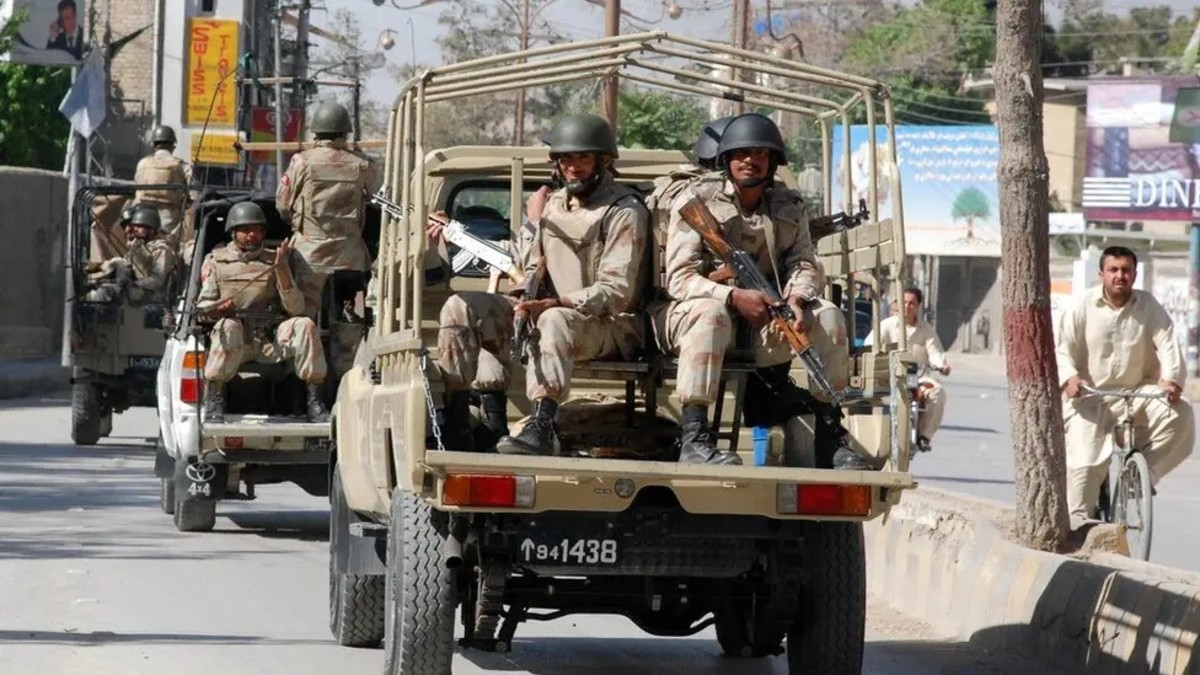
 "Operation Herof 2.0: Pakistan is a pawn in the new Great Game in Balochistan")
For nearly a decade, Pakistan promoted the China-Pakistan Economic Corridor as the foundation of its geopolitical revival, terming it a once-in-a-generation partnership that would elevate Islamabad from a fragile security state into the nerve centre of Eurasian trade and maritime strategy. CPEC was marketed with great aplomb as Pakistan’s ultimate escape route from its economic instability and strategic irrelevance. The recent Operation Herof 2.0 carried out by the Baloch insurgents has exposed how dangerously premature that calculus may have been.
The recent coordinated insurgent offensive across Balochistan is not simply another eruption of separatist violence. It represents a geopolitical turning point as it reveals not only the structural fragility of Pakistan’s internal security architecture but also exposes how Islamabad is now drifting into a far more dangerous strategic trap, one where it risks losing control of Balochistan not to insurgents alone but to the competing gravitational pull of the global great powers. Pakistan, which once imagined itself as the orchestrator of a great-power competition, now risks becoming its casualty.
China’s Corridor Dream Meets Balochistan’s Reality
China’s entry into Balochistan through CPEC was never purely economic. As a matter of fact, economically it was never even a viable option. Gwadar Port, sitting just outside the Strait of Hormuz, the world’s most critical oil chokepoint, represented Beijing’s boldest maritime gamble. Nearly one-fifth of global energy shipments pass through the narrow strait, making it one of the most strategically sensitive maritime corridors on the planet.
For China, Gwadar promised something revolutionary: a proximity to the Persian Gulf energy lifeline without the dependence on the vulnerable Malacca Strait. It was meant to give Beijing a permanent strategic vantage point near the artery that fuels the global economy. But the renewed Baloch insurgency that has struck its roots time and again has brutally exposed the fragility of that vision.
Quick Reads
View AllThe recent insurgent attacks have once again demonstrated that Gwadar remains surrounded by contested territory where Pakistan’s control is neither absolute nor stable. Chinese engineers, infrastructure convoys, and security facilities have repeatedly come under attack, turning Gwadar into less of a maritime triumph and more of a fortified island surrounded by insurgent hostility.
Beijing’s response has been quite telling. While Chinese officials publicly reaffirm commitment to CPEC, investment momentum has quietly died as the new megaproject announcements have dwindled. The Chinese planning discussions on CPEC with Pakistan are now only dominated by the security concerns and the payback of the outstanding loans that it granted to Pakistan under the guise of CPEC.
As Pakistan is increasingly failing to secure Balochistan politically and militarily, China appears to be recalibrating rather than retreating, but the recalibration signals a growing acceptance in Beijing that CPEC may never deliver the sweeping strategic dominance it once promised.
Washington’s Counter-Move: The Pasni and Mining Pivot
Sensing China’s hesitation, Pakistan has begun repositioning itself as a geopolitical swing state once again. Islamabad is now aggressively pitching Balochistan’s rare earth reserves, copper mining concessions, and coastal infrastructure, including the other strategic maritime Pasni Port, to the Western investors, particularly the United States.
Pasni’s geographical advantage is undeniable. Located along the same strategic coastline as Gwadar, it offers proximity to the Strait of Hormuz and maritime energy routes critical to global trade. For Washington, whose naval doctrine prioritises securing global sea lanes, Pasni represents a potential counterbalance to Chinese maritime expansion.
Pakistan appears to believe that it has discovered a masterstroke by playing China and the United States against each other to maximise investment inflows. In reality, it is engaging in a dangerously naive geopolitical gamble.
Pakistan is offering access to regions where its own sovereignty remains contested. The mineral corridors, rare earth reserves, and maritime infrastructure Islamabad is marketing to global powers lie inside insurgency-affected zones where insurgent groups like the BLA and the TTP dominate the geography. Operation Herof 2.0 has once again revealed the shrinking limits of state authority that is selling this strategic geography despite clearly struggling to govern and control it.
The Strait of Hormuz: The Real Prize Behind the Balochistan Battlefield
The emerging interest of both China and the United States in Balochistan is not coincidental. It is driven by the gravitational pull of the Strait of Hormuz, the energy artery that connects Middle Eastern oil producers to global markets.
Control, surveillance, or even proximity to Hormuz offers immense strategic leverage. Gwadar gives China potential observation and logistical access to this maritime chokepoint. Pasni and associated coastal infrastructure could offer Western powers similar monitoring advantages.
In essence, Balochistan has become the outer security ring of the Persian Gulf energy ecosystem. Operation Herof 2.0 demonstrates that this outer ring is dangerously unstable.
Pakistan’s Suicidal Strategy: Playing Both Sides While Losing Control
Pakistan believes that it has historically excelled at balancing great powers. During the Cold War, it navigated U.S. alliances while maintaining regional influence. After 9/11, it repositioned itself as a counter-terrorism partner while sustaining complex regional networks. But Balochistan presents a far more dangerous balancing act, as it has put Pakistan on a table of Russian roulette.
By inviting China to anchor Gwadar while simultaneously offering mineral concessions and maritime alternatives to Western powers, Pakistan is attempting to monetise strategic geography through competitive patronage. This strategy might deliver short-term financial relief for Pakistan, but it risks creating overlapping spheres of external influence inside Pakistan’s most volatile province. History is a testament that such external competition rarely strengthens fragile states. It actually fractures them.
History repeatedly shows that when great powers compete for access to contested territories, local sovereignty becomes collateral damage. Pakistan risks discovering that its attempt to leverage Balochistan as a geopolitical bargaining chip may ultimately completely dilute its authority over the province altogether.
Operation Herof 2.0 and the Collapse of Military Legitimacy
Perhaps the most dangerous consequence of Operation Herof 2.0 lies within Pakistan’s domestic power structure. The Pakistani military has long justified its dominant role in governance through its claim of being the ultimate defender of national unity.
The Baloch insurgents’ ability to infiltrate, frequently disrupt and repeatedly seize administrative and security infrastructure, even temporarily, strikes at the heart of that legitimacy. Military power projection doesn’t rest only on firepower but on perception. Operation Herof 2.0 has challenged this by both inflicting heavy damage to the military and seizing administrative control of key towns, albeit temporarily, thereby shattering the narrative that Pakistan’s armed forces maintain of having uncontested control over its strategic territory.
This erosion carries two devastating consequences. Domestically, it weakens the public confidence in the state’s ability, thereby weakening its military’s power grip. Internationally, it raises alarm among global investors and strategic partners who rely on Pakistan’s military to safeguard any of their strategic investments and interests.
Pakistan’s strategic Achilles’ heel is in its homegrown insurgency that is leading to the gradual erosion of the institutional credibility its military is facing.
The Internal Security Time Bomb
External power competition in Balochistan risks intensifying internal security fractures. Competing foreign investments often create rival economic enclaves, security arrangements, and political patronage networks. Such fragmentation can fuel local power struggles and deepen separatist narratives.
As Balochistan becomes a contested playground for Chinese and the Western strategic interests, Pakistan may find itself governing a province shaped increasingly by external geopolitical calculations rather than its own national policy coherence. The subsequent outcome would ultimately lead not to its perceived economic development but towards its imminent sovereignty erosion.
The New Great Game and Pakistan’s Dangerous Role
The rivalry unfolding in Balochistan echoes the historical Great Game of the 19th century, when imperial powers competed for influence across Central and South Asia. In that earlier contest, regional territories often became battlegrounds for external competition rather than beneficiaries of geopolitical attention.
The operational scale of Operation Herof 2.0 signals that Balochistan may be entering a modern version of that Great Game, one that is defined by energy security, maritime dominance, and rare earth resource competition.
The Pakistan military junta under Field Marshal Asim Munir appears convinced that it can manipulate this rivalry to its advantage. Yet history suggests that states attempting to simultaneously appease competing great powers often lose strategic autonomy in the process. Given the geopolitical odds at play, instead of emerging as a geopolitical kingmaker, Pakistan has instead gravely put itself at risk of becoming a geopolitical fault line that will be prone to further fractures caused by the great powers’ pull and push.
A Nation Caught Between Ambition and Reality
Operation Herof 2.0 has exposed Pakistan’s military’s soft underbelly, as it has exposed the fragile foundations of Pakistan’s grand geopolitical vision. China’s cautious recalibration of CPEC, coupled with Washington’s emerging interest in alternative Balochistan assets, along with the persistent insurgent defiance, collectively highlight a dangerous trajectory.
Pakistan is attempting to transform Balochistan into a strategic marketplace for great-power competition. But in doing so, it is increasingly losing control of the very territory it is trying to monetise.
If current trends continue, Balochistan could evolve into a region shaped less by Pakistan’s national strategy and more by the competing interests of external powers. The long-term consequences would not merely be economic or diplomatic. They would strike at the heart of Pakistan’s internal security, political cohesion, and territorial sovereignty.
Operation Herof 2.0 may ultimately be remembered as the moment when Pakistan failed to realise that it is no longer the kingmaker playing the Great Game but a pawn in the hands of great powers getting played in the very same game.
(Raja Muneeb is an independent journalist and columnist. He tweets @rajamuneeb. The views expressed in this article are personal and solely those of the author. They do not necessarily reflect the views of Firstpost.)

 "India, Israel elevate ties to special strategic partnership; PM Modi calls it ‘reflection of aspirations of both nations’")
 "India vs Zimbabwe LIVE Score, T20 World Cup 2026: Kishan falls for 38 after Abhishek completes fifty")
 "Who is Borge Brende, World Economic Forum chief who quit over Epstein files?")
 "US-Iran tension: Third round of nuclear talks begin in Geneva — can it avoid war?")
 "India, Israel elevate ties to special strategic partnership; PM Modi calls it ‘reflection of aspirations of both nations’")
 "India vs Zimbabwe LIVE Score, T20 World Cup 2026: Kishan falls for 38 after Abhishek completes fifty")
 "Who is Borge Brende, World Economic Forum chief who quit over Epstein files?")
 "US-Iran tension: Third round of nuclear talks begin in Geneva — can it avoid war?")