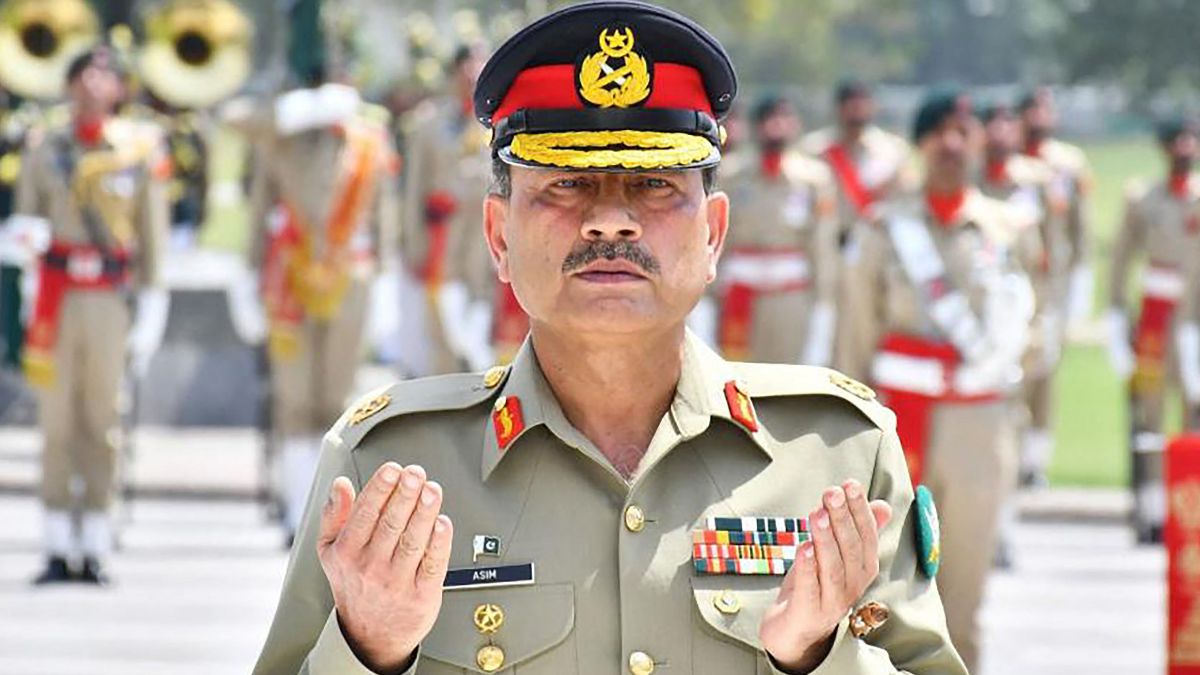
 "Chief of Defence Forces Field Marshal Asim Munir. (File/AP)")
Field Marshal Asim Munir’s magic moves have moved into a whole new dimension. He has not only been given Saudi Arabia’s highest honour, but also seems to be sailing smoothly towards sending troops to Gaza, with, amazingly, no crowds, groups or fraternities opposing the move on the streets. Truly magical, for a country that has seen almost the largest pro-Palestinian protests the world over. That says something about Pakistan, and most of all about its intelligence agencies.
The lunch was never free
First to the basics. Ever since Munir went for his luncheon date with President Trump, analysts were wondering what the payback was. After all, this was a self-declared transactional President. The truth began to get clear in stages. After fulsome praise of his favourite General, Munir began to accrue more and more power with the 27th Amendment, which essentially made him a “Supreme Leader” rather than an Ayatollah himself, and more importantly, gave him lifelong immunity from prosecution. That means he can take a lot more risk than any of his predecessors ever could.
That was accompanied by investments in ‘rare earths’ with the Pakistan Army’s Frontier Works Organisation. This has since been followed up with another deal for a $1.5 billion investment in the Reko Diq copper mines, with the US Chargé d’Affaires noting the creation of 6,000 jobs in the US and 7,500 in Balochistan. All this was the general prelude to soften relations, even as the new CDF visited Washington yet again, in what seemed to be a bromance of no uncertain order.
The proposal on Gaza
Then came the 23 September meeting with major Muslim countries, where Trump presented his Gaza Plan, which essentially revolved around his basic strategy — to get others to pull the coals out of the fire while the US reaped the benefits. Two days later the plan was up on the White House website, which noted that the US would work with “Arab and international partners to develop a temporary International Stabilisation Force (ISF) to immediately deploy in Gaza”.
Quick Reads
View AllThe ISF was to provide support to ‘vetted Palestinian police forces’ and said clearly: “This force will be the long-term internal security solution.” In other words, it is going to be around for some time. In case Hamas refused or delayed this proposal, the ISF would go in any way, in ‘terror-free’ areas to be handed over by the Israeli Defence Forces.
A United Nations Resolution 2803 (17 November) followed, which authorised this and other issues like a ‘Board of Peace’ to monitor funding for rebuilding Gaza, among other things, but only said a Palestinian state ‘may’ arise at a future date after all these steps were fully taken. Pakistan signed up to this, but publicly its representative, Asim Iftikhar Ahmed, declared itself “not entirely satisfied” with the outcome, and warned that “some critical suggestions” from Pakistan were not included in the final text — referring to the uncertain language of the statehood clause and the even more uncertain role of the United Nations, since the ISF is not to be a traditional UN-led force.
Foreign Minister Ishaq Dar also stated in the Senate that the plan was ‘not ours’, but that there was ‘no room for politicking’ on the matter. This was Pakistan walking a very thin line.
Everyone is cheering Islamabad on
But the pressure is building up. On December 19, Secretary of State Marco Rubio dodged a question on Pakistan in Gaza, noting only that: “So we’re very grateful to Pakistan for their offer to be a part of it, or at least their offer to consider being a part of it. I think we owe them a few more answers before we can ask anybody to firmly commit.”
Meanwhile, Munir was being feted by Saudi Arabia with its highest civilian honour, and King Abdullah II of Jordan made a significant two-day state visit to Pakistan (15-16 November 2025), his first in over two decades, to boost defence, economic and strategic ties, with discussions on expanding cooperation and military exercises. Pakistan’s Air Force provided an escort for the King’s arrival.
Earlier, there was a defence pact with Saudi Arabia, with nuclear deterrence implied, causing talk of an Islamic NATO. Then there is talk of an ‘Islamic railway line’ and other connectivity projects. Turkey is already a strong actor on Pakistan’s side, and even blocked the overflight of an aircraft carrying American Apaches to India. It seems Pakistan suddenly has a lot of friends.
But here’s a teaser. Turkey is not part of the ISF. While it has offered to send troops as a ‘guarantor’ of Palestinian statehood — and been refused by Israel — Pakistan is not so fortunate.
Munir’s magic
Meanwhile, as all this activity takes place, here’s the magic. Remember the spate of protests in Pakistan on the Palestinian issue. It was not just the fiery Tehreek-e-Labbaik Pakistan, but also the Jamaat-e-Islami, the Sunni Tehreek and others. These have seen an outpouring of millions on the streets. Yet, as there is open talk of troops being sent to Gaza, there is not a peep on the streets. Munir’s minions have done their work well.
In October, the government announced that an ‘extremist party’ would be put on the Fourth Schedule that lists banned terror groups. This was after some 2,500 TLP protestors were detained and another similar number put on the Exit Control List, after the party (now a political entity created to defeat Nawaz Sharif) announced its absolute opposition to the Gaza peace plan and prepared to march to the US Embassy. Since then, no further protests have taken place, by this or any other party. Those with street power know when a line has been drawn.
The political parties are mum. But then they always were where the army was concerned. With Imran Khan’s fate literally hanging by a thread, not even his party seems inclined to protest. It is game, set and match, for the time being.
A joint declaration is no big deal
Meanwhile, a group of Muslim clerics at a gathering chaired by prominent scholar Mufti Taqi Usmani brought together leaders from Deobandi, Barelvi, Ahl-e-Hadees and Shia schools of thought, alongside leaders of the country’s main religio-political parties, Jamiat Ulema-e-Islam-Fazl (JUI-F) and Jamaat-e-Islami (JI). Held in Karachi, it carefully only demanded that Pakistan’s forces should not be used to disarm Hamas.
For full effect, it also added that Pakistan’s armed forces are “imbued with the spirit of jihad” and that the “notion of placing them against any sacred struggle for the liberation of Baitul Muqaddas or Palestine is impossible for the nation to accept”. This may well be another bargaining counter by the establishment to ensure that Pakistan’s troops only deploy in support roles for reconstruction and stabilisation, rather than an actual combat role. That was a day ago. True, anything can happen — and will — especially after the first shot is fired.
In the final analysis, however, a successful deployment of Pakistani troops — without any internal protests of any kind — will set up Pakistan as a leader of the Muslim world, and as a tested US ally. Unlike India, it is — and always has been — ready for hire, but at a price. Under Trump, it will not result in heavy funding or subsidised weaponry. But it is still a useful bargaining chip for Washington, especially when it turns to the Indo-Pacific and wants India to ‘step up’ against China, or even to get a better trade deal that he can trumpet, pun implied.
But everything hinges on a population fed for decades on extreme religious beliefs and heavyweight promises. Perhaps the Munir Magic will work to ensure that you can fool all the people all the time. But if there are no protests or large outpourings of rage, it will actually prove on the ground that all of them have, at all times, been paid lackeys of the army. That, at least, will be proved beyond doubt. This would be proof positive. Pakistan watchers, take note.
(The writer is Director [Research and Analysis] at the Centre for Land Warfare Studies. Views expressed in the above piece are personal and solely those of the author. They do not necessarily reflect Firstpost’s views.)