

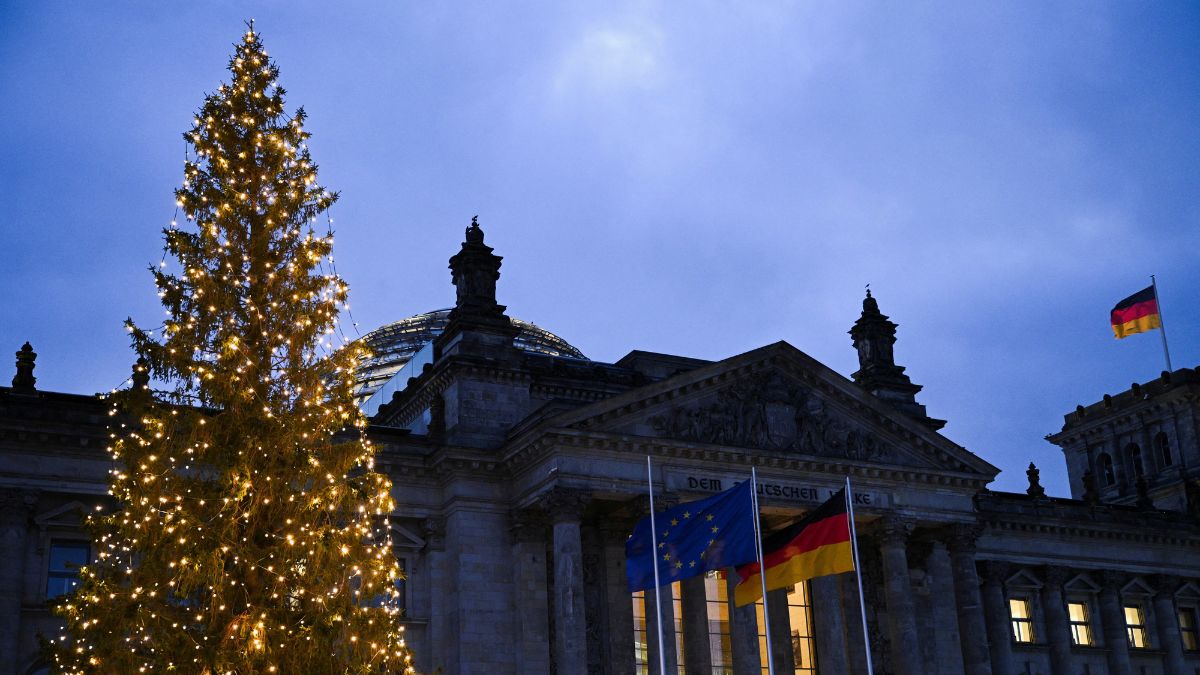
 "How did the Christmas tree become a global tradition?")
Few objects are as closely associated with Christmas as the decorated tree.
Across homes, public squares, shopping districts, and places of worship, evergreen trees occupy a central place in the modern celebration of the holiday.
For many families, choosing a tree — whether freshly cut, potted, or artificial — marks the informal beginning of the festive season, followed by days of decorating with lights, ornaments, and gifts placed beneath its branches.
Yet the Christmas tree, now regarded as an essential part of December festivities, is the result of a long historical evolution. The tradition has been shaped as much by religion and ritual as by commerce, conservation, and changing social norms.
What came before the Christmas tree
Long before Christmas existed as a religious festival, evergreen plants held symbolic importance across several ancient civilisations.
In regions where winter brought long periods of darkness and cold, plants that retained their green colour year-round were often viewed as signs of resilience, continuity, and hope.
In ancient Egypt, greenery such as date palm fronds featured prominently in seasonal observances connected to rebirth and regeneration, particularly during winter months.
Within the Roman Empire, evergreen branches were widely used during Saturnalia, a festival held around the winter solstice to honour Saturn, the god of agriculture.
Homes and temples were decorated with greenery as part of celebrations marking the end of the agricultural year and the anticipated return of light.
Similar symbolic meanings emerged farther north. Celtic druids associated evergreen plants with the idea of eternal life, while Norse traditions connected them to Baldur, the god linked with light and the sun.
In Jewish tradition, evergreens represented growth and vitality, and in Han Dynasty China they were seen as symbols of endurance during harsh conditions.
As Christianity expanded across Europe, many pre-Christian seasonal customs were absorbed rather than erased.
The practice of bringing evergreen branches indoors, hanging wreaths, or decorating entryways survived the transition, gradually acquiring new religious interpretations connected to Christ’s birth and the promise of spiritual renewal.
When the first Christmas tree grew
By the late Middle Ages, evergreen trees had begun to take on a more structured role within Christian observance, particularly in German-speaking regions.
One important precursor to the Christmas tree was the “paradise tree,” which appeared in homes and churches during December.
These trees were linked to religious plays known as “miracle plays,” staged on December 24, which was observed as the feast day of Adam and Eve in the early Christian calendar.
The plays were designed to teach biblical stories to populations that were largely unable to read. Evergreen trees decorated with apples symbolised the Garden of Eden and served as visual teaching tools.
In some regions during the 14th and 15th centuries, evergreen boughs adorned with apples were the only decorative elements used in these performances.
Over time, the trees themselves began appearing inside homes, initially undecorated and later adorned with fruit, nuts, and handmade items.
Written records from 1510 also describe a decorated tree in Riga, present-day Latvia. Members of a local merchants’ guild reportedly decorated a tree with artificial roses, danced around it in a public marketplace, and later burned it.
The rose, which remained a common decoration for many years, was often associated with the Virgin Mary.
By the 16th century, indoor evergreen trees were becoming more widespread in parts of Germany. In Alsace, records show that trees were sold in markets for home use, with regulations limiting their height.
During this period, apples became the most common decorative feature, reinforcing the connection to Adam and Eve’s Day.
How Christmas trees were decorated at the time
Alongside apples, trees were adorned with nuts, cookies, paper strips, and later candles. The earliest use of lit candles on Christmas trees dates back to the 18th century in parts of Europe.
These candles were intended to symbolise divine light as well as the gradual return of daylight after the winter solstice.
Another influential tradition developed alongside the tree: the Christmas pyramid. Known in German as the Weihnachtspyramide, these wooden, tiered structures displayed Christian figurines, candles, greenery, and a star.
Over time, the objects used on these pyramids migrated onto trees.
In the 1700s, certain regions of Austria and Germany adopted the practice of hanging evergreen tips upside down from ceilings. These were decorated with apples, gilded nuts, and strips of coloured paper.
Edible decorations became so popular that the trees earned the nickname “sugartrees.”
By the early 19th century, Christmas trees had become a well-established part of German holiday life, appearing regularly in private homes and public celebrations.
How Christmas trees spread across Britain
The migration of Germans across Europe played a major role in exporting the Christmas tree tradition beyond its original regions. In Britain, the custom first gained a foothold through the royal household.
In the 1790s, Queen Charlotte, the German-born wife of King George III, introduced decorated Christmas trees at court. However, it was Prince Albert, also German-born, and his wife Queen Victoria who transformed the tree into a national symbol.
An illustration published in 1848 depicting the royal family gathered around a decorated Christmas tree captured public attention.
The image presented the tree as both fashionable and family-oriented, accelerating its adoption across British society. Within years, Christmas trees had become common features in middle-class and affluent homes throughout England.
How the Christmas tree was adapted in the US
Christmas trees arrived in North America through German settlers as early as the 1600s, but the tradition faced significant opposition.
Many Puritan communities rejected Christmas entirely, viewing it as rooted in pagan customs. In the Massachusetts Bay Colony, celebrating Christmas was once prohibited by law, and churches were closed on December 25.
This resistance gradually faded in the early 19th century. By the 1820s, Christmas celebrations were becoming more widespread, and the first documented Christmas trees in the United States appeared during the 1830s.
Commercialisation followed soon after.
In 1851, Christmas trees began to be sold commercially, often harvested indiscriminately from forests. Franklin Pierce is credited with bringing the first Christmas tree to the White House in 1853, reinforcing its growing legitimacy.
Media played a crucial role in popularising the custom. In 1850, Godey’s Lady’s Book published an adapted version of the British royal illustration, modifying it to reflect American aesthetics.
By the 1870s, the Christmas tree had become a mainstream symbol of the holiday across the United States.
During the same time, German-made glass ornaments began arriving in the United States. Initially simple in design, these ornaments evolved into chains, figurines, and intricate shapes.
Department stores such as FW Woolworth made glass ornaments widely available, allowing households to decorate trees without crafting items themselves.
Lighting technology also evolved. While candles remained common into the 19th century, electric Christmas lights were introduced in the 1890s, dramatically reducing fire risk.
Over time, lighting systems improved in safety and efficiency, culminating in modern LED lights that consume less energy and last longer.
How artificial Christmas trees stepped in
As demand for Christmas trees surged, environmental concerns emerged. By the late 19th and early 20th centuries, overharvesting had begun to affect natural evergreen populations, particularly in Germany.
In response, artificial trees made from dyed goose feathers were developed in the 1880s. These trees spread internationally and were later replaced by versions made from bristles, aluminum, and plastic.
Around 1883, artificial trees were sold through major retailers, offering consumers alternatives to real trees.
In the 1930s, bristle-brush trees gained popularity after manufacturers adapted surplus materials for decorative use. Aluminum trees peaked in popularity during the mid-20th century.
Conservation efforts also reshaped the industry. In 1901, the first Christmas tree farm was established in New Jersey, planting tens of thousands of spruce trees.
Theodore Roosevelt attempted to discourage the use of Christmas trees due to environmental concerns, though conservationists argued that managed plantations were sustainable.
By the mid-20th century, Christmas tree farming had become widespread. Franklin D Roosevelt later established a tree farm on his estate in New York.
What the modern Christmas tree means today
Today, the Christmas tree industry reflects both tradition and modern consumer preferences.
Millions of real trees are sold annually, with the vast majority grown on plantations rather than harvested from wild forests. At the same time, artificial trees dominate many households, offering durability and convenience.
According to industry data for 2025, a significant majority of American households planning to display a Christmas tree opted for artificial versions, while a smaller portion chose live or freshly cut trees.
Public traditions have also endured. Since 1966, the National Christmas Tree Association has maintained the practice of presenting a Christmas tree to the US First Lady for display in the White House.
Also Watch:
With inputs from agencies

 "Wishing 'radical left scum' to warn about 'Bad Santa', Trump stirs controversy with his Christmas greetings")
 "12 charred to death, 20 face burn injury as private bus catches fire in Karnataka")
 "As Bangladesh simmers, BNP's Tarique Rahman returns home today ending 17-year exile")
 "DoJ says 1 mn more documents related to Epstein uncovered, to be released in few weeks")
 "Wishing 'radical left scum' to warn about 'Bad Santa', Trump stirs controversy with his Christmas greetings")
 "12 charred to death, 20 face burn injury as private bus catches fire in Karnataka")
 "As Bangladesh simmers, BNP's Tarique Rahman returns home today ending 17-year exile")
 "DoJ says 1 mn more documents related to Epstein uncovered, to be released in few weeks")



