

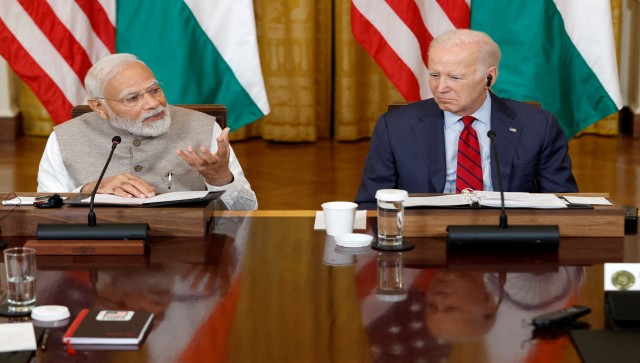
 "India must look beyond the China question to understand US' mixed signals")
The morning of November 30, 2023, was awkward for India-United States relations. Halfway across the globe in New York, the US District Court issued an indictment accusing an Indian government employee of directing a plot against the assassination of a US citizen and a Khalistani terrorist. But on the northeastern edge of the nation, the US Ambassador to India, Eric Garcetti, was seen enjoying the scenic landscapes of Arunachal Pradesh. While the first development risked a breakdown in the India-US ties, the latter was a welcome affirmation of India’s claims along the disputed boundary with China. Both events aptly summed up the India policy of the Biden administration: a policy of contradictions.
Though there have been more positives than negatives, the laundry list of contradictory actions sent under the Biden administration is so long that I cannot not think about Chinese political theorist and senior CCP politician Wang Huning’s Tocqueville-esque memoir America Against America (1991). Today, excessive decentralisation and openness in American institutions without a strong executive is hampering US foreign policy efficiency. A lack of policy coordination is sending mixed signals to allies and partners around the globe.
Take India’s example. On a fine morning breakfast, a senior US National Security Council official declares that bilateral relations with India were the most important. During the lunch, the US Department of State accuses India of democratic backsliding and purging free speech. For drinks, the US Department of Defense signs unprecedented deals with India to co-produce GE-404 jet engines and Stryker armoured vehicles. By dinner, officials posted at the US Commission on International Religious Freedom find alleged religious intolerance in India frightening. But all day, the US-India Business Council was proactive in networking with the scientific and business communities to make cooperation on trade and technology fruitful. In the after-party, the US Ambassador to India is upping his public relations game by X-ing about India’s culinary diversity and grooving on Bollywood numbers. Such are the mood swings of the American foreign policy establishment regarding India.
These contradictions have long permeated the government level and have seeped into civil society as well. India’s opinion in the US looks deeply divided today. While American investors and tech CEOs increasingly bet on India’s growth story, an NYT-WaPo column comes out every other week on the domestic politics and human rights in our ‘elected autocracy’. Even the Indian diaspora is not left out of this quandary. A 2020 study on Indian-American attitude by the Carnegie Endowment for World Peace finds that the partisan views on India’s domestic politics tend to mimic those within the diaspora communities in the US. It is no wonder that we see heightened socio-cultural consciousness in the resurgence of the conservative Hindu-American movement against caste-based legislations and a deracinated advocacy from some DC-based “India watchers” at the same time.
Quick Reads
View AllWhat should be made of these mixed signals coming out of the United States? A devil’s advocate would argue that is precisely how a liberal democracy should function. Freedom of expression and thought is a norm in the US, and it is acceptable for various interest groups to have conflicting interests. India is just another issue on which Americans are unable to agree. Some would argue that India is not unique. Even the Saudis are in the same boat, leading to their strategic diversification in China and Russia. The United States has historically had credibility issues, from South Vietnam to Afghanistan (and Ukraine in the pipeline). Further, it is a frequent meddler in the internal affairs of the Global South, neighbour Bangladesh being an example close home. But, I observe a transformational shift in the forces that shape US-India relations.
The fundamental conflict about India is between the material and ideological impulses of the American establishment. President Biden’s words from his inaugural speech are a living testimony of these contradictions, “We will lead not merely by the example of our power but by the power of our example”. The Biden administration has sought to apply the unipolar playbook of projecting military and economic power along with its self-exceptionalism and democratic zeal. But when it comes to India, this has utterly failed because the corresponding forces run contradictory to each other.
The India-US story looks bright when institutions like the Department of Defense, the military-industrial complex, and Silicon Valley drive the narrative. Their organisational interests are tied with America’s material interests of securing the Indo-Pacific, selling arms to India, and leading the innovation race with China, respectively. However, India becomes a lost cause when institutions batting for American exceptionalism take precedence. As a result, India’s democratic system and religious pluralism are condescended by them. Its concerns for territorial integrity and terrorism are dismissed in the name of free speech and the rule of law.
Similarly, India’s diaspora networks have gradually churned in the last ten years. In this period, the trust in top leadership of both countries has been at an all-time high. Unlike the Clinton-Vajpayee or Bush-Manmohan era, official communication is not significantly shaped by Track-II and backchannels anymore. The biggest losers in this development have been those groups who derived their credibility from cultivating trust in post-Pokhran and civil nuclear deal years. As India-US strategic partnership becomes comprehensive today, those interlocutors have been replaced by business, technology, and military-industrial elites.
The interests of the new professional elites are material and not affected by India’s domestic politics. When they see India, they see a market. However, the interests of old intellectual elites are ideological and closely tied with who rules India. The current government has sidelined them for various reasons, a mismatch of worldview being one. When Narendra Modi visits the US, he meets the CEOs, entrepreneurs and military contractors. When Rahul Gandhi visits the US, he visits think tanks, activists, and universities. The writing on the wall cannot be clearer. The material-ideational tussle can be observed in the diaspora as well.
What can New Delhi do in these circumstances? It has to be patient till a strong and realpolitik-driven President takes the Oval Office to ensure that material forces triumph over ideological ones in American institutions. Without a strong White House, some ideological US bureaucracies occasionally would emerge over their national interest of courting India. Nevertheless, India should selectively cultivate favourable entities such as the Department of Defence, the Military-Industrial Complex, Silicon Valley, the US-India Business Council, and the professional diaspora. The strategic objective should be to cultivate a strong Indian lobby in US politics, akin to the Irish or the Jews.
Then looms the larger strategic questions. Do we, in India, understand the US enough? How long can China be the sole driver of India’s relations with the US? To what extent India should adopt a competitive position against China depends strongly on the strategic trust it can place in the United States. Contradictory behaviour from the US would not adversely affect the ties. Still, it would imply that India can never, in theory, rule out the possibilities of rapprochement with China. My observations reflect only one reality: though China remains the biggest strategic challenge for India, the United States is the biggest intellectual challenge for our strategic community.
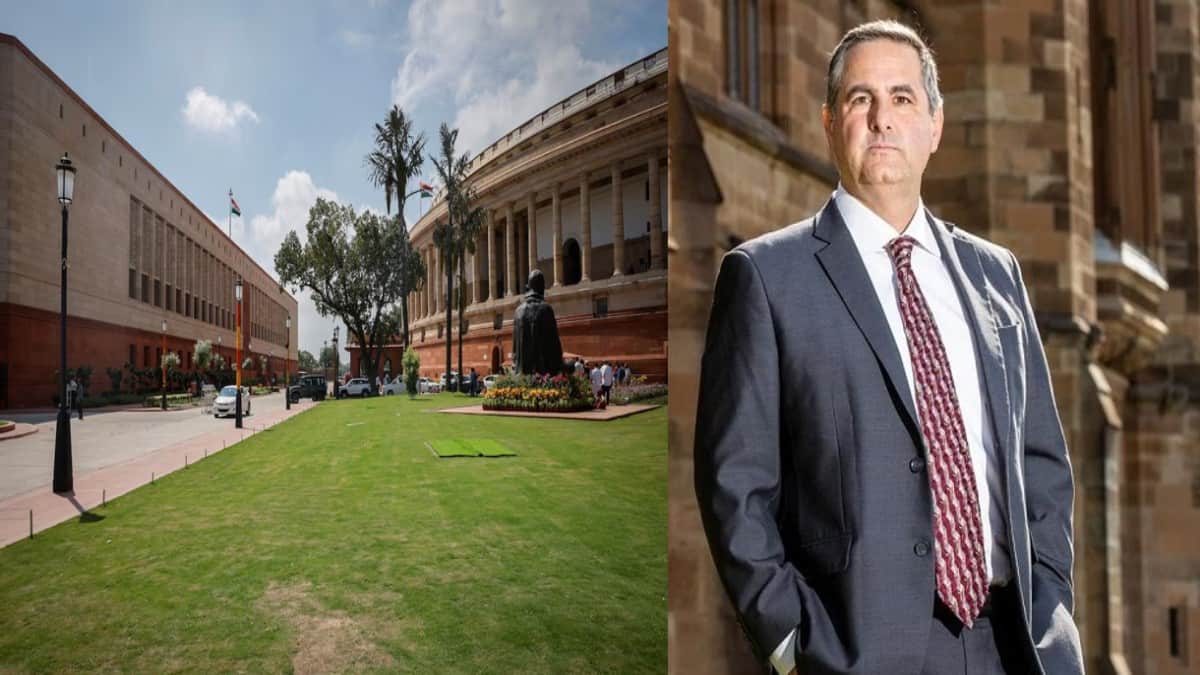
The author is currently pursuing PhD at Indiana University Bloomington and holds a B Tech in Electrical Engineering from IIT Delhi. He writes frequently on India-US relations. Views expressed in the above piece are personal and solely that of the author. They do not necessarily reflect Firstpost’s views.
Read all the
Latest News,
Trending News,
Cricket News,
Bollywood News,
India News and
Entertainment News here. Follow us on
Facebook,
Twitter and
Instagram.

 "'PM Modi a fantastic man... we're going to have a good deal': Trump tells Moneycontrol | Watch")
 "Greenland unveils 'crisis' guidelines as Trump renews call for talks on taking island")
 "Is Canada preparing for a US invasion as Trump unsettles allies? Report says...")
 "Trump says Ukraine war deal ‘reasonably close’, plans Zelenskyy meeting in Switzerland")
 "'PM Modi a fantastic man... we're going to have a good deal': Trump tells Moneycontrol | Watch")
 "Greenland unveils 'crisis' guidelines as Trump renews call for talks on taking island")
 "Is Canada preparing for a US invasion as Trump unsettles allies? Report says...")
 "Trump says Ukraine war deal ‘reasonably close’, plans Zelenskyy meeting in Switzerland")



