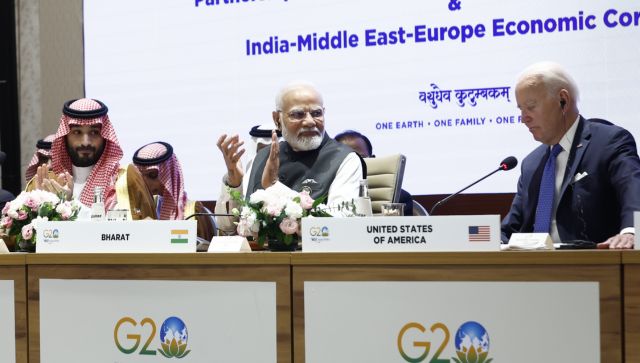
 "India-Middle East-Europe trade corridor is a great geopolitical idea, but it doesn’t make much economic sense")
In the last few days, there has been a fair bit of hype over the India-Middle East-Europe Economic Corridor (IMEC) — a transcontinental rail, maritime, energy and data network that aims to link Europe with India via the Arabian Peninsula that, at least on paper, is quite ambitious in scope, scale, and goals. It is time to make an objective assessment of the project.
It is being said that the massive trade and digital corridor, that was announced last week on the sidelines of the G20 summit in New Delhi by the leaders of the United States, India, Saudi Arabia, the United Arab Emirates, France, Germany, Italy and the European Union, is a “game changing regional investment” that may usher in “a new era of connectivity.”
Though concrete details of the IMEC are yet to take shape, preliminary aspects indicate that the infrastructure and connectivity project will comprise two separate corridors — the east corridor connecting India to the Arabian Gulf and the northern corridor connecting the Arabian Gulf to Europe.
It will be multimodal in nature, traversing a distance of over 3000 miles, and proposes to integrate the geopolitical and geoeconomic zones of Asia, Middle East (West Asia) and Europe, enabling smooth transition of goods and services to, from, and between India, the UAE, Saudi Arabia, Jordan, Israel, and Europe, as the White House stated in a memo shortly after the announcement.
The IMEC seeks to revive the ancient Red Sea route through which India and the Roman Empire traded spices, silk and wine in the 1st and 2nd century, CE, “with many hundreds of ships going in both directions each year”, as historian William Dalrymple says in an interview with Indian Express.
Quick Reads
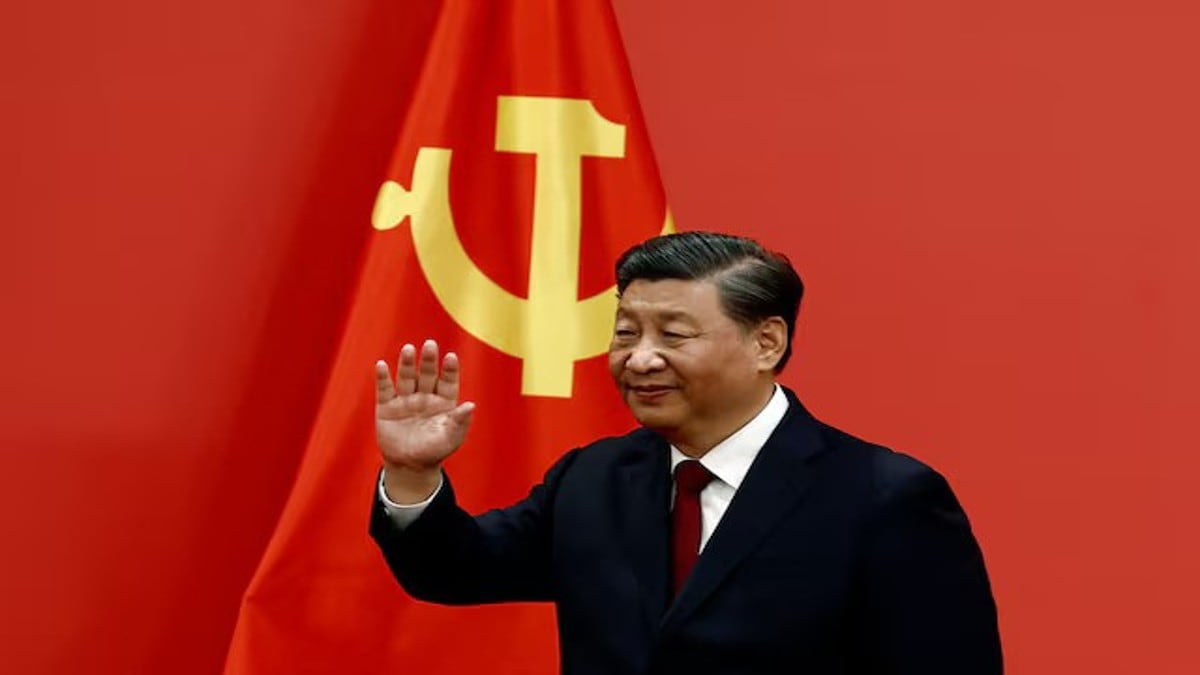
View AllWith its genesis in the Partnership for Global Infrastructure (PGII) launched by the G7 in June for “values-driven, high-impact, and transparent infrastructure… to meet the enormous infrastructure needs of low- and middle-income countries”, the geostrategic vision of this project is breathtaking. The motivation is clear. It is as much an “economic corridor” as a geopolitical one, challenging the supremacy of BRI, the Xi Jinping-led infrastructure project that spans the globe and has added to China’s hard and soft power.
An alternative to the current maritime trade conducted through the Suez canal, the idea of the IMEC is to generate economic activity by connecting continents and civilisations, and the stated objectives and promises are a laundry list from a genie’s wish-bag.
European Commission president Ursula von der Leyen announced that it would make trade between India and Europe 40% faster, and India, Arabian Gulf and Europe will be linked through railway network, electricity cable, clean hydrogen pipeline and “a high-speed data cable to link some of the most innovative digital ecosystems in the world and create business opportunities all along the way.”
Not holding back, the EU Commission chief said “this corridor is much more than ‘just’ a railway or a cable, it is a green and digital bridge across continents and civilisations.” Rhetoric isn’t in short supply.
To US president Joe Biden, “the corridor will secure regional supply chains, increase trade accessibility, improve trade facilitation, and support an increased emphasis on environmental social, and government impacts.” Not just that, it may “increase efficiencies, reduce costs, enhance economic unity, generate jobs, and lower greenhouse gas emissions.” In short, one corridor to solve all global problems.
That sounds a bit excessive. Until you observe the stated goal of the PGII partnership, of which the IMEC is a part, which is to “support the United States’ and its allies’ economic and national security interests.”
Though none of the participants would openly admit, the multinational rail and ports project is an obvious counter to China’s sprawling BRI — Xi’s geostrategic transportation megaproject that makes China the hub of global connectivity and commercial activity. Launched by Xi in 2013, the BRI in a decade has expanded to more than 150 countries including Africa, West Asia and Latin America, covering nearly 75% of the global population.
It has dished out billions of dollars in loans and grants to create a vast network of ports, railways, energy pipelines, power stations and highways to meet the infrastructure needs of low and middle-income nations, underwritten hundreds of special economic zones to create jobs, and in the process, has thrown a challenge to the Western rules-based order.
The pandemic and the war in Ukraine have made it clear to the West that China’s BRI, despite concerns over questionable financing and unsustainable debts, has got the ‘Global South’ on its side — countries that have fallen behind in the wake of globalization and have grown tired of the preachy, interfering West.
Something had to give. The US floated many stillborn ideas to counter BRI, seeking to fill the gap between the Global South’s infrastructure needs and responsible financing but all of it came to nought, with the Build Back Better plan, launched amid much fanfare in 2021 G7 Summit now pronounced “ officially dead.” It died even before it took off.
A similar fate befell European Union’s infrastructure drive ‘Global Gateway’, that was touted to be the “true alternative” to China’s BRI with “better and different offers” but one year since its announcement in December 2021, the ‘Global Gateway’ has little in term of concrete projects, if anything, to show for its grand claims.
This is where the IMEC fits in. What may make this project a success is that the aspirational Arabian Gulf has now been added as a stakeholder, a region that is seeking to diversify its economy away from solely energy to connectivity and future technologies. The IMEC also has its core pillar India, the world’s fastest growing large economy and the fifth largest global economy, poised to reach number three in a few years.
The IMEC is a veritable statement of optimism borne out of desperation. There are, however, crucial assessments to be made to match the hype with reality.
To begin, the IMEC won’t take off if it is presented as a counter to the BRI. The zero-sum game that such a framing inflicts won’t be well received by most stakeholders. China is an essential partner for nations in West Asia and is building interdependencies that are deep and enduring.
The Arbian Gulf won’t be pushed into alienating China. Countries such as Saudi Arabia and the UAE aim to reduce reliance on oil to develop new industries and spur job creation through an economic transformation.
And China is aiding that diversification, building space partnerships, brokering deals between geopolitical rivals such as Iran and Saudi Arabia, navigating the geopolitics while increasing business opportunities. Chinese tech giant Huawei, for instance, is building 5G networks and data centres despite American concerns.
In 2019, as an Atlantic Council piece observes, “China signed a $10 billion deal to develop a new industrial city in the UAE and has also been involved in major infrastructure projects in Saudi Arabia, such as the $10 billion Yanbu refinery.”
During Xi’s visit to Saudi Arabia last year, deals were signed between both sides worth $30 billion that would enable Huawei to provide cloud computing and high-tech complexes in Saudi cities while Saudi energy giant Saudi Aramco would be aided by China’s Shandong Energy “in the development of cooperation across hydrogen, renewables and carbon capture technologies.”
More recently, at the Saudi-China Business Forum held in Riyadh in August, both sides inked a “dozen cooperation agreements worth over $1.33 billion… bolstering collaboration in key sectors such as infrastructure, financing and housing.”
Both Saudi and the UAE have entered the non-western, China-dominated BRICS grouping this year and both nations are inking nuclear energy cooperation deals with China. In short, Beijing is deeply embedded in West Asia and has learnt to adapt to local laws, local actors, local contexts and navigating regional complications. It won’t simply be pushed out by a corridor.
There are more pressing logistical and security concerns. While the IMEC has been hyped to the sky, it is not clear whether it would be an economically viable project. Geopolitical justification and strategic interests in themselves cannot ensure the sustainability of a network this expansive, vast and complicated unless it has a strong economic logic.
Though the details would be fleshed out when IMEC partners meet within the next sixty days and develop an action plan, to substitute, or provide a feasible trade corridor to the Suez Canal, which handles roughly 10% of global maritime trade, will depend on a variety of factors — none of which seem favourable at this point.
To fructify estimates of trade between India and Europe becoming 40% faster due to the corridor — compared to the current system where Indian cargo is shipped directly to Europe through the maritime route or is transshipped via UAE’s Jebel Ali or major European ports before reaching its final destination — the IMEC must build railway networks through the Arabian desert. Typically, the containers sent from India would be taken off at a port in the UAE and then carried through the yet-to-be-built railway networks in Saudi Arabia and Jordan before ending up in Israel, where these would be transshipped from the Haifa port to destinations in Europe.
According to the global shipping community, this doesn’t sound like a good plan at all. If we add the port overheads, the building of land infrastructures that are not in place, complex issues related to local regulations and customs, not to speak of the multi-modal nature of the corridor, then the Suez Canal maritime route appears smarter despite rising costs and frequent disruptions.
Shippingwatch quotes Bimco’s chief shipping analyst, Niels Rasmussen, as saying, ”so far, only the planned route for IMEC is known. Transportation time, costs and capacity are not known… However, based on what we know, it seems likely that it will remain a niche product as it is hard to imagine that the capacity can compete with the ships sailing all the way from India. It should also be mentioned that port costs in Jebel Ali and Haifa will add to the cost of the product.”
The railway lines not just have to be freshly laid, the transportation through the land link should take less than six days, say industry operatives. From the analysts’ viewpoint, “ultimately, it’s the transportation customers who pay for the freight that decide which way the cargo travels… But from an isolated economic point of view, this route does not seem to make much sense.”
The project’s funding at this stage remains vague, and the demand for an alternative route unclear. Emil Avdaliani, professor at European University, writes in Silk Road Briefing, “New trade corridors are successful when basic infrastructure is already in place. In the IMEC’s case we see that in Greece (the closest EU ports to the IMEC), railways are poorly developed due both to mountainous geography and a lack of finances. In the Gulf region, Saudi Arabia and the UAE will require the construction of a railway network across deserts – substantially increasing the costs of the project.”
Apart from the logistical challenges, the IMEC may also face geopolitical complications. Saudi Arabia still does not officially recognize Israel. If the IMEC becomes operational, Egypt is likely to face massive revenue loss while Turkey’s president Recep Tayyip Erdogan has said the corridor won’t work if Turkey is bypassed. The transcontinental project may also face regulatory hurdles and challenges with coordination since so many stakeholders are involved.
Overall, the IMEC is an interesting idea — but shorn of geopolitics, it will require political will to match the promise with implementation.
Views expressed in the above piece are personal and solely that of the author. They do not necessarily reflect Firstpost_’s views._
Read all the
Latest News,
Trending News,
Cricket News,
Bollywood News,
India News and
Entertainment News here. Follow us on
Facebook,
Twitter and
Instagram.

 "India–EU FTA to benefit Rs 6.4 lakh crore exports across key states and sectors, says Piyush Goyal")
 "Will reset in Indo-Canada ties be complete with Carney's visit?")
 "Zelenskyy sets 2027 target for Ukraine’s EU accession, stresses security guarantees")
 "How Taliban's new criminal code legalises slavery, grants clerics immunity")
 "India–EU FTA to benefit Rs 6.4 lakh crore exports across key states and sectors, says Piyush Goyal")
 "Will reset in Indo-Canada ties be complete with Carney's visit?")
 "Zelenskyy sets 2027 target for Ukraine’s EU accession, stresses security guarantees")
 "How Taliban's new criminal code legalises slavery, grants clerics immunity")