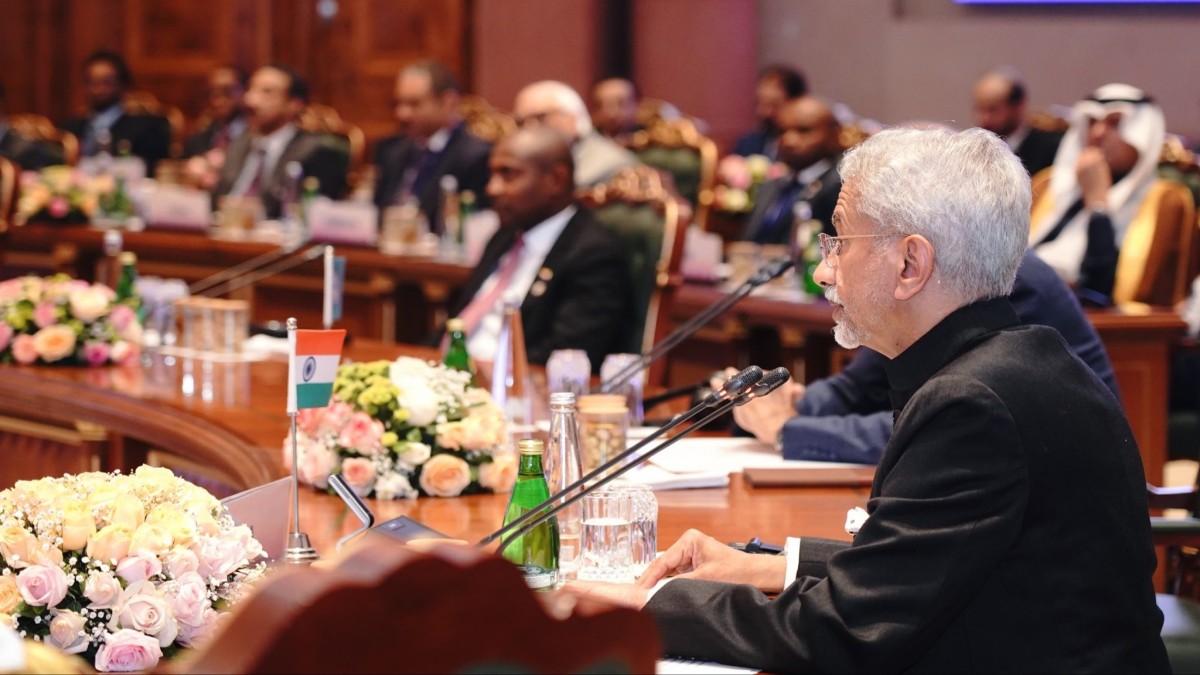
 "How India and Arab world cement civilisational ties for today’s challenges")
The second meeting of the Foreign Ministers of India and Arab countries (IAFMM) was held in New Delhi on January 31, 2026. Co-chaired by India and the UAE, the summit brought together representatives from all 22 Arab League nations and served as a critical strategic and diplomatic milestone for both regions.
It may be noted that the first meeting of Indian and Arab foreign ministers had been hosted by Bahrain in 2016. Against this background, the second meeting, held in New Delhi after a ten-year hiatus, holds both strategic and symbolic importance as it revitalises high-level institutional engagement between the two sides. By hosting this meeting, India solidified its role as a key Global South partner of Arab countries, positioning itself as a dependable actor for regional stability and economic resilience in an increasingly volatile global landscape.
The Arab region is a cornerstone of India’s foreign policy, serving as a vital partner in energy security, economic growth, and regional stability. Centuries-old civilisational ties form the bedrock of current relations. Trade routes dating back to the Indus Valley and Mesopotamian civilisations have established a legacy of mutual trust. India’s large Muslim population (the world’s second-largest) maintains deep religious ties to the Arab region through the Hajj and Umrah pilgrimages. Indian films, music, and yoga are highly popular across the Arab world.
The Arab world is one of India’s largest trading blocs, with bilateral trade exceeding $240 billion. Arab nations have committed billions to India’s infrastructure and renewable energy sectors, including a $75 billion investment commitment from the UAE. The India-Middle East-Europe Economic Corridor (Imec) aims to integrate India with global markets through Arab trade corridors.
The Arab region is vital for powering India’s rapidly growing economy. Over 60 per cent of India’s crude oil and more than 50 per cent of its LNG are sourced from members of the 22-nation Arab League. Iraq, Saudi Arabia, the UAE, Qatar, Kuwait and Oman are critical suppliers of crude oil and liquefied natural gas (LNG) to India. In this context, long-term deals are important. In February 2024, India’s Petronet LNG signed a historic long-term agreement with Qatar Energy for the import of 7.5 million metric tonnes per annum (MMTPA) of liquefied natural gas (LNG) until 2048. This deal ensures sustained energy stability.
Quick Reads
View AllKey Arab League nations are also major suppliers of India’s fertiliser requirements. Oman is India’s largest supplier of urea, accounting for roughly 46 per cent of its total urea imports. Much of this is supplied through the Oman India Fertiliser Company (OMIFCO) joint venture. Saudi Arabia is a major source of DAP (di-ammonium phosphate) and potash.
In July 2025, India signed a landmark 5-year agreement with Saudi mining giant Ma’aden to supply 3.1 million metric tonnes of DAP annually starting in FY26. Morocco is India’s primary supplier of phosphatic fertilisers. The Moroccan state-owned OCP Group has long-term agreements to supply millions of tonnes of DAP and TSP (Triple Super Phosphate) to India. Jordan, the UAE, Egypt and Qatar are also major suppliers of potash and nitrogen-based fertilisers, including urea.
Another important factor is the Indian diaspora in the Arab countries. This human link between the two regions is a significant pillar of the relationship. Over 9 million Indians live and work in Arab nations. The Indian diaspora sends home tens of billions of dollars annually, fortifying India’s foreign exchange reserves. Indians in the Gulf Cooperation Council (GCC) countries contribute roughly 38 per cent to 40 per cent of India’s total annual remittances, which amounted to over $135 billion in FY25. The security and wellbeing of these citizens are primary drivers of India’s diplomatic engagement with the region.
Security and geopolitics are increasingly becoming important factors in India’s relations with the Arab countries. Cooperation has shifted from a “buyer-seller” relationship to a deep security partnership in which counter-terrorism is an important issue. India collaborates closely with Saudi Arabia, the UAE, and Oman on intelligence sharing and curbing terror financing. Another important aspect is maritime security. India conducts regular bilateral naval exercises with several Arab nations to strengthen maritime security, interoperability, and defence cooperation in the Gulf and Arabian Sea region. Key partners include the UAE (Zayed Talwar Exercise), Saudi Arabia (Al Mohed Al Hindi Exercise), Qatar (Zair Al Bahar Exercise) and Oman (Naseem Al Bahar Exercise). The Indian Navy also maintains a year-round presence in the Gulf of Aden and the Gulf of Oman to protect vital sea lanes, with access to Oman’s Duqm port for military logistics.
India, too, has great importance as a partner for the Arab region, which is currently navigating a period of profound, multifaceted, and deeply challenging times, driven by a convergence of economic crises, geopolitical instability, climate change, and demographic pressures. The region is facing a “triple burden” of malnutrition, high inflation, and significant debt, which has severely impacted social safety nets and the livelihoods of millions. Arab League nations view India as a critical and indispensable partner due to its emergence as a global economic and technological power, its role as a stable anchor in a shifting international order, and deep-rooted civilisational ties.
The Arab region faces severe geopolitical dangers driven by the Israel-Hamas/Hezbollah conflicts, the resurgence of ISIS as a mobile insurgent force, and intensified Iran-US/Israel tensions, particularly risking Gulf oil infrastructure. Major threats include Houthi attacks in the Red Sea disrupting trade, severe water scarcity creating national security crises, and shifting regional alignments.
Against this background, the significance of the New Delhi meeting of the Indian and Arab Foreign Ministers is defined by several key outcomes:
Adoption of the “New Delhi Declaration”: This landmark document outlines a shared vision for a strategic partnership through 2030, emphasising mutual respect for sovereignty and territorial integrity.
Economic Ambitions: Leaders set a bold target to double bilateral trade to $500 billion by 2030. The launch of the India-Arab Chamber of Commerce, Industry and Agriculture further institutionalised this goal.
Security & Counter-Terrorism: Both sides affirmed a “zero tolerance” approach to terrorism in all forms. They specifically condemned cross-border terrorism and the misuse of new technologies (like drones) for terrorist activities.
Support for Palestine: India reiterated its unwavering support for a two-state solution and the establishment of a sovereign, independent State of Palestine based on the 1967 borders. Prime Minister Modi also welcomed the Gaza peace plan.
New Frontiers of Cooperation: The meeting expanded the partnership beyond traditional sectors (energy and trade) into modern domains like AI, space exploration, digital governance, and start-ups.
Executive Programme (2026-2028): A concrete roadmap was adopted to ensure continuous engagement, including plans for a Start-up Conclave, a Cultural Festival, and the first India-Arab Health Partnership Conference.
Summing up, the 2nd India-Arab Foreign Ministers’ Meeting (IAFMM) held in New Delhi on January 31, 2026, marks a historic revival of a key diplomatic platform after a ten-year hiatus. It solidifies India’s role as a key ally for Arab countries, positioning itself as a dependable partner for regional stability and economic resilience in an increasingly volatile global landscape. Several geopolitical, economic, and security challenges currently impact the partnership between India and the Arab League nations, but both sides want a “strategic reset” aimed at transforming traditional ties into a modern, multi-sectoral partnership.
(The writer is a retired Indian diplomat and had previously served as Ambassador in Kuwait and Morocco and as Consul General in New York. Views expressed in the above piece are personal and solely those of the author. They do not necessarily reflect Firstpost’s views.)

 "India, Israel elevate ties to special strategic partnership; PM Modi calls it ‘reflection of aspirations of both nations’")
 "India vs Zimbabwe LIVE Score, T20 World Cup 2026: Kishan falls for 38 after Abhishek completes fifty")
 "Who is Borge Brende, World Economic Forum chief who quit over Epstein files?")
 "US-Iran tension: Third round of nuclear talks begin in Geneva — can it avoid war?")
 "India, Israel elevate ties to special strategic partnership; PM Modi calls it ‘reflection of aspirations of both nations’")
 "India vs Zimbabwe LIVE Score, T20 World Cup 2026: Kishan falls for 38 after Abhishek completes fifty")
 "Who is Borge Brende, World Economic Forum chief who quit over Epstein files?")
 "US-Iran tension: Third round of nuclear talks begin in Geneva — can it avoid war?")