

 "How Ukraine crisis undermines nuclear non-proliferation regime and may lead to more countries developing nukes")
The nuclear dimension is back in the spotlight in the Ukrainian war but in a manner different from how deterrence was envisaged. The strategic concept of nuclear deterrence aimed at preventing war. It is the justification virtually every nuclear state uses for maintaining nuclear arsenals. There are many analysts who feel that nuclear deterrence prevented the outbreak of ‘hot war’ during the Cold War era in the West. The belief was that any nuclear attack would lead to massive nuclear retaliation and ‘mutually assured destruction’ — it thus helped avoid nuclear war and maintain peace. To quote General Rupert Smith from his seminal book, Utility of Force: “The introduction of nuclear power made industrial war practically impossible as a deciding event.” However, the Russian invasion of Ukraine is now leading to questioning of these beliefs. After the breakup of the Soviet Union in 1991, Ukraine had the third-largest nuclear arsenal in the world. Soviet strategic bombers and associated bombs and tactical nuclear weapons that were still under Moscow’s command and control were left on Ukraine’s territory. Ukraine had physical but no operational control. Russia controlled the codes needed to operate the nuclear weapons. Ukraine did not have the ability to use the weapons nor the facilities to store and maintain them. However, given time, Ukraine could have reverse-engineered the weapons, although at great expense. Instead, Ukraine used the Soviet nuclear weapons as a bargaining chip in negotiations for economic aid and security assurances that ultimately led to the 1994 Budapest Memorandum with Russia, the United States and the United Kingdom. As per this agreement, Ukraine renounced its nuclear weapons and the US, Russia and Britain guaranteed Kyiv’s territorial integrity. Russia and the other signatories pledged “to respect the independence and sovereignty and the existing borders of Ukraine”. In 2013, soon after President Xi Jinping assumed office, Beijing also became a party to this pledge. In a joint statement signed between Chinese President Xi Jinping and then Ukrainian President Viktor Yanukovych, China pledged “to provide Ukraine security assurances when Ukraine encounters an invasion involving nuclear weapons or Ukraine is under threat of a nuclear invasion.” [caption id=“attachment_9241031” align=“alignnone” width=“640”]
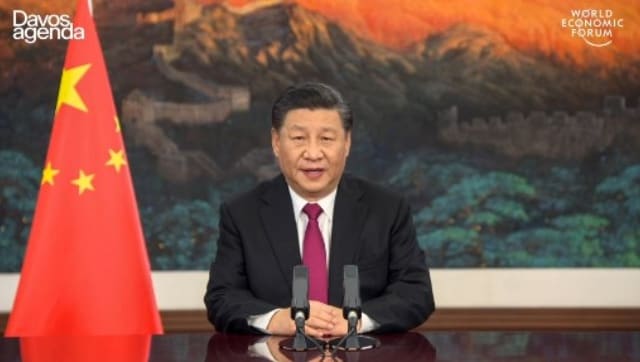 File image of Chinese President Xi Jinping. AP
[/caption] In 1950, for the first time post-Hiroshima, President Harry S Truman publicly stated that the use of nuclear weapons was under “active consideration” against Chinese targets during the Korean war. In 1953, President Dwight Eisenhower threatened the use of nuclear weapons to end the Korean war if the Chinese refused to negotiate. This was a period when US nuclear monopoly was largely intact. The first Soviet bomb test had been conducted in August 1949; the first Soviet airdrop would not be made until 1951 and China only conducted its first test in 1964. The armistice was signed in June 1953, three months after the death of Stalin but there are many who feel that the decisive threat contributed significantly.
***
Also Read **'West foolishly made Ukraine give up nuclear weapons, led it poke Russia with NATO expansion': Top political scientist** **Russia would only use nuclear weapons faced with 'existential threat', says Kremlin spokesperson** **Ukraine crisis: What might happen if the war spreads to a NATO country** **Joe Biden to visit Polish town near Ukraine border in show of solidarity against Russian invasion**
***
As per Fred Kaplan in The Bomb, Nixon “believed that North Korea called a truce to its three-year war because Eisenhower threatened to nuke China”; he “also believed that nuclear threats played a role in deterring China from attacking Quemoy in Taiwan and in forcing Khrushchev to back off in the 1961 Berlin crisis”. In 1968, Kissinger even issued a warning to a North Vietnamese delegation during peace talks in Paris but soon realised that “the Madman theory was not having any effect on the North Koreans and actually using nuclear weapons would be unacceptable”. The Cuban Missile Crisis in October 1962 is considered the closest the Cold War came to escalating into a full-scale nuclear war. It was a confrontation between the United States and the Soviet Union which escalated into an international crisis when American deployments of medium-range nuclear missiles, known as Jupiter, in Turkey were matched by Soviet deployments of similar ballistic missiles in Cuba. The crisis ended on 28 October when President Khrushchev announced that he was withdrawing his missiles. Within six months all the missiles had been withdrawn from Cuba and Turkey, a catastrophic crisis had been avoided and the powers had found a way to get out of the nuclear trap. In the Indian context on 10 December 1971, President Nixon took the decision to dispatch the US Navy’s 7th Fleet into the Bay of Bengal, officially to evacuate its citizens from East Pakistan (today’s Bangladesh) and unofficially to support Pakistan in its war efforts against India. This also included its nuclear-powered aircraft carrier USS Enterprise. In response to this move, the Soviet dispatched a naval task force from Vladivostok towards the Indian Ocean and Bay of Bengal. India due to this threat and China having become a nuclear power was compelled to take the nuclear route to ensure its security concerns having suffered a humiliating defeat against China in 1962. In the early stages of the Ukrainian invasion, Russian President Vladimir Putin repeatedly warned of Moscow’s nuclear capabilities, saying that they could escalate the conflict by resorting to weapons of mass destruction if Russia’s leadership perceived a threat to its existence. While Russia does possess a vast nuclear arsenal, it is unlikely that it will use nuclear weapons against Ukraine. President Vladimir Putin’s threats of nuclear use is aimed at deterring the Western nations from coming to the aid of Ukraine. Though his order to put Russia’s nuclear deterrence forces “on high alert” raised the shadow of an existential threat. [caption id=“attachment_10423521” align=“alignnone” width=“640”]  Russian president Vladimir Putin. AP File[/caption] The possession of nuclear weapons has been one of the ultimate bargaining tools in international diplomacy. According to the Stockholm International Peace Research Institute, as of 2021, nine countries were said to be classified as nuclear-armed states. These are in descending order of nuclear warheads per country: Russia – 6,375 nuclear warheads; United States of America – 5,800 nuclear warheads; China – 320 nuclear warheads; France – 290 nuclear warheads; United Kingdom – 215 nuclear warheads; Pakistan – 160 nuclear warheads; India – 135 nuclear warheads; Israel – 90 nuclear warheads; and, North Korea is estimated to have 30-40 nuclear warheads. The figures for North Korea are SIPRI’s estimates of the number of warheads that North Korea could potentially build with the amount of fissile material it has produced. Five of these counties (Russia, USA, France, China and the UK) join a further 186 non-nuclear-weapon States to have signed the 1968 Treaty on the Non-Proliferation of Nuclear Weapons (NPT). The treaty is based on an informal agreement between nuclear and non-nuclear states: That non-nuclear states agree to never acquire nuclear arsenals, while nuclear states agree to pursue nuclear disarmament, with the long-term aim of eliminating nuclear weaponry. The NPT is a legally-binding instrument that recognises only five countries as legitimate holders of nuclear weapons: China, France, Russia, the UK and the US. All other countries are banned from developing a nuclear arsenal and those that have, including India, Pakistan, Israel and North Korea, are not parties to the NPT. Under the Budapest Agreement Ukraine was given “security assurances” in exchange for its adherence to the Treaty on the Non-Proliferation of Nuclear Weapons. The Ukrainian conflict has clearly brought to the fore the glaring inequalities between these five countries and the rest. For Ukraine, the NPT is but a worthless piece of paper as Russia has used the threat of nuclear weapons to prevent the Western powers from coming to its aid. In the India-Pakistan context, Pakistan has endeavoured to compress the conventional space by its deterrence by nuclear weapons and has concentrated on engaging India in the sub-conventional space often through proxies. In February 2016, Russian Foreign Minister Sergey Lavrov claimed, “Russia never violated the Budapest memorandum. It contained only one obligation, not to attack Ukraine with nukes.” War forces one to accept certain realities and the reality regarding nuclear weapons is clear: “Russia has used nuclear deterrence to provide it the freedom for conventional operations.” Their actions have weakened the credibility of major power security assurances, undermined the nuclear non-proliferation regime and will lead to more countries developing and declaring their nuclear arsenals for the security it provides. The author is an Army veteran. Views expressed are personal. Read all the Latest News , Trending News , Cricket News , Bollywood News , India News and Entertainment News here. Follow us on Facebook, Twitter and Instagram.


 "Russian drones over Poland: Trump’s tepid reaction a wake-up call for Nato?")
 "As Russia pushes east, Ukraine faces mounting pressure to defend its heartland")
 "Why Mossad was not on board with Israel’s strike on Hamas in Qatar")
 "Turkey: Erdogan's police arrest opposition mayor Hasan Mutlu, dozens officials in corruption probe")
 "Russian drones over Poland: Trump’s tepid reaction a wake-up call for Nato?")
 "As Russia pushes east, Ukraine faces mounting pressure to defend its heartland")
 "Why Mossad was not on board with Israel’s strike on Hamas in Qatar")
 "Turkey: Erdogan's police arrest opposition mayor Hasan Mutlu, dozens officials in corruption probe")



](https://images.firstpost.com/wp-content/uploads/2021/01/Xi-Jinping-640.jpg)
](https://images.firstpost.com/wp-content/uploads/2022/03/putins1.jpg)