

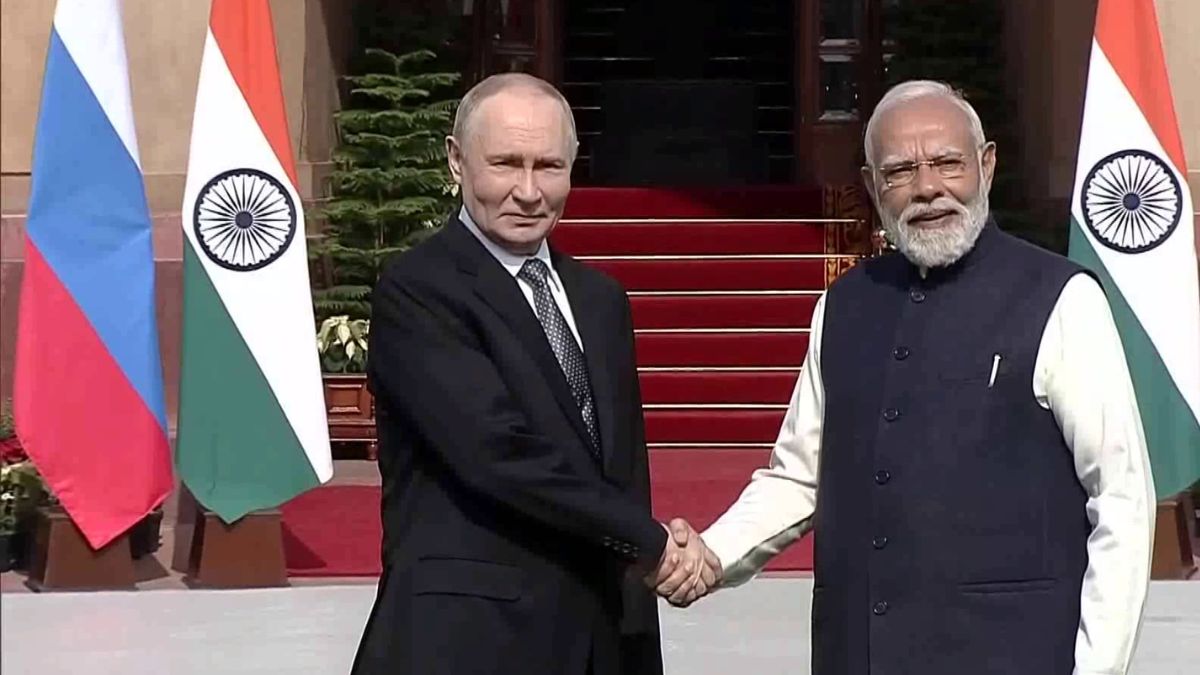
 "How Modi and Putin re-energised India-Russia multilateral cooperation")
The India-Russia partnership is truly multi-dimensional, covering bilateral, regional, and global facets of cooperation and diverse domains of human endeavour, ranging from commerce, culture, and science and technology to nuclear, space, defence, and energy cooperation. But the focus on the bilateral aspects of the relationship should go hand in hand with an awareness of what the two nations have been accomplishing in various multilateral organisations. This latter aspect adds to the significance of the decades-old collaboration between the world’s largest country by landmass (Russia) and the world’s most populous country (India).
The intergovernmental dialogue leading up to President Vladimir Putin’s visit to India (4-5 December) and his discussions with Prime Minister Narendra Modi during his two-day stay in New Delhi appeared to devote considerable time to issues of multilateral cooperation. The joint statement issued by the two leaders on 5 December asserted: “Development of Russia-India relations across the entire spectrum is a foreign policy priority.” This outcome document comprises 70 paragraphs, of which 17 (i.e., 24 per cent) are devoted exclusively to cooperation in the UN and multilateral fora.
The nature and scope of cooperation in various multilateral institutions, which often finds Russia and India pursuing the same causes and goals, are wide-ranging.
The United Nations
For many decades after India’s independence, the country was placed in a paradoxical situation. It was widely hailed as a principal leader and champion of the UN, but in the context of the Security Council’s work on the Jammu and Kashmir question, India found itself in the dock thanks to the unholy collaboration between the West and Pakistan. In that complex situation, leading up to the liberation of Bangladesh in 1971 and thereafter, New Delhi banked confidently on Moscow’s solid support, which was crucial because the Soviet Union/Russia held the veto power as a permanent member of the Security Council. This alone earned enormous trust and appreciation in India for Soviet/Russian support, and there were, of course, other reasons as well.
In the current situation, similarities in perceptions of the two countries on the UN still remain striking. Both are committed to “reinvigorating multilateralism, with a central coordinating role played by the UN”; both advocate “comprehensive reform” of the Security Council; and Russia expresses “steadfast support” for India’s permanent membership of a reformed and expanded Security Council.
G20
In the wake of a serious controversy and public dispute that emerged between the US and South Africa as the latest G20 Summit ended in Johannesburg on 23 November, the adroitly crafted formulation in Paragraph 44 of the India–Russia joint statement deserves a close look. In two statements issued by the US president and the secretary of state, Washington listed reasons related to Pretoria’s internal policies and its handling of the G20 presidency to announce that South Africa would not be invited to next year’s summit, hosted by the US. The South African president rejected the US arguments while asserting that his country was still open to dialogue.
The joint statement takes a principled position while keeping ample room for negotiating a reconciliation between the US and South Africa, if the two sides are willing to seek it. In two simple sentences, it makes three clear points. One, the G20 is the premier international economic forum meant for dialogue between emerging and developed economies on “equal and mutually beneficial footing”. Two, India and Russia stand for “the continued and productive functioning of the G20”. Three, the forum must continue to operate on the basis of “consensus and focusing on its key mandate”.
Quick Reads
View AllObservers are now debating what happens next. The US is set to host the first G20 Sherpa meeting in Washington on 15-16 December. The South African sherpa has not been invited. Will the sherpas of the African Union, of the two members of IBSA (India and Brazil), and some BRICS members such as Russia and China, attend and go along with the US position, or will they, possibly with the assistance of the UK and South Korea, the presidency countries for 2027 and 2028 respectively, try to re-establish the unity of the G20? We shall know soon.
BRICS and SCO
While BRICS rated only one paragraph, four paragraphs were devoted to the SCO. This perhaps indicates that the two countries are happy with their cooperation within BRICS, but they need to work harder to achieve greater convergence within it. This aligns with India’s perception of itself as an outlier in the SCO, where Russia, China, and the Central Asian states often hang together on a range of issues. The need to expand India-Russia cooperation within the SCO was explicitly stated in the joint statement: “The Sides reiterate the importance of their joint work within the framework of SCO for further deepening the Special and Privileged Strategic Partnership between Russia and India.”
Another favourite Indian idea won Russian support, namely the necessity of promoting the “modernisation of SCO” in such fields as countering terrorism, extremism, separatism, drug trafficking, cross-border organised crime, and information security threats. New Delhi has been keen on the acceptance of English as a working language within the SCO, but it failed to secure Russia’s public support for it during Putin’s visit.
Other bodies and issues
India and Russia also agreed to strengthen their cooperation in other regional fora, such as the East Asia Summit, ASEAN Regional Forum, and Asia Defence Ministers’ Meeting Plus, without providing any specifics. References to other institutions, such as the UN Committee on the Peaceful Uses of Outer Space, the Convention on Biological Weapons, and the conventions on biological diversity, revealed the range of cooperation between the two nations. In addition, Russia has already adopted the framework agreement to join the International Big Cat Alliance, at India’s initiative. Further, India’s suggestion to Russia to join the International Solar Alliance and the Coalition for Disaster Resilient Infrastructure is also receiving favourable consideration by the Russian side.
Conclusion
To deepen their cooperation in multilateral fora, the Indian and Russian leaders provided a strategic framework. They identified common themes and goals to be pursued in a coordinated, effective manner. The list of priorities includes reformed multilateralism; reform of international economic governance institutions, including multilateral development banks; relentless pursuit of Sustainable Development Goals; enhancing the sustainability and resilience of international supply chains, including critical minerals; free and fair trade; and climate change.
It is indeed an ambitious agenda. Some success has been achieved, but more is needed. Persistence and sharp-eyed coordination and supervision from both ends — Delhi and Moscow — are essential for achieving what the leaders have set as key tasks before their diplomats, officials, and ministers.
Finally, those who paint Russia as “a junior partner to China” and India as “a middle power” should take note that Russia and India perceive and project themselves as “major powers”. A concluding paragraph states: “They stressed that Russia and India as major powers will continue to strive for global peace and stability in a multipolar world as well as a multipolar Asia.” The last three words were meant especially for Beijing.
(Rajiv Bhatia is a Distinguished Fellow at Gateway House, with extensive diplomatic experience in regional and global groupings, and the author of three books on Indian foreign policy. The views expressed in this article are those of the author and do not represent the stand of this publication.)

 "What the dramatic US seizure of Venezuela-linked oil tanker tells us")
 "Should Ukraine concede territory to Russia? Zelenskyy wants Ukrainians to vote in referendum")
 "Who is Kilmar Ábrego García, the man ‘mistakenly’ deported by US, now freed?")
 "Trump's new tax guidance could let companies save billions more")
 "What the dramatic US seizure of Venezuela-linked oil tanker tells us")
 "Should Ukraine concede territory to Russia? Zelenskyy wants Ukrainians to vote in referendum")
 "Who is Kilmar Ábrego García, the man ‘mistakenly’ deported by US, now freed?")
 "Trump's new tax guidance could let companies save billions more")



