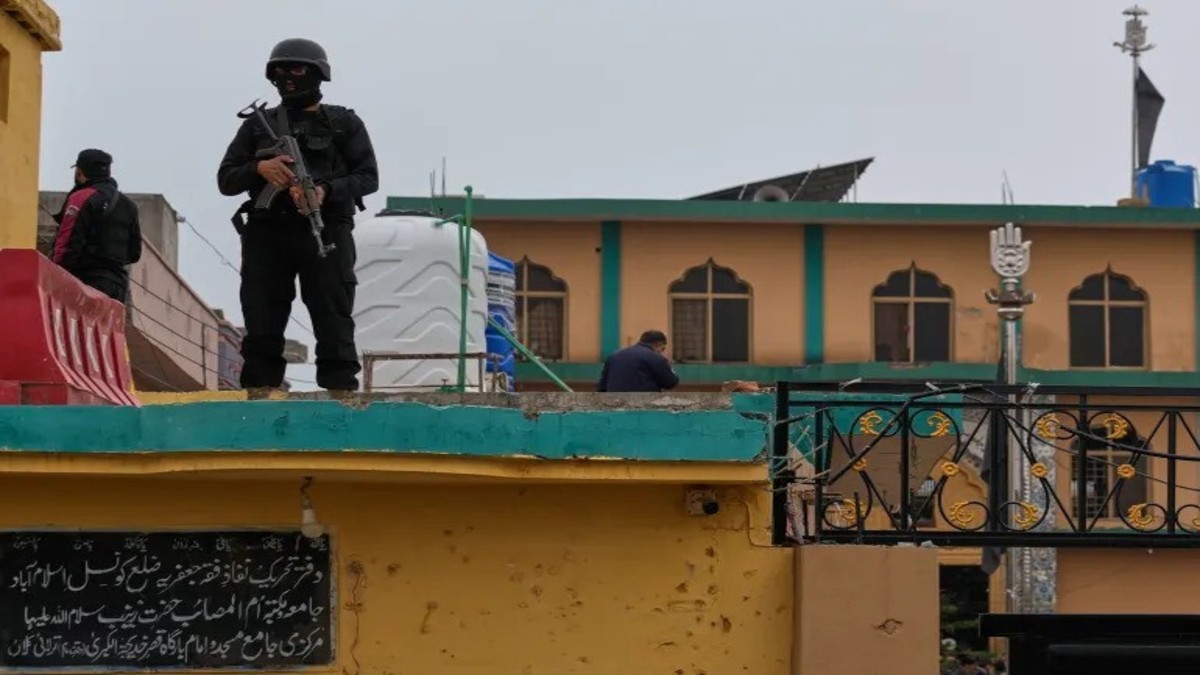
 "How Islamabad Shia mosque bombing fits Pakistan’s history of manufactured crises")
On February 6, 2026, a devastating suicide bombing ripped through the Khadija Tul Kubra Mosque in Islamabad’s Tarlai Kalan area during Friday prayers, killing at least 31 people and injuring over 169 others. The attack, targeting a Shia mosque, marked one of the deadliest incidents in Pakistan’s capital in recent years, evoking memories of past sectarian violence like the 2023 Peshawar mosque blast.
While no group immediately claimed responsibility, initial reports pointed to a lone suicide bomber who detonated explosives after being stopped by security at the mosque’s gate. In the immediate aftermath, Pakistani officials condemned the act as terrorism, with international reactions pouring in, including a strong denunciation from India, which rejected any attempts by Pakistan to externalise blame.
Yet, amid the grief and chaos, a darker narrative has emerged in online forums, geopolitical analyses, and whispers among regional observers.
Could this tragedy have been orchestrated by elements within Pakistan’s own military establishment, specifically under the direction of its Army Chief General Asim Munir, as a calculated ploy to deflect international pressures and stoke regional tensions? The theory posits that the bombing was engineered to pin the blame on Afghanistan’s Taliban regime and Indian intelligence, thereby justifying low-level skirmishes along the borders.
This, in turn, would serve as a convenient excuse for Pakistan to sidestep deeper involvement in the escalating Gaza conflict, where Western and Arab allies have reportedly been urging Islamabad to contribute troops or resources. While this remains speculative and unsubstantiated by official evidence, it draws on a pattern of alleged military manipulations in Pakistan’s history, raising uncomfortable questions about the army’s role in national and international affairs.
The Theory: A Manufactured Crisis to Evade Gaza Entanglements
At its core, the theory suggests that General Asim Munir, who has navigated Pakistan through economic turmoil and border insecurities since assuming command in late 2022, may have authorised a “false flag” operation to redirect attention. Proponents argue that by framing the attack as the work of Afghan-based militants (such as the Tehrik-I-Taliban Pakistan or ISIS-Khorasan) with supposed Indian backing, Pakistan could escalate confrontations along the Durand Line with Afghanistan and the Line of Control with India. This would create a domestic rally-around-the-flag effect, bolstering military prestige while providing a pretext to refuse deeper commitments in the Middle East.
Quick Reads
View AllWhy Gaza? Pakistan has long positioned itself as a staunch supporter of Palestine, with public sentiment fiercely anti-Israel. However, reports from 2025 indicate subtle pressures from Saudi Arabia and the United States for Pakistan to join multinational efforts in Gaza, possibly through troop deployments or logistical support under the guise of humanitarian aid. Munir, critics claim, views such involvement as a quagmire that could drain resources needed for domestic stability and border defences. By engineering a homegrown crisis, the army could claim its hands are tied, prioritising “national security” over foreign adventures.
This narrative gained traction online shortly after the blast, with social media users and analysts pointing to Pakistan’s history of blaming external actors for internal woes. For instance, in late 2025, Munir publicly warned the Taliban to choose “peace or chaos” amid airstrikes on Afghan soil following attacks in North Waziristan, which Pakistan attributed to cross-border militants. Similarly, accusations against India have been rote: after a suicide bombing in Waziristan, Pakistani forces accused New Delhi of involvement, a claim India dismissed as “delirious”. In the context of the Islamabad bombing, some theorists link it to these patterns, suggesting the attack’s sectarian nature (Shia targeting) was chosen to mimic ISIS-style operations, easily attributable to Afghan havens allegedly supported by Indian RAW intelligence.
Sceptics counter that this theory lacks concrete proof and ignores genuine sectarian tensions within Pakistan. Groups like Lashkar-e-Jhangvi or TTP have a track record of anti-Shia violence without needing military orchestration. Moreover, India and Afghanistan have their own incentives to deny involvement, with Kabul rejecting Pakistani airstrikes as violations of sovereignty. Nonetheless, the theory persists, fuelled by Pakistan’s opaque military decision-making and Munir’s reputation as a hardliner who has clashed with civilian leaders.
Historical Precedents of the Pakistani Military Scripting Its Own Dramas
If the Islamabad bombing theory holds any water, it wouldn’t be the first time allegations of self-inflicted wounds have surfaced against Pakistan’s army. Critics often describe the military as a “state within a state”, willing to engineer crises to secure public endorsement, Western aid, and internal dominance. Below is a list of notable incidents where the Pakistani military or its intelligence arm, the ISI, has been accused of staging or exacerbating attacks on its own soil or people, often to blame external enemies and rally domestic and international backing. These claims, drawn from declassified documents, journalistic investigations, and academic analyses, remain contentious, with Pakistan denying them as propaganda.
Mangla Dam Displacement (1960s): There is evidence of the Pakistani establishment having played a clear hand in the engineered eviction of ~100,000 and the forced disappearance of many who resisted the setting up of the Mangla hydropower dam. With natural resources of Pakistan-occupied Jammu and Kashmir (PoJK) being exploited, little benefit was directed towards the development of the region, with major power exported to Punjab. This dissatisfaction even fuelled protests where forces killed civilians (eg, 8 in 2024-2025 clashes).
Operation Searchlight (1971): In a brutal crackdown on Bengali nationalists in East Pakistan (now Bangladesh), the army launched a campaign that killed thousands, including intellectuals and civilians, while framing the violence as a response to “Indian-backed” separatism. Reports indicated that the military exaggerated or staged initial incidents, like anti-Bihari violence, to justify the genocide, which ultimately led to the 1971 war with India. This “Hollywood script” secured US support during the Cold War but backfired, resulting in Pakistan’s bifurcation.
The 1971 Indian Airlines Hijacking: Orchestrated by Kashmiri militants with ISI backing, the hijacking of a plane to Lahore was hailed by Zulfikar Ali Bhutto as heroic but later revealed as a false flag to disrupt Indo-Pak talks and blame India for escalating tensions. It provided a pretext for banning Indian overflights, straining relations and winning domestic applause for “defending” Kashmir.
Black September (1970): Under Brigadier Zia-ul-Haq (later army chief and president), Pakistani troops aided Jordanian forces, as per reports, in massacring up to 25,000 Palestinians, framing it as countering “terrorist” threats. This mercenary-like intervention, while not on Pakistani soil, showcased the army’s willingness to slaughter civilians for foreign patrons, boosting its image as a reliable anti-communist force for the West.
Sectarian Violence in the 1980s-90s (Operation Topac and Beyond): Under Zia-ul-Haq, the ISI allegedly armed Sunni militant groups to target Shias, creating chaos blamed on Iran or India to justify military rule and secure U.S. funding during the Afghan jihad. This “engineered” sectarianism won Western endorsement as part of the anti-Soviet effort but devastated Pakistani society.
Balochistan Insurgency Operations (2000s-Present): Accusations abound that the army stages attacks on its own installations or civilians to blame Baloch separatists, justifying crackdowns and resource extraction. Human rights groups claim “kill-and-dump” policies mimic terrorist acts, rallying public support against “foreign-funded” rebels while attracting aid from China and the U.S.
The 9th May 2023 Events: Framed as riots by Imran Khan supporters, some analysis suggests military provocation to discredit civilians and consolidate power, akin to a false flag to win international sympathy against “instability”.
These incidents, while disputed, illustrate an alleged pattern: the army uses violence as a tool to manipulate narratives, secure budgets, and maintain control, often at the expense of its citizens.
Pakistan’s Army as a Modern East India Company
To understand why such theories persist, one must contextualise the Pakistani Army’s evolution. Born from the British Indian Army in 1947, it inherited a colonial structure but morphed into something more akin to the British East India Company (EIC), a corporate military entity that effectively owned and ran vast territories for profit. The EIC, with its private army, colonised India through trade, conquest, and divide-and-rule tactics, prioritising shareholder interests over native welfare. Similarly, Pakistan’s military controls an economic empire through entities like the Fauji Foundation and National Logistics Cell, owning businesses from cereals to real estate, generating billions while the civilian economy falters.
This “army that owns a country” acts as a mercenary for hire, deploying troops to Saudi Arabia (1979 Grand Mosque seizure), Bahrain (2011 protests), and even Zimbabwe for training gigs. During the Cold War, it fought US proxies in Afghanistan. Today, it balances ties with Washington, Beijing and Riyadh for aid and arms. Critics argue this hangover from colonial mercantilism explains the army’s propensity for engineered crises. They sustain the institution’s power, attract foreign patronage, and suppress democratic accountability. And worst of all, the collective civilian society of Pakistan, in its indoctrinated and conditioned hate of India and others, fails to hold the military establishment accountable, as it recognises it as a necessary evil to fend off against India.
In conclusion, while the Islamabad bombing theory remains unproven, it underscores deep-seated distrust of Pakistan’s military. Whether fact or fiction, it highlights the perils of an institution that, like the East India Company, prioritises self-preservation over the people it claims to protect.
(The author is the co-founder of Indic Society. Views expressed in the above piece are personal and solely those of the author. They do not necessarily reflect Firstpost’s views.)

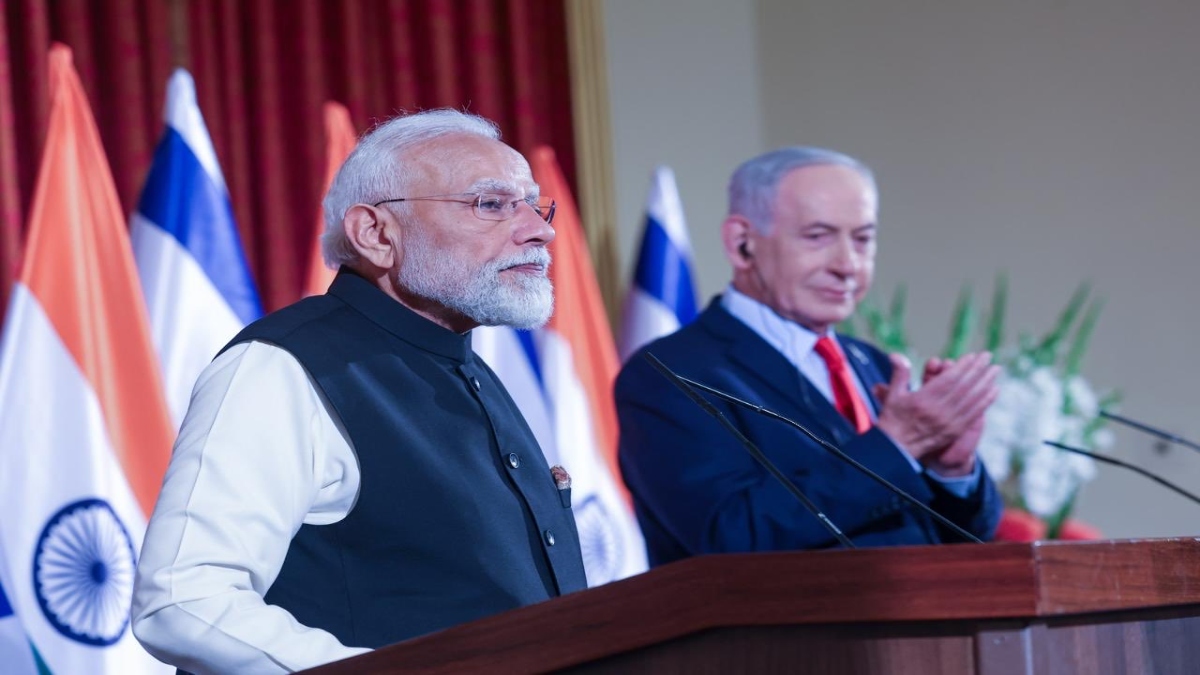 "India, Israel elevate ties to special strategic partnership; PM Modi calls it ‘reflection of aspirations of both nations’")
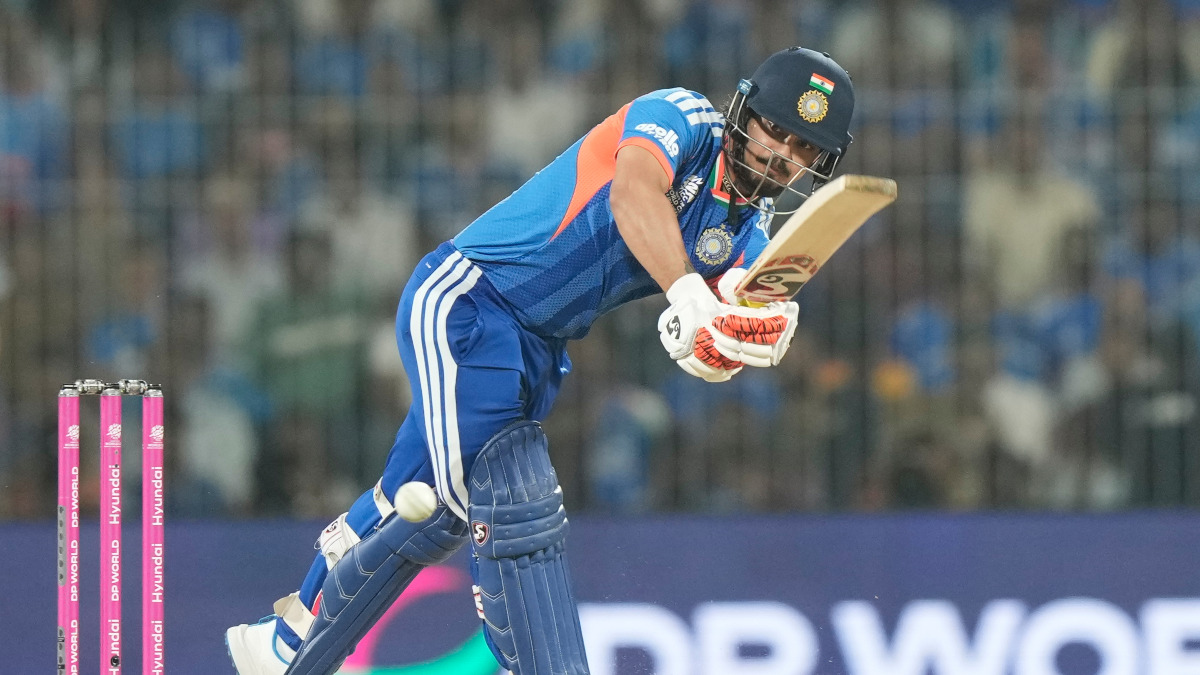 "India vs Zimbabwe LIVE Score, T20 World Cup 2026: Kishan falls for 38 after Abhishek completes fifty")
 "Who is Borge Brende, World Economic Forum chief who quit over Epstein files?")
 "US-Iran tension: Third round of nuclear talks begin in Geneva — can it avoid war?")
 "India, Israel elevate ties to special strategic partnership; PM Modi calls it ‘reflection of aspirations of both nations’")
 "India vs Zimbabwe LIVE Score, T20 World Cup 2026: Kishan falls for 38 after Abhishek completes fifty")
 "Who is Borge Brende, World Economic Forum chief who quit over Epstein files?")
 "US-Iran tension: Third round of nuclear talks begin in Geneva — can it avoid war?")