

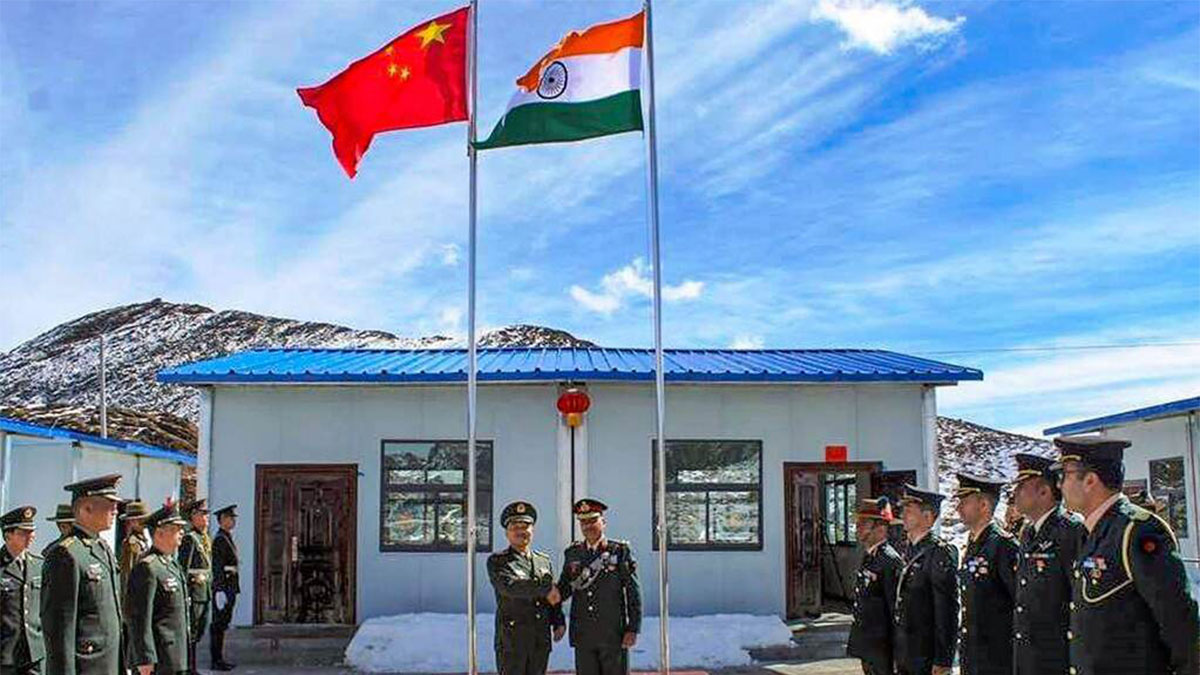
 "How India can counter China’s sinister renaming of Tibetan places")
Beijing has done it again. China’s Ministry of Civil Affairs has so-called ‘standardised’ the names of 27 places in Zangnan, an abbreviation of (Xi)Zang and ‘Nan’ (south in Mandarin), ie, Southern Tibet. In recent years, Beijing has started using this term for the Indian state of Arunachal Pradesh. For Beijing, Zangnan is itself part of the Xizang Autonomous Region, Xizang being the Chinese name for ‘Tibet’.
Is this name changing not confusing?
It is probably Beijing’s main purpose to bring confusion.
The renamed 27 places (released ‘in accordance with regulations on geographical names issued by the State Council – China’s Cabinet’) cover geographical features: 15 mountains, five residential areas, four mountain passes, two rivers and one lake.
As earlier, each location is given in Chinese characters, Tibetan, and pinyin – the romanised spelling of Mandarin Chinese – with latitude and longitude coordinates and a high-resolution map.
But what is Beijing’s ultimate purpose?
It was probably an indirect way to show sympathy with Pakistan when it was facing a near-war situation with India.
India’s Reaction
On May 14, 2025, in response to media queries on the renaming of places in Arunachal Pradesh by China, the Spokesperson of the Ministry of External Affairs, Randhir Jaiswal, said, “We have noticed that China has persisted with its vain and preposterous attempts to name places in the Indian state of Arunachal Pradesh. Consistent with our principled position, we reject such attempts categorically. Creative naming will not alter the undeniable reality that Arunachal Pradesh was, is, and will always remain an integral and inalienable part of India.”
Impact Shorts
More ShortsRenaming is Not New
Renaming places is not new. It has been done by all colonisers; India still remembers the British days.
China has done it in a more systematic manner. After it invaded Tibet in 1950-51, Shigaste became Rìkazé or Xigatse, Sakya was Sa’gya, Metok, north of Arunachal’s Upper Siang district, Mutao or Medog.
Apart from the cases of pure pinyinisation like the ones just mentioned, in many cases, names have been completely changed. Ngari province is now called Ali Prefecture (perhaps due Chinese faulty pronunciation who can’t pronounce ‘Ng’ and ‘r’); Kyirong at the border with Nepal is now Jilong, and worse, Barahoti in today’s Uttarakhand is called Wuje, while Demchok in Ladakh is termed Parigas.
First Renaming in Arunachal Pradesh
In 2017 already, the Chinese Cabinet had announced the ‘standardised names’ for six places in Arunachal Pradesh. At that time, it looked like a childish reaction to the Dalai Lama’s visit to the state a month earlier.
The official names of the six places (transcribed in the Roman alphabet) were Wo’gyainling, Mila Ri, Qoidengarbo Ri, Mainquka, Bumo La and Namkapub Ri. Let us have a look at a couple of them.
Wo’gyainling is the new spelling for Urgyeling, the birthplace of Tsangyang Gyaltso, the Sixth Dalai Lama, a few kilometres south of Tawang town. One understands the political reasons why China would be so attached to the place. Beijing was not ready to accept that a Dalai Lama could be born outside Tibet. The situation has become more acute today with the recent announcement by the Dalai Lama that he will be reborn in the ‘free world’.
Another place was Qoidengarbo Ri, for ‘Chorten Karpo’ or ‘White Stupa’. It refers to Gorsam Chorten, the only large white stupa in the area (and the largest in Arunachal). It is not far from Zimithang, the tactical headquarters of the 4th Infantry Division during the 1962 war. The name ‘Ri’ or ridge in Tibetan, may refer to one of the ridges around the stupa.
China knows that the Indian media will jump on this type of ‘scoop’.
This is fine; one can consider it as part of the Information Warfare (IW) against India, but the Indian media should just be aware of it.
The Case of Sakteng in Bhutan
In the map recently released with the 27 new names, China seems to have relinquished a claim on Sakteng, a Bhutanese area adjacent to the West Kameng district of Arunachal Pradesh. Does it signal that Sakteng has now been accepted as part of Bhutan by China and that Beijing does not claim the place anymore? In itself it is good, but if it is part of a ‘package deal’ between China and Bhutan sometimes mentioned in the Indian press, it has other implications. Has a deal been arrived at or is such a deal in the pipeline? Only the future will show.
Reaction from Arunachal MP
In the meantime, Tapir Gao, the BJP member of parliament (MP) for Arunachal East constituency, slammed China for changing the names and urged Delhi to take steps to “correct historical wrongs” by reclaiming areas inhabited by Lhoba Tani and Mishmi communities beyond the McMahon Line. He said that these communities living north of the Line share “deep civilisational roots with Bharat”, and it’s time for India to reclaim the regions “that are rightfully part of our country”. Gao further stated, “China can rename mountains and rivers as much as it wants, but it cannot rewrite history…it is a deliberate and politically motivated attempt to distort geographical and cultural facts.” Gao has a point.
India Could Claim More
In this context, it is interesting to look at the discussions held in London, Delhi and Lhasa to fix the Red Line between India and Tibet in 1912-1914 and the different arguments used to arrive at a final decision in March 1914 (ie, the McMahon Line duly reported on a map and signed).
By June 1912, the Indian General Staff in London had decided it was necessary to fix a boundary between Tibet and India, notwithstanding the terms of the 1907 British pact with Russia in which London and St Petersburg agreed to settle their colonial disputes in Persia, Afghanistan, and Tibet by delineating their respective spheres of influence in Persia, recognising Britain’s influence over Afghanistan and stipulating that neither country would interfere in Tibet’s internal affairs.
The General Staff, however, thought that it was necessary to immediately do something in the Tawang sector; a note says, “The demarcation of the frontier line about Tawang requires careful consideration. The present boundary (demarcated) is south of Tawang, running westwards along the foothills from near Udalgiri to the southern Bhutan border, and thus a dangerous wedge is thrust between the Miri country and Bhutan.”
This referred to the Inner Line, which had another purpose; it was to protect the tea gardens in Assam from tribal raids; it was therefore not a boundary line, which was required.
The note of the General Staff continues: “A comparatively easy and much-used trade route traverses this wedge from north to south, by which the Chinese would be able to exert influence or pressure on Bhutan, while we have no approach to this salient from a flank, as we have in the case of the Chumbi salient. A rectification of the boundary here is therefore imperative, and an ideal line would appear to be one from the knot of mountains to the Bhutan border north of Chona Dzong [Tsona] in a direct east and west line with the northern frontier of Bhutan. There appears to be a convenient watershed for it to follow.”
It means that the border would have been located at Tsona, some 40 km north of the present one.
It was also the proper ‘ethnic’ border since the entire Monyul (inhabited by the Monpa tribe) would have come under India’s administration. Let us not forget that the Chinese (and the Russians) were nowhere in the picture; however, the proposal was unfortunately not accepted by the authorities in Delhi. This would have changed history, and the 1962 war would perhaps not have taken place; who knows.
British historian Alistair Lamb commented, “The Indian government, while becoming convinced of the need to take over some of the Tawang Tract, evidently concluded that a more southerly alignment would meet its requirements.”
But the time has come to study the issue deeper, in particular the geography and the ethnic history of the area which has close civilisational ties with India, and bring up this issue with Beijing.
Incidentally, it would be more correct that the line agreed upon by British India and the Government of Tibet under the 13th Dalai Lama in 1914 be called the ‘McMahon-Shatra Line’, since the map bears the signatures of both Sir Henry McMahon, India’s Foreign Secretary, and Lonchen Shatra, the Tibetan Prime Minister.
The writer is Distinguished Fellow, Centre of Excellence for Himalayan Studies, Shiv Nadar Institution of Eminence (Delhi). Views expressed in the above piece are personal and solely those of the writer. They do not necessarily reflect Firstpost’s views.

 "Russian drones over Poland: Trump’s tepid reaction a wake-up call for Nato?")
 "As Russia pushes east, Ukraine faces mounting pressure to defend its heartland")
 "Why Mossad was not on board with Israel’s strike on Hamas in Qatar")
 "Turkey: Erdogan's police arrest opposition mayor Hasan Mutlu, dozens officials in corruption probe")
 "Russian drones over Poland: Trump’s tepid reaction a wake-up call for Nato?")
 "As Russia pushes east, Ukraine faces mounting pressure to defend its heartland")
 "Why Mossad was not on board with Israel’s strike on Hamas in Qatar")
 "Turkey: Erdogan's police arrest opposition mayor Hasan Mutlu, dozens officials in corruption probe")



