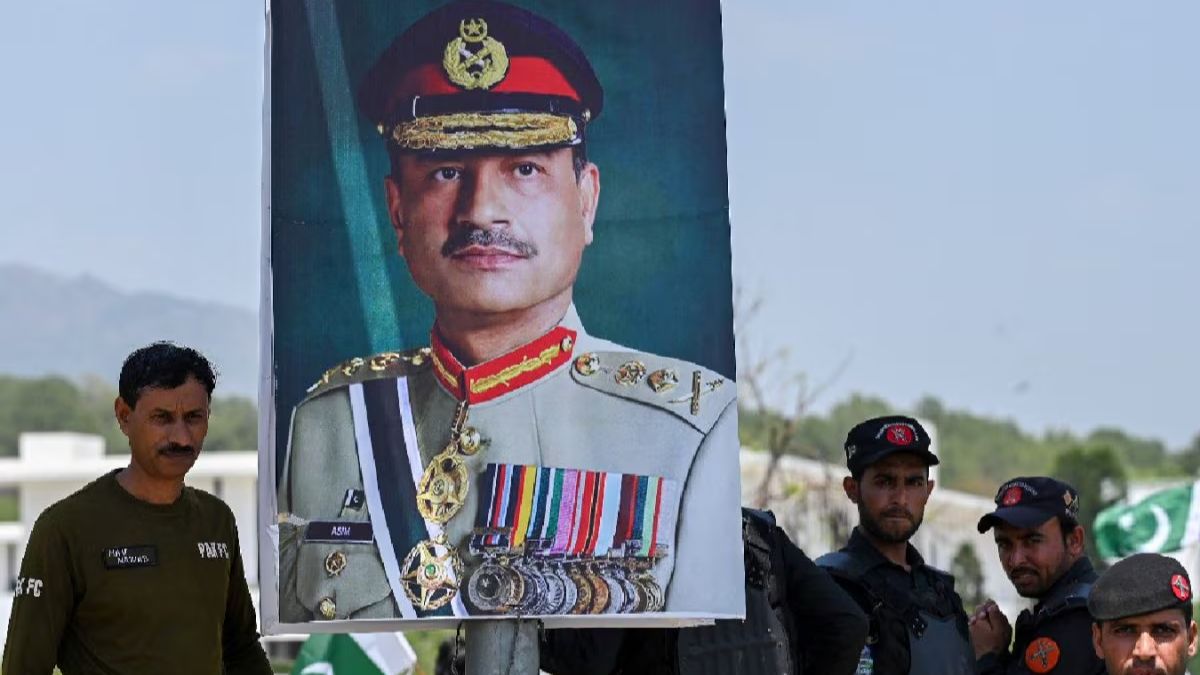
 "The infamous Pakistani failed marshal now faces his sternest test, which is convincing his people, including his own army, that he is not selling the country to Israel but saving Gazans. Image: AFP/File Photo")
Reports mention that Pakistan’s de facto head of state, constitutionally protected ‘failed marshal’ Asim Munir, is expected to visit the US in January to discuss deployment of his troops in Gaza as part of the International Stabilisation Force (ISF) under US President Donald Trump’s peace plan.
Pakistan’s foreign affairs ministry stated that it had no inputs on the visit, as also no decision has yet been taken on the deployment. US Secretary of State Marc Rubio, in a press conference last weekend, mentioned, ‘We’re very grateful to Pakistan for their offer to be a part of it (ISF), or at least consider being a part of it.’
The reality is that US pressure on Pakistan to deploy its troops has been increasing. The grant of $686 million to modernise and sustain Pakistan’s F-16 fleet, as well as their Export-Import Bank $1.25 billion financing for the Reko Diq copper-gold mine project in Baluchistan alongside the continuing ongoing loan from the IMF, is based on Pakistan accepting to deploy troops in Gaza.
Media inputs mention Pakistan is expected to contribute 3,500 soldiers, which is about an infantry brigade, though they are being pushed to dispatch one division, which is about three times the number. Details of their role remain unclear, but based on demands from Israel, it would involve disarming Hamas, which could lead to clashes with them. Further, Gaza is unlikely to be a short-term deployment.
For Trump, the peace plan is key for his nomination for the Nobel award, and there is no way nations pressured to participate can back away. Pakistan, the only Muslim nuclear power, is expected to take the lead. Arab states would only contribute in name, with the majority being provided by Pakistan and Indonesia. The US-Pakistan relationship, booming currently, depends on them providing requisite forces for the mission.
Quick Reads
View AllFor Munir personally, the decision to get involved is riddled with contradictions. For 70 years Pakistan has been projecting Israel as an enemy which has subdued the Palestinians and denied them a homeland. It refuses to recognise it. There is anger against Israel across Pakistan. In October, the Tehreek-e-Labbaik Pakistan (TLP), a far-right Islamist party, led by its firebrand leader, Saad Hussain Rizvi, protested against Israel. These were brutally crushed with dozens killed, the organisation banned, and Saad Rizvi in hiding, while his deputy was sentenced to 35 years.
There is only a vague mention of an independent Palestinian state in Trump’s plan, which Israel has sworn not to permit. It is known that Pakistan would be forced to implement Israel’s desired end state in Gaza, the disarming of Hamas, without the involvement of the Israeli army.
Protests within Pakistan against Munir and the Pakistan army for selling their souls to Israel will commence as soon as the deployment materialises and will be exploited by Imran Khan’s Pakistan Tehreek-e-Insaf (PTI). TLP protests may also resurface. Even within the military there are hardliners. Expecting them to implement Israel’s end state is difficult. In a radicalised Pakistan, choosing troops for this task will not be easy.
This could have been offset if troops deployed would have served under the UN flag and been financially well compensated. However, this being Trump’s masterpiece, pushed through the UNSC but not a UN-mandated force, payment may be low. This will add to discomfort for troops deployed.
Pakistan has additional troops deployed in Khyber Pakhtunkhwa (KP) battling the Tehreek-e-Taliban Pakistan (TTP), against which it launched Operation Sarbakaf at the end of July, alongside increased forces in Balochistan. The operation is ongoing with limited gains. It also cannot reduce forces deployed against India along the Line of Control.
Pakistan also has two divisions termed as Special Security Divisions South and North to protect ‘foreign commercial interests’, implying the China-Pakistan Economic Corridor (CPEC). The Chinese are being regularly targeted, and this has angered Beijing. While Munir courts closer ties with Washington, President Asif Ali Zardari seeks enhanced ties with Beijing.
Reduction of troops from either of these two forces could result in increased targeting of the CPEC as well as Chinese workers, distancing Beijing. Pakistan is drowned in Chinese debt and also banks on them militarily and hence cannot anger them. Therefore, protecting the Chinese and the CPEC will remain a priority.
To spare troops for employment in Gaza, Pakistan would need to reduce deployment somewhere. This is a difficult decision to make. Raising additional forces for Gaza will not be financially viable.
Munir will insist Trump guarantee to rein in India in case of a terrorist strike over which India is bound to retaliate. Any future retaliation by India will be unlike Operation Sindoor 1.0, when Pakistan was able to play its narrative, sidelining its losses. This time objectives will be such that Munir has no opportunity to play his narrative.
The question is whether New Delhi will listen to Trump’s pleadings, especially as India-US ties are at an ebb. Unlikely, as it would have a major political impact within, especially as elections are always ongoing. India too could have its demands, which Munir may find difficult. Conversely, Trump could insist that Pakistan rein in its terrorist groups, which again will bounce back for Munir.
Afghanistan too has not recognised Israel. Kabul has announced that it seeks ties with all nations except Israel. Any Pakistan deployment in Gaza, involving the disarming of Hamas, will anger them and, through them, the TTP, which has made major inroads into KP. Any reduction of troops in the region could open doors for the TTP’s expansion. The same would be the scenario in Balochistan. Any strikes across the border into Afghanistan could add to pressures, as the Taliban would be further emboldened.
A similar sentiment exists in Iran, which is Israel’s vowed enemy and backer of Hamas. By deploying in Gaza, Pakistan would be angering Iran. This implies that Pakistan would be surrounded by adversaries on all sides.
Benjamin Netanyahu, the Israeli PM, is scheduled to visit India in January. This would be around the time Trump would commence pushing for deployment of forces in Gaza. The peace plan would be discussed between PMs Narendra Modi and Benjamin Netanyahu. New Delhi’s ties with Tel Aviv are close. Indirectly, India would have a role to play in Gaza, without committing troops.
Munir is in a bind. Turning down Trump’s demand for deployment in Gaza would ruin the progress he has made in mending ties and also ongoing aid, while accepting it would add to pressures within. Munir has discussed the subject with nations likely to participate and is aware that others would only contribute in case Pakistan takes the lead and deploys maximum forces. Hence, Trump would not let Pakistan get away.
Munir is aware that he is constitutionally protected from any legal action. While this may be of benefit, hardliners within the army would see his actions as a sell-out to Israel, resulting in demands for his resignation. Pakistani PM Shehbaz Sharif has played safe by washing his hands of the deployment, leaving it to Munir to take the decision.
The infamous Pakistani failed marshal now faces his sternest test, which is convincing his people, including his own army, that he is not selling the country to Israel but saving Gazans. Whether this can happen in a radicalised state taught to hate Israel for 70 years while supporting Hamas is to be seen.
(The author is a former Indian Army officer, strategic analyst and columnist. Views expressed in the above piece are personal and solely those of the author. They do not necessarily reflect Firstpost’s views.)