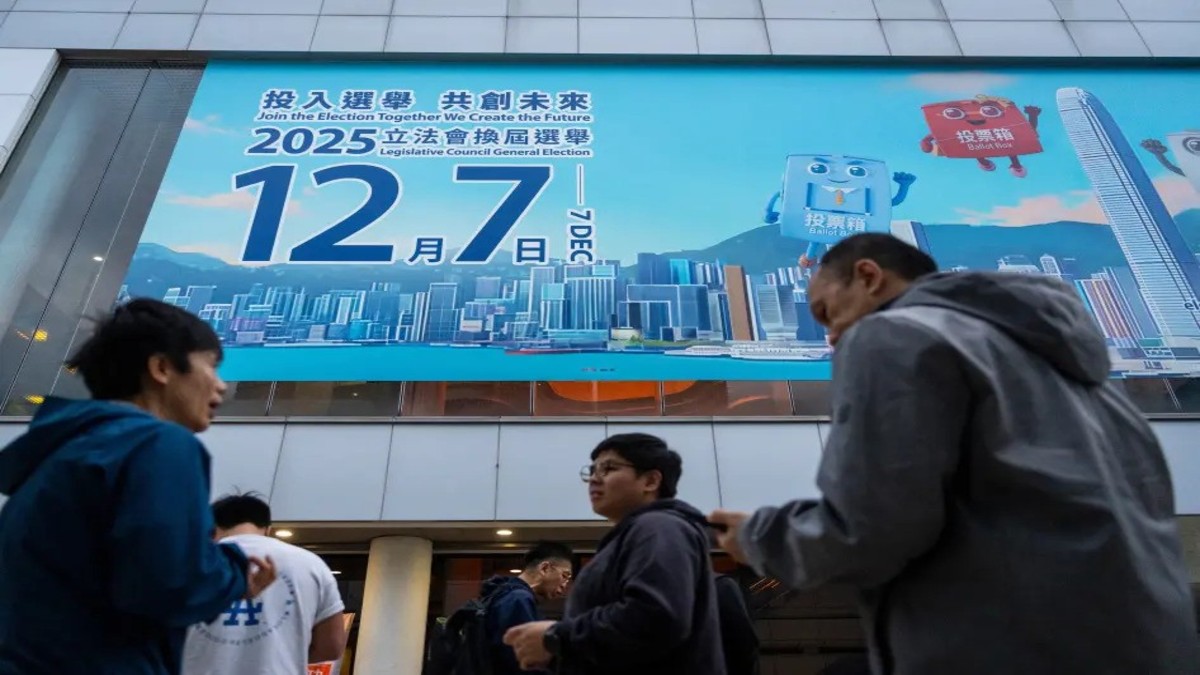
 "All 90 seats were again won by pro-establishment candidates fully aligned with Beijing. Yet the silent protest was unmistakable: 69.1 per cent abstained, and thousands spoiled their ballots. Image: Chan Long Hei/AP Photo")
The latest election for the eighth term of the Hong Kong Legislative Council (LegCo) was held on December 7, 2025. The results were declared on December 8, and the term of the new LegCo will commence on January 1, 2026. The following were the distinct features of the election:
Patriots Only
Only specially curated candidates vetted as “patriots” by the government were allowed to run for the global financial hub’s 90-seat legislature. Of these, only 20 seats were directly elected through geographical constituencies. The remaining seats were filled through:
Election Committee Constituency (ECC) — 40 seats elected by a small Election Committee stacked with Beijing loyalists; and
Functional Constituencies (FC) — 30 seats representing trades, professions, and sectors.
Hobson’s Choice
Under the complex web of Hong Kong’s electoral system, revised since 2020, voters effectively face a Hobson’s choice. They may vote only for candidates presented to them by the government. The only alternative available to voters is not to vote at all.
Decision to Opt Out
This is precisely what happened during the December 7 election, despite the Electoral Affairs Commission (EAC) extending voting hours to 7:30 a.m. to 11:30 p.m., compared with the usual 8:30 a.m. to 10:30 p.m., in an effort to boost turnout. In addition to the 615 general polling stations, extra polling stations were opened to enable special groups to vote.
According to government data, the final turnout in the Legislative Council election was a near record low of 31.9 per cent, compared with 30.2 per cent in 2021 — the lowest since Hong Kong returned to Chinese rule in 1997. The absolute number of votes cast, however, was slightly lower than four years ago.
Spoiling the Show
Voters clearly expressed anger and frustration, exacerbated by the recent fire accident in which at least 159 Hongkongers were killed. This frustration was reflected not only in nearly 70 per cent of registered voters refusing to vote, but also in many others deliberately seeking to spoil the process.
In the LegCo election recently completed, a substantial number of Hongkongers disrupted the voting exercise by casting a record number of invalid ballots, despite stern official warnings against doing so.
According to government data cited by Nikkei Asia, the number of invalid votes exceeded 41,000 — more than 3.1 per cent of the total votes cast. This is the highest number of invalid votes since Hong Kong’s return to China in 1997 and represents a 50 per cent increase over the 27,495 invalid votes recorded in the first “patriots-only” LegCo election in 2021.
Travesty of an Election
What impact did invalid votes have on the election? I argue that the impact was significant. Eleven of the 20 winners in geographical constituencies received far fewer valid votes and significantly more invalid votes.
This is the travesty of the election:
69.1 per cent of voters chose not to vote, despite elaborate government arrangements including extended voting hours and additional polling stations.
More than 3.1 per cent of the 31.9 per cent who voted cast invalid ballots as a form of protest.
Taken together, the election boycott and invalid votes make the 2025 LegCo election the least patronised election since Hong Kong returned to China in 1997.
At face value, Hong Kong’s latest LegCo elections appeared similar to elections elsewhere in the world. However, as the foregoing analysis demonstrates, this was far from the case.
Hong Kong: An Abridged History
First, the Opium Wars and British Rule
Hong Kong became a British colony through a series of treaties following the Opium Wars. Britain seized Hong Kong Island in 1841 during the First Opium War against the Qing Dynasty. The war ended with the Treaty of Nanking in 1842, which ceded Hong Kong Island to Britain “in perpetuity” and opened five Chinese ports to trade.
Quick Reads
View AllThe Kowloon Peninsula was added in 1860 following the Second Opium War via the Convention of Peking, and the New Territories were leased to Britain for 99 years in 1898.
For nearly 156 years thereafter, Hong Kong remained a British colony.
Second, the Handover to China
At midnight on June 30, 1997, Hong Kong was formally handed over to China, ending 156 years of British rule. The terms were set out in the Sino-British Joint Declaration signed on December 19, 1984, by Margaret Thatcher and Zhao Ziyang. The agreement promised Hong Kong a high degree of autonomy under the principle of “one country, two systems” until 2047, preserving its capitalist system and freedoms.
Third, Compliance with the Terms
China committed to maintaining Hong Kong’s autonomy, legal system, and freedoms for 50 years after 1997. However, as the following sections demonstrate, China has largely breached these commitments despite asserting adherence to them.
Whither the Basic Law
Adopted by China’s National People’s Congress (NPC) on April 4, 1990, and effective from July 1, 1997, the Hong Kong Basic Law serves as the territory’s mini-constitution. It enshrines the principle of “one country, two systems”, allowing Hong Kong to maintain its capitalist economy, common-law legal system, and a high degree of autonomy (except in foreign affairs and defence) for at least 50 years.
The Basic Law also defines the executive, legislative, and judicial structures, as well as the method for selecting the Chief Executive. Articles 39, 45, and 68, read together, provide for the eventual election of the Chief Executive and Legislative Council by universal suffrage under a “one person, one vote” system. However, recent electoral changes have significantly curtailed direct public representation.
Elections in Hong Kong: A Brief History
Whether under British rule or after the transfer to China, Hong Kong’s electoral history has been brief and chequered.
First, Elections under British Rule
Direct Rule: Hong Kong was governed by a British-appointed Governor who exercised near-absolute authority.
LegCo: Established in 1843, LegCo initially consisted entirely of appointed members, including officials and business elites.
First Elections: The first elections occurred on March 7, 1982, for District Boards, introducing limited indirect representation.
LegCo Elections: The first direct elections for 18 geographical constituency seats were held in 1991. Pro-democracy candidates won 16 of 18 seats, driven by a united front and the aftermath of the Tiananmen Square protests.
Despite this mandate, power remained diluted: in the 60-seat LegCo, 21 members were elected through restricted functional constituencies and another 21 were appointed by the Governor, preserving conservative and pro-business influence.
Second, Elections after the China Takeover
One: 1998-2019
Post-1997 elections combined geographical constituencies, functional constituencies, and Election Committee seats. LegCo had 60 seats in 1998 and 70 seats by 2012, with roughly half directly elected. Pro-democracy forces gained momentum in 2004 and 2012, winning nearly 60 per cent of the popular vote. Despite loyalty pledges and disqualifications after 2015, opposition influence persisted until 2019.
Two: 2019-2021
The 2019 protests, triggered by an extradition bill, escalated into mass demonstrations demanding full withdrawal of the bill, an inquiry into police conduct, release of arrested protesters, withdrawal of the “riot” label, and universal suffrage.
In the November 24, 2019 local elections, pro-democracy candidates won a landslide victory, capturing 389 of 452 seats, with turnout reaching nearly 70 percent of eligible voters.
China responded with the 2020 National Security Law and, in 2021, overhauled the electoral system. LegCo was expanded to 90 seats, but directly elected seats were cut to 20, while 40 EC seats and 30 FC seats ensured pro-Beijing dominance. All candidates were required to pass “patriot” vetting.
Three: 2021-2025: Patriots Only
The First: The December 2021 “patriots-only” election saw turnout collapse to 30.2 per cent, down from 58 per cent in 2016. All 90 seats went to pro-Beijing candidates.
The Latest: The 2025 election followed the same format. Turnout was 31.9 percent, with 1,317,682 votes cast out of 4.1 million eligible voters. More than 3.1 per cent of voters cast invalid ballots as protest votes. Turnout in FC and EC categories stood at 40.09 per cent and 99.45 per cent respectively.
All 90 seats were again won by pro-establishment candidates fully aligned with Beijing. Yet the silent protest was unmistakable: 69.1 per cent abstained, and thousands spoiled their ballots.
The Hong Kong Basic Law promised Hongkongers a way of life under “one country, two systems” for 50 years, including the eventual realisation of “one person, one vote”. By 2025, that aspiration has withered. Hong Kong is now firmly under Beijing’s grip, and universal suffrage has receded into near impossibility.
(The author is a multi-disciplinary thought leader with Action Bias and an India based impact consultant. He is a keen watcher of changing national and international scenarios. He works as President Advisory Services of Consulting Company BARSYL. Views expressed in the above piece are personal and solely those of the author. They do not necessarily reflect Firstpost’s views.)