China is experiencing yet another purge under the leadership of its President Xi Jinping. This comes in the form of the sudden replacement of two top leaders of its elite Rocket Force Unit that manages its nuclear arsenal. General Li Yuchao of the People’s Liberation Army(PLA) and his deputy had reportedly ‘disappeared’ for several months. The new replacements are former deputy navy chief Wang Houbin and Xu Xisheng who is a member of the Chinese Communist Party’s(CCP’s) central committee. This move is seen as an attempt by Xi to strengthen his grip on the PLA. This was preceded by the mysterious disappearance of Chinese foreign minister Qin Gang. He has been replaced by Wang Yi. There have been many purges in the CCP since it came to power in 1949. In recent times the ousted general secretary, Hu Yaobang and his successor Zhao Ziyang are some of the big leaders who were victims of the power struggle. Several generals, the mayors of Shanghai and Beijing and a number of provincial chiefs have also been targeted by the purges which are now a normal feature of the Chinese regime. Xi Jinping has ensured that his key rivals were ousted. Bo Xilai and Zhou Yongkang are in prison. In the garb of an anti-corruption campaign, Politburo members Sun Zhengcai and Ling Jihua have also been taken care of. At Least two generals on the Central Military Commission were removed unceremoniously; one of them is dead while the other one is in jail for alleged charges of corruption. Xi’s playbooks of purge There are two playbooks that Xi follows as far as the purge during his regime is concerned. One of them is the Soviet Union’s notorious dictator Joseph Stalin’s manual on how to run a dictatorship titled History of the Communist Party of the Soviet Union(Bolsheviks) and the other one is a controversial utopian novel What is to be done? written by a Russian writer named Nikolai Chernyshevsky. Stalin published this book as a manual for a ‘short course’ for communist cadres in 1939 and it deeply influenced the Chinese Communist movement. One can draw the similarity between the purge in China under Xi Jinping and what Stalin had written in this manual where the latter documented how he had crushed his rivals within the Communist Party in the Soviet Union. In chapter 10, he explained unabashedly what he did to his rivals during 1926-29, “The First Five-Year Plan of Socialist construction was adopted. The building of new factories, state farms and collective farms was developed on a vast scale. This advance towards Socialism was attended by a sharpening of the class struggle in the country and a sharpening of the struggle within the Party. The chief results of this struggle were that the resistance of the kulaks was crushed, the bloc of Trotskyite and Zinovievite capitulators was exposed as an anti-Soviet bloc, the Right capitulators were exposed as agents of the kulaks, the Trotskyites were expelled from the Party, and the views of the Trotskyites and the Right opportunists were declared incompatible with membership of the C.P.S.U.(B.).” There is a stark similarity between what Stalin did to his rivals and how Xi is neutralising his challengers. What is to be done? The novel titled What is to be done? was published in 1863 by Nikolai Chernyshevsky to counter Ivan Turganev’s Fathers and Sons. Chernyshevsky’s novel was considered to be of extremely poor standards by most literary critics. But soon it became a trailblazer as it mocked the then-existing Czarist system in Russia and presented a Utopian model of collectives and unrestricted freedom to do anything in the name of revolution. Most importantly, it established the principle of ‘Rational Egotism/Rational Selfishness’ that justified the selfish acts of annihilating rivals as something that would bring greater good to society. Several attempts were made on Czar’s life by Communist cadres who were motivated by Chernyshevsky’s novel where one of the characters Rakhmetov became a role model for anarchists and rebels. Soviet Union’s first dictator Vladimir Lenin was so impressed by this book that when he penned a pamphlet that outlined the skeletal plan of overthrowing the Russian regime through a Communist uprising, he titled it “What is to be done?” as a homage to Chernyshevsky. This pamphlet was written in 1901 and was published in 1902. Lenin himself said that he had read Chernyshevsky’s novel several times and he imitated Rakhmetov in his real life. How impressed is Xi with this playbook can be gauged from the Chinese official newspaper People’s Daily report titled “Reading with Xi Jinping | What Is to Be Done?”. The report published on the website of People’s Daily on 23 April, 2022 said, “Chernyshevsky was a great literary critic, philosopher, and revolutionary democrat of Russia in the 19th century. His works cover various topics, including philosophy, economics, aesthetics, literature and sociology." ‘What Is to Be Done?’, as a representative work of Chernyshevsky, has enjoyed a positive worldwide reputation. On the evening of 23 March, 2013, Chinese President Xi Jinping met with Russian sinologists, Chinese language students and media representatives in Moscow. Xi said that he was once inspired by Chernyshevsky’s work ‘What Is to Be Done?’ when he was young, suggesting that given this reason it indicated the charm of an excellent culture. The report further said, “In January 1969, 15-year-old Xi Jinping arrived in Liangjiahe, a village in Yan’an city in northwest China’s Shaanxi Province, having taken up work as a farmer in the locality. While living in a cave dwelling in Liangjiahe, Xi read the full-length novel ‘What Is to Be Done?’ In order to strengthen his will, Rakhmetov, the leading character in the book, lives an ascetic life, even going so far as to sleep on a bed of nails, which left his body covered in blood. Recalling his life in Liangjiahe, Xi said that he and his fellow compatriots thought that this was the right way to temper one’s willpower. They then decided to remove their cotton-padded mattresses and instead just slept on the bare brick beds. On rainy days, they would go outdoors to expose themselves to the rain; and on snowy days they went outside to rub snow onto themselves, taking cold showers beside the well all in an attempt to strengthen their willpower, which was all inspired by this book.” Ironically, What is to be done? has not only influenced Russian and Chinese dictators but its impact can be felt even in the United States of America. The so-called Left-Liberal movement has been deeply influenced by this novel. Adam Weiner, an expert on Russian studies and the author of the much-acclaimed book How Bad Writing Destroyed the World, wrote in Politico way back in 2016, “Chernyshevsky was one of the great destructive influences of the past century: first in his home country, where his writing helped spawn the Soviet Union, and now, of all places, in the United States, where his rational egotism continues to reverberate in American political and economic thought.” The writer is an author and columnist and has written several books. He tweets @ArunAnandLive. Views expressed in the above piece are personal and solely that of the author. They do not necessarily reflect Firstpost’s views. Read all the Latest News , Trending News , Cricket News , Bollywood News , India News and Entertainment News here. Follow us on Facebook , Twitter and Instagram .
Global Watch | How a poorly written Russian novel became Xi Jinping’s playbook of purge
Arun Anand
• August 3, 2023, 13:41:57 IST
Xi Jinping draws inspiration from Nikolai Chernyshevsky’s book ‘What is to be Done?’ to secure his longevity as the foremost power centre in China, effectively identifying and eliminating potential threats from key aides, whether civilian or military
Advertisement
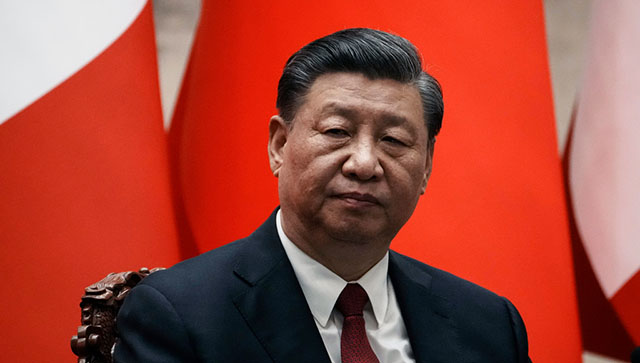 "Global Watch | How a poorly written Russian novel became Xi Jinping’s playbook of purge")
End of Article