

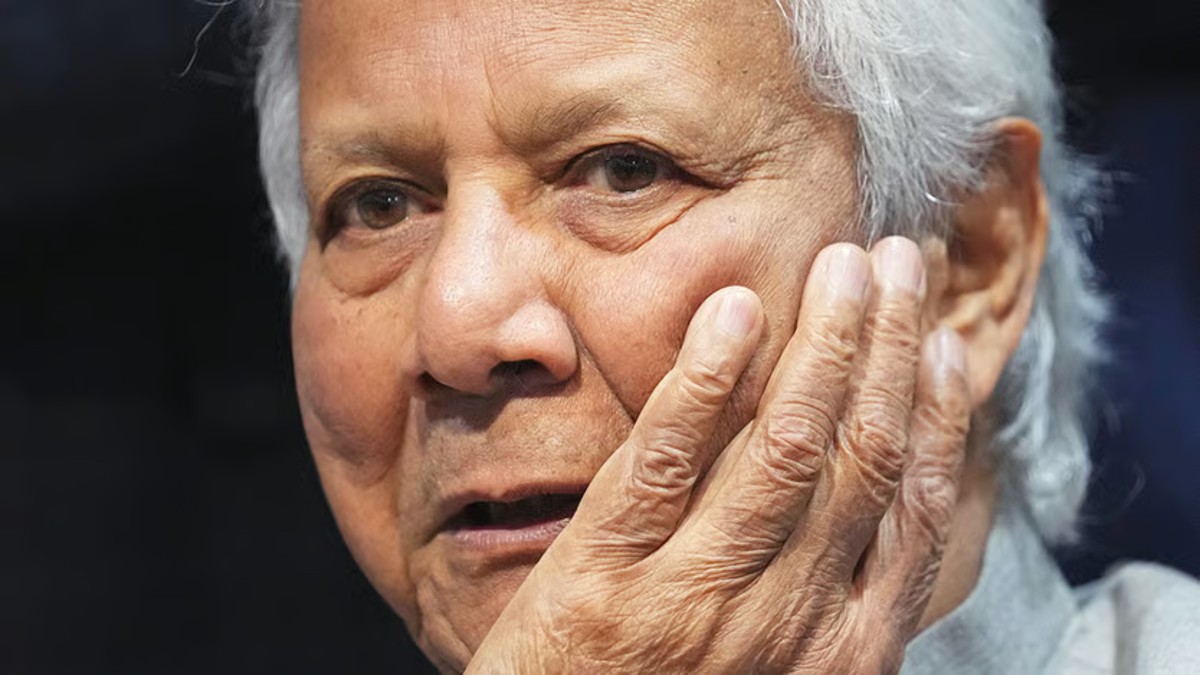
 "Dhaka’s dangerous drift: How Yunus’s power play has empowered Islamists and external actors")
Sheikh Hasina’s conviction and death sentence for crimes against humanity by Bangladesh’s ‘International Crimes Tribunal’ (ICT) marked yet another turning point in the nation’s five-and-a-half-decades-long chequered history, marred by coups and regime changes.
The verdict was no surprise, obvious from the way the trial was conducted in absentia; in a fast-tracked mode marked by opaqueness. Muhammad Yunus, who heads the interim government, had set the stage for rigging the trial, evident from the composition of the tribunal, appointment of Chief Prosecutor Tajul Islam (principal defendant of Jammati leaders who were tried for 1971 war crimes in 2010) and ensuring weak defence.
The ICT judgement went on to sharply divide Bangladesh, with Awami League (AL) supporters seeing it as political prosecution and vendetta against their leader. The anti-Hasina forces, on the other hand, called the verdict long-overdue justice for deaths and excesses committed by her during the final years in power. The duality signals likelihood of future violence and instability due to the charged environment. Further, the Yunus administration is bent upon rewriting the narrative of the 2024 students-led uprising.
Bangladesh politics have been dominated by two main political parties — AL and Bangladesh National Party (BNP) headed by Khalida Zia, wife of the slain Bangladesh President Ziaur Rahman. During Sheikh Hasina’s 15 years of uninterrupted rule from 2009 to 2024, she wielded immense political control, while her authoritarian tendencies and electoral irregularities drew deep dissent. Incidentally, during Hasina’s tenure, Bangladesh witnessed rapid economic progress and was hailed as the rising tiger of South Asia. Currently, there is a political vacuum as most of the AL leaders are behind bars and BNP is riddled with internal fissures with Khalida Zia being critically ill.
With the political environment highly fractured, there is marked erosion of democratic institutions in the country. Minorities are frequently under attack from radical elements and local mobs. The Islamist elements and extremist groups like Jamaat-ul-Islam, against whom Hasina had taken a firm stand, sensing opportunity, are now asserting themselves. Apropos, its cadres were part of the paramilitary force Razakars, who had actively connived with the Pakistan Army in unleashing a nine-month genocide and loot in 1971.
Quick Reads
View AllWhile the Bangladesh Army is a professional force, it suffers from factionalism and radicalisation. General Wakar-uz-Zaman, the Army Chief, remains in control but is constrained to mend fences with Pakistan and maintain close relations with China. As the Bangladesh Army is a significant contributor to UN peacekeeping missions, there is international pressure as well to safeguard the democratic credentials of the nation. During the students’ protests in 2024, the Army did not intervene and visibly adopted a neutral stance.
Bangladesh’s economic boom over recent years was driven primarily by the ready-made garment sector, overseas remittances and a growing middle class. Due to domestic turbulence and the global financial slowdown, Bangladesh’s economy is under strain. It is growing barely at 3.5 per cent, marked by inflation, currency depreciation and declining investments. Even the IMF has shown concerns about Bangladesh’s rising debts.
Under Yunus, Dhaka has heavily leaned towards Beijing, enabling the Dragon to further expand its economic and strategic footprints in Bangladesh. China has committed to invest $40 billion — $26 billion under the ‘Belt and Road Initiative’ (BRI) and $14 billion as joint ventures. There is growing defence cooperation, especially sale of major Chinese military hardware items to Bangladesh, including a deal to purchase 20 J-10C fighter jets; SY-400 short-range ballistic missiles; VT-5 light tanks; and CS/AA3 anti-aircraft guns already acquired. The militaries of the two countries regularly carry out joint training exercises. There are reports of Bangladesh planning to operationalise Lalmonirhat airfield in close proximity to the Siliguri Corridor with Chinese assistance.
Another significant development is Dhaka cosying up to Islamabad. Over a dozen Pakistani military delegations have visited Bangladesh, including the Director General of ISI and Naval Chief Admiral Naveed Ashraf. A number of Bangladesh military delegations have been hosted in Pakistan as well. As part of defence cooperation, Pakistan will be training Bangladesh pilots to fly J-10C jets. Pakistan Naval Ship (PNS) Saif docked at Chittagong on a goodwill visit last month from November 8–11. Due to the dramatic reset of ties between the two countries, direct trade and flights have also restarted.
Given US strategic interests, the Biden administration spent millions of dollars on Hasina’s ouster and regime change, as claimed by her son Sajeeb Wazed who is currently based in the US. During his interview with ANI, Wazed quoted President Trump to substantiate his claim. However, he amplified that the American approach has changed distinctly as Trump is more concerned about the threat of terrorism and rise of Islamism in Bangladesh than the previous administration. The US is also wary of Bangladesh becoming a Chinese vassal state.
For India, Bangladesh is a strategic neighbour. During Hasina’s time, bilateral relations saw one of the best periods, with excellent cooperation, especially in counter-terrorism. Currently, the ties between the two have nose-dived. Dhaka has sought Hasina’s extradition as per the 2013 treaty between India and Bangladesh.
India has taken a nuanced stance, evident from the Ministry of External Affairs’ statement: “As a close neighbour, India remains committed to the best interest of the Bangladesh people, including peace, democracy, inclusion, and stability. We will always engage constructively with all stakeholders to that end.” India needs to mobilise the non-Islamist majority of Bangladesh who are frustrated with the current dispensation. Delhi must also lay down clear red lines and sensitise Dhaka about its security concerns.
Yunus had assumed that he would get a few years to initiate political reforms before holding the elections. Now that the elections have been announced in February next year, it is to be seen if the state machinery will be able to ensure free and fair polls. Incidentally, AL is already banned and Hasina has been handed another sentence of 21 years on corruption charges. Jamaatis are being tacitly backed by the current dispensation. A constitutional referendum will also take place alongside the elections wherein voters will be asked about the provision of the July Charter and related amendments to the nation’s constitution.
It is to be seen whether Bangladesh will emerge as a democratic entity or get swept by radical forces. The possibility of military rule returning cannot be ruled out. Today, Bangladesh stands at a crossroads, marred by internal turbulence and major powers rivalry, with the future rather unpredictable.
(The author is a Bangladesh War Veteran, Former Assistant Chief, currently Professor Strategic-IR and Management Studies. Views expressed in the above piece are personal and solely those of the author. They do not necessarily reflect Firstpost’s views.

 "What the dramatic US seizure of Venezuela-linked oil tanker tells us")
 "Should Ukraine concede territory to Russia? Zelenskyy wants Ukrainians to vote in referendum")
 "Who is Kilmar Ábrego García, the man ‘mistakenly’ deported by US, now freed?")
 "Trump's new tax guidance could let companies save billions more")
 "What the dramatic US seizure of Venezuela-linked oil tanker tells us")
 "Should Ukraine concede territory to Russia? Zelenskyy wants Ukrainians to vote in referendum")
 "Who is Kilmar Ábrego García, the man ‘mistakenly’ deported by US, now freed?")
 "Trump's new tax guidance could let companies save billions more")



