

 "Cycle of instability: Unpacking South Korea's turbulent politics")
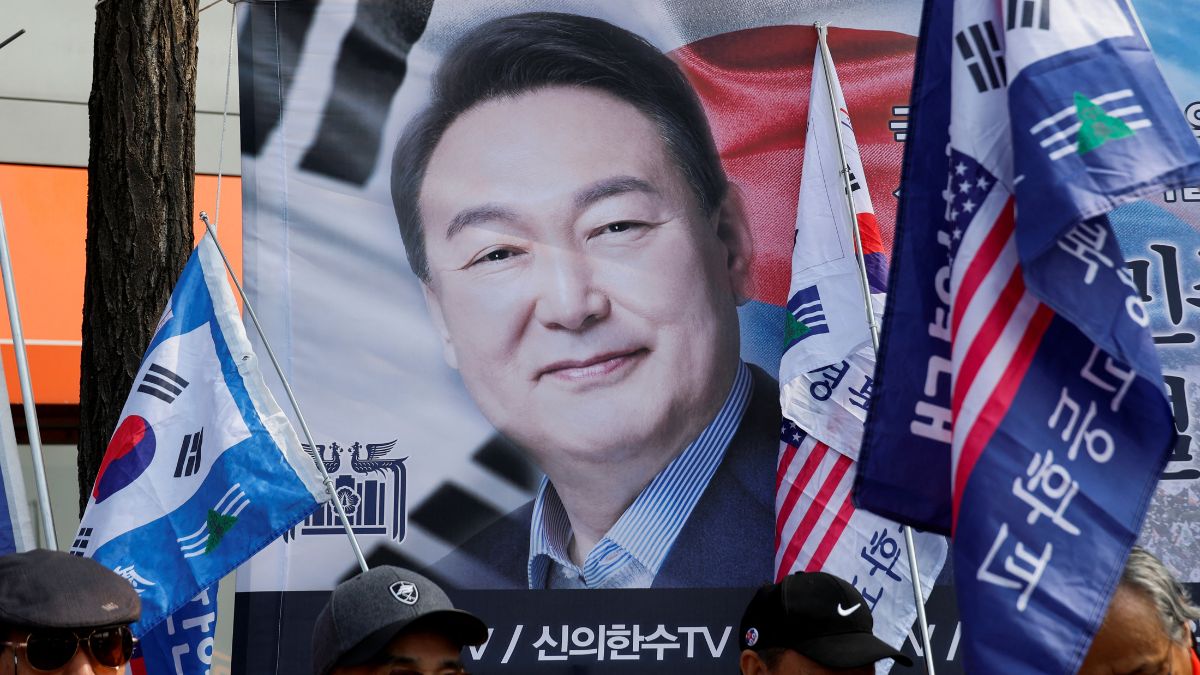
South Korea has been engulfed in unprecedented political chaos and confusion over the past few months. Its more than 44,000,000 registered voters are now set to vote in a snap election to replace President Yoon Suk Yeol, after the Constitutional Court upheld his impeachment in a unanimous 8–0 decision on April 4, 2025. The successor will be elected to a single five-year term through a single-round plurality voting system.
Fraught Time
South Korea finds itself in turmoil, facing a power vacuum at the highest level at an especially fraught moment, driven by a triple whammy of factors:
One, Inability to Effectively Manage the Trump Tariff Tsunami
Having rebuilt itself from a war-torn nation into an export-driven economic powerhouse, South Korea is now reeling from US President Donald Trump’s sweeping 25 per cent tariffs—particularly on its key export sectors like the auto industry. For the last four months, Asia’s fourth-largest economy—and a key US ally—has been under the command of a revolving cast of interim presidents who have failed to adequately respond to the tariff shock. During the next two critical months, as the country remains politically rudderless, Seoul may be unable to coordinate effectively with Washington or respond swiftly to Trump’s fast-paced decisions that affect its security and economy.
Two, The Economy in Serious Trouble
Even before the tariffs hit, South Korea’s economy was already on shaky ground. In Q4 of 2024, GDP expanded just 0.1 per cent quarter-over-quarter (seasonally adjusted), according to the Bank of Korea’s advanced estimates. The country narrowly avoided a technical recession in Q3, growing only 0.1 per cent after a 0.2 per cent contraction in Q2. A prolonged political standoff between the governing and opposition parties has only deepened economic uncertainty. The South Korean won has plunged to a 16-year low.
Three, Ballooning Debt
South Korea’s household debt-to-GDP ratio in 2024 was the second highest among major nations, trailing only Canada. The ratio stood at 91.7 per cent in Q4 2024, compared to a global average of 60.3 per cent, according to the Institute of International Finance. Concerns are mounting about household borrowing amid sluggish economic growth and weak domestic demand.
Quick Reads
View AllA Flawed Democracy
South Korea’s political troubles are further compounded by a decline in democratic standards. According to the Economist Intelligence Unit’s (EIU) Democracy Index 2024, South Korea’s rank fell from 22nd in 2022 to 32nd in 2024, with its overall score dropping from 8.09 to 7.75—the lowest since the index began in 2006. The EIU reclassified South Korea as a “flawed democracy”, down from the “full democracy” status it had held since 2020. Nations with scores between 6.00 and 7.99 fall under this category.
The Root of the Present Crisis
The crisis began just before midnight on December 3, 2024, when President Yoon declared martial law—a first since South Korea became a democracy in 1987. Justifying the decision as necessary to combat “anti-state” forces allegedly sympathetic to North Korea, it soon became evident that Yoon’s move was politically motivated. His presidency, which began in May 2022, had been marred by scandals, poor approval ratings, and a landslide opposition victory in the 2024 general elections. Under intense political pressure and reportedly acting on advice from aides, Yoon imposed martial law.
Short-Lived Declaration
Public anger and mass protests quickly followed. In a dramatic late-night session, lawmakers scaled fences and breached barricades to enter the National Assembly and voted down the martial law declaration. The move was condemned across the political spectrum. Tens of thousands of protesters took to the streets, demanding Yoon’s removal.
Impeachment
Opposition lawmakers filed a motion to impeach Yoon, requiring a two-thirds majority. With 192 seats in the 300-member National Assembly, they needed 12 defectors from Yoon’s party. Though the first vote failed, the opposition pushed again, and on December 14, succeeded when 12 ruling party lawmakers voted in favor. Following the impeachment, Yoon was suspended, and the matter was handed to the Constitutional Court, which had six months to deliver a verdict.
Chaos Continues
The chaos intensified. Prime Minister Han Duck-soo assumed the role of interim president but lasted only two weeks before being impeached himself. Deputy Prime Minister Choi Sang-mok then took over as acting president. Several former ministers and presidential aides either resigned or were detained by the Corruption Investigation Office (CIO), which is probing Yoon for abuse of power and inciting insurrection.
Kissa Kursi Ka
In another twist, on March 24, 2025, the Constitutional Court reinstated Han Duck-soo as acting president in a 7-1 vote—another dramatic turn in the saga. Since then, Han has led the country in a caretaker capacity.
The Case Settled
On April 4, the Constitutional Court upheld Yoon’s impeachment in a unanimous 8-0 verdict, bringing closure to the 18-week crisis and clearing the way for a snap presidential election on June 3, 2025.
But why does South Korea keep landing in political turmoil? A deeper understanding requires a look at the country’s turbulent history.
Litany of Woes
To understand South Korea’s current predicament, one must examine its historical swings between authoritarianism and democracy:
- 1948–1960: Under Syngman Rhee’s “democratic authoritarianism”, the country endured 12 years of iron-fisted anti-communist rule before Rhee was ousted and exiled to Hawaii.
- 1961–1972: Park Chung Hee’s “illiberal democracy” began with a coup and ended with the imposition of an authoritarian constitution in 1972.
- 1972–1987: A period of full-fledged authoritarianism marked by military dominance, brutal suppression, and the infamous Gwangju Uprising.
- 1987–present: The “democratic revival” was spurred by student-led protests that ushered in constitutional democracy.
At the Crossroads
President Yoon’s declaration of martial law on December 3 evoked memories of South Korea’s authoritarian past. As the nation heads into its snap election on June 3, it stands at a critical crossroads. It must now commit to restoring democratic order through a transparent and credible electoral process. This is not only essential to rebuild public trust but also to reassert South Korea’s standing among global democracies and economies.
What Next?
The question now is: who will be South Korea’s next president? The ruling People’s Power Party (PPP) is in disarray, with many Yoon loyalists portraying him as a victim of injustice. Meanwhile, Lee Jae-myung of the Democratic Party of Korea (DPK)—who led his party to a resounding victory in last year’s parliamentary election—is emerging as the frontrunner. Lee, who narrowly lost to Yoon in the 2022 presidential race, is now leading in several polls by double-digit margins. Notably, he was among the lawmakers who stormed the National Assembly on December 3 to vote down martial law.
Regardless of who wins, the new president will face monumental challenges: pulling South Korea back from political brinkmanship, restoring public faith in democracy, and reviving the economy will be top priorities for the next administration.
The author is a multi-disciplinary thought leader with Action Bias and an India based impact consultant. He is a keen watcher of changing national and international scenarios. He works as President Advisory Services of Consulting Company BARSYL. Views expressed in the above piece are personal and solely those of the author. They do not necessarily reflect Firstpost’s views.

 "UAE to host first 'trilateral' talks between Ukraine, US and Russia, says Zelenskyy")
 "Trump finds new raid target? Report says US actively seeking regime change in Cuba by 2026-end")
 "Power shift in Hanoi: Vietnam party list hints PM and president losing clout")
 "Can Trump’s Board of Peace replace the United Nations?")
 "UAE to host first 'trilateral' talks between Ukraine, US and Russia, says Zelenskyy")
 "Trump finds new raid target? Report says US actively seeking regime change in Cuba by 2026-end")
 "Power shift in Hanoi: Vietnam party list hints PM and president losing clout")
 "Can Trump’s Board of Peace replace the United Nations?")



