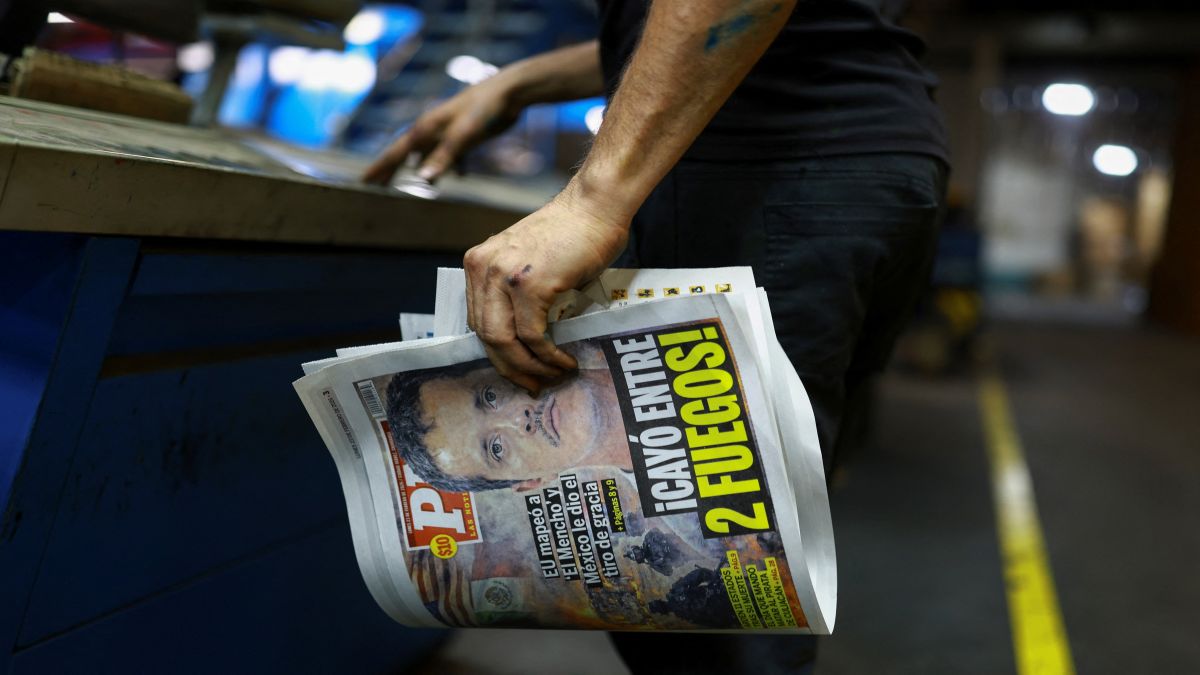
 "Why El Mencho’s death won't end Mexico’s cartel crisis")
Nemesio Rubén Oseguera Cervantes was killed in Tapalpa, Jalisco, Mexico, on Sunday, 22 February, as part of a targeted Mexican military operation reportedly assisted by US intelligence input. Oseguera was seriously injured in the shoot-out and died during an air transfer to Mexico City. Six other cartel members were also killed and two were arrested, Mexico’s Ministry of National Defence announced. Three members of the military were also injured during the operation.
The raid and killing triggered immediate Jalisco New Generation Cartel’s (CJNG) retaliation: torched businesses, burning roadblocks, destroyed vehicles, and attacks across multiple states (Jalisco, Michoacán, Guanajuato and others), leading to casualties, flight cancellations, and US travel warnings. Official accounts put the number of deaths in the aftermath at 70, and the deteriorating law and order situation has forced Mexico to deploy more than 10,000 armed forces personnel to the affected states.
The scenes that unfolded on Sunday reminded many of the violence that erupted in the state of Sinaloa after the capture of another notorious drug lord, Ovidio Guzmán López, in 2019.
The Official Account
Mexican Defence Secretary General Ricardo Trevilla said that Sunday’s special forces operation, which included US intelligence information, concluded when forces found Oseguera Cervantes “hidden in the undergrowth” in his home state of Jalisco. After several exchanges of fire, eight gunmen were killed, and the drug lord and two of his bodyguards were wounded. They were taken into custody and died en route to Mexico City, Trevilla said.
The Dreaded Don
Who was Cervantes, and why did Mexican special forces and US intelligence collaborate to eliminate him, leaving parts of Mexico burning?
Oseguera, nicknamed El Mencho, was the founder and supreme leader of the CJNG, an international criminal organisation and one of Mexico’s two most powerful cartels.
Quick Reads
View AllAlso known by its Spanish initials, CJNG dominates much of Guadalajara and controls parts of Jalisco, as well as other states such as Colima and Michoacán. The organisation has rivalled the Sinaloa Cartel, formerly led by kingpin Joaquín “El Chapo” Guzmán, who is serving a life sentence.
The Ascent
Born in July 1966 in the western state of Michoacán, Oseguera later moved to the United States and became deeply involved in drug trafficking from the 1990s, according to the US Drug Enforcement Administration (DEA). Reports state that in 1994 he was convicted in California for conspiracy to distribute heroin and served three years in a US prison.
After returning to Mexico, he worked as a police officer in Jalisco but soon resumed his criminal activities, gradually building influence in the narcotics underworld and rising to head one of the country’s most powerful and ruthless criminal empires.
Wanted by authorities in both Mexico and the United States, he later co-founded CJNG around 2007-2010 after breaking away from Sinaloa-aligned structures.
Under his leadership from roughly 2009, CJNG expanded from a regional group into a multinational organisation operating in at least 30-36 countries, trafficking methamphetamine, cocaine, heroin and especially fentanyl to the United States.
The US State Department placed a $15 million bounty on him, describing CJNG as one of the most dangerous criminal organisations. National security agencies regarded him as Mexico’s most powerful kingpin following El Chapo’s arrest.
The Nemesis of Mexico
Drug trafficking remains one of Mexico’s most severe security challenges, fuelling widespread violence, corruption and economic distortion. Cartels have long functioned as parallel power structures across Mexico’s society, economy and polity. Killing El Mencho may represent a major tactical blow to cartel operations, but on its own it is more likely to trigger further deterioration — more violence and disruption — than any lasting structural improvement.
Dominant Groups
The Sinaloa Cartel and CJNG are the primary powerhouses, designated as foreign terrorist organisations by the United States in 2025. Sinaloa, rooted in north-west Mexico, traffics vast quantities of fentanyl, methamphetamine, cocaine, heroin and marijuana globally, using violence such as the 2019 and 2023 “Culiacanazos” to protect its operations. CJNG, emerging around 2011, has expanded ruthlessly through franchise-style operations in over 40 countries, dominating fentanyl production and cocaine supply while diversifying into theft and extortion.
Mexican cartels collectively earn an estimated $12-29 billion annually from US drug sales, equating to roughly $50-80 million per day, with fentanyl alone generating between $700 million and $1 billion annually. Sinaloa’s revenues are estimated at $3-39 billion per year, while CJNG’s assets exceed $20 billion, bolstered by money laundering through property, cryptocurrency and front businesses. These figures derive primarily from wholesale trafficking and far surpass those of Colombia’s cartels.
Severity of Impact
Organised crime, driven by drug cartels, has intensified over the past two decades. In 2024, Mexico’s homicide rate reached 23.3 per 100,000 people, largely linked to cartel violence. Proximity to the United States — the world’s largest drug market — sustains this crisis, with synthetic drugs such as fentanyl amplifying both lethality and profits.
Societal Impact
Cartel violence fractures communities, causing displacement, mental health crises and over 90 per cent impunity in femicides linked to narco-control in states such as Jalisco and Guerrero. Cartels infiltrate politics, police and courts, enforcing shadow governance through intimidation and corruption, while fuelling US overdose deaths through fentanyl trafficking.
In many rural and peri-urban areas, cartels act as de facto authorities, enforcing rules, mediating disputes and determining who may work or trade, particularly where the state is weak. They recruit marginalised youth by offering income, weapons and status. Fear and normalised violence shape daily life, influencing migration, business hours and travel routes.
Economic Impact
Cartels distort Mexico’s economy through extortion, business takeovers in agriculture, mining and transport, and violence that deters investment and tourism. Per capita losses have averaged $2,198 in recent years, inflating food prices and hindering growth. Recent violence has disrupted cross-border trade, port operations and trucking.
Cartels have diversified far beyond drugs into fuel theft, illegal mining, agriculture (including avocados and limes), transport and property fraud. Business extortion alone cost firms an estimated $1.3 billion in 2023, though up to 97 per cent of cases are believed unreported. In states such as Michoacán, cartels effectively tax farmers and exporters, embedding themselves within legal supply chains.
Political Impact
Organised crime has penetrated local governments, police and prosecutors through bribery and intimidation. Political violence linked to organised crime surged between 2021 and 2024, with murders associated with political violence rising by 356 per cent. In some municipalities, elections resemble contests between rival cartels, producing a form of criminal governance in which democratic institutions coexist with informal cartel veto power.
Why Cartels Will Continue to Thrive
Cartels are deeply embedded within Mexico’s society, economy and governance structures. Estimates suggest drug cartels generate tens of billions of dollars annually, with US drug sales alone producing roughly $20-30 billion per year. Money laundering moves an estimated $18–44 billion annually through various channels, blending illicit funds with legal flows.
Mexico’s GDP stands at approximately $1.8-2.0 trillion. Even conservative estimates suggest cartel-related income amounts to 1-3 per cent of GDP, while the broader economic cost of violence reached about $230 billion (18.3 per cent of GDP) in 2022.
Beyond Nemesio ‘El Mencho’ Oseguera
Given the structural grip of cartels on Mexico’s society and polity, and the macroeconomic significance of their activities, the elimination of El Mencho — like the imprisonment of El Chapo — is unlikely to resolve the crisis without deep-rooted reforms addressing corruption, weak local policing and persistent global drug demand.
Symbolically, the killing of the CJNG leader is a significant victory for the Sheinbaum administration and US intelligence, demonstrating that even previously untouchable figures can be targeted. Nonetheless, removing one or two kingpins does little to dismantle the structural embedding of organised crime in Mexico. The history of Mexican cartels for last two decades show that after one drug lord is removed from the scene another, more ferocious one, replaces him.
The challenge is compounded by the fact that cartels are woven into local governance, significant portions of the legal economy and the social fabric in many regions. With Mexico set to co-host the 2026 FIFA World Cup, escalating violence and disruptions to transport, tourism and investment present serious concerns. Further instability cannot be ruled out. A fierce struggle to succeed as CJNG’s new supremo is likely to intensify, while rival cartels may swiftly move to seize territory and routes left vulnerable in the power vacuum. At the same time, both the US and Mexican governments would do well to remember the enduring lesson of the past: there is no purely military solution to Mexico’s cartel crisis.
(The author is a multi-disciplinary thought leader with Action Bias and an India-based impact consultant. He is President of Advisory Services at BARSYL. Views expressed are personal and do not necessarily reflect Firstpost’s position.)


 "Pakistan-Afghanistan War Live Updates: Russia, China call for ceasefire as Pak-Taliban conflict worsens")
 "Local ceasefire in Russia-Ukraine war to repair Moscow-controlled Zaporizhzhia nuclear plant")
 "Rising Bharat Summit: Gold’s big moment? What the World Gold Council chief revealed")
 "Pakistan Stock Exchange tanks over 3,000 points as border tensions with Afghanistan escalate")
 "Pakistan-Afghanistan War Live Updates: Russia, China call for ceasefire as Pak-Taliban conflict worsens")
 "Local ceasefire in Russia-Ukraine war to repair Moscow-controlled Zaporizhzhia nuclear plant")
 "Rising Bharat Summit: Gold’s big moment? What the World Gold Council chief revealed")
 "Pakistan Stock Exchange tanks over 3,000 points as border tensions with Afghanistan escalate")