 "Rising Bharat Summit: Gold’s big moment? What the World Gold Council chief revealed")
Gold markets continue to rewrite history as the metal’s price remains elevated near record levels while geopolitical factors reshape how bullion is valued and held.
From surging ETF inflows and central bank accumulation to regulatory shifts and digital innovation, gold is increasingly at the centre of strategic portfolios and financial market debates worldwide.
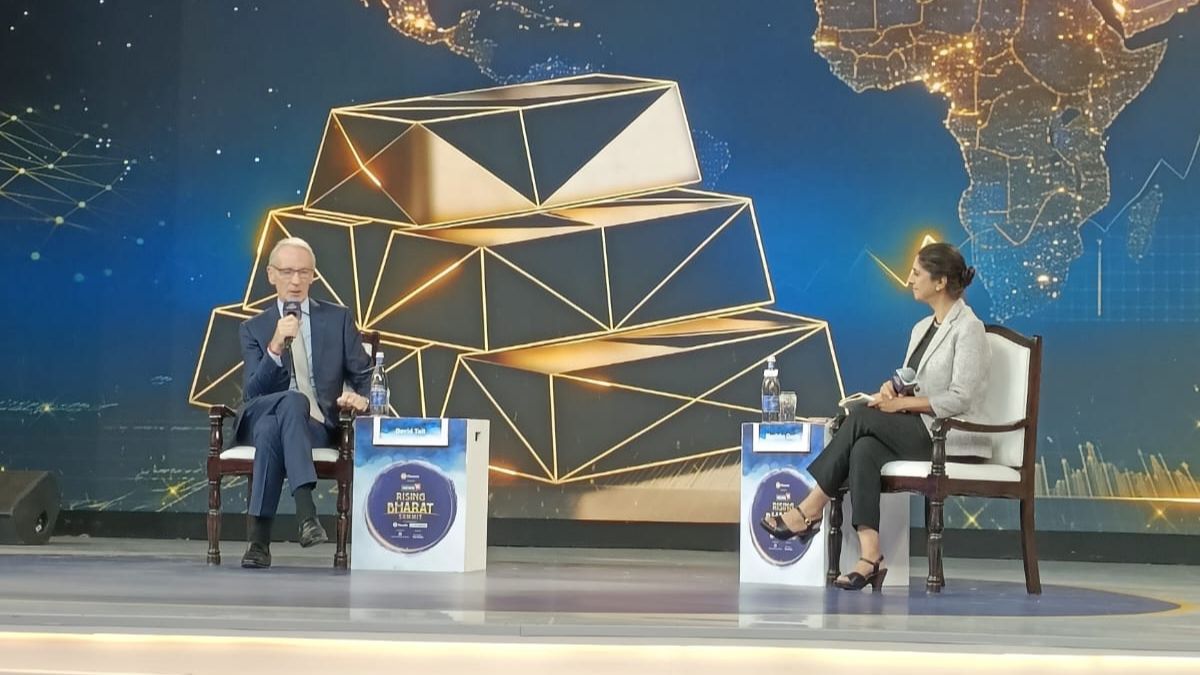
David Tait, chief executive officer of the World Gold Council (WGC), spoke in detail about the forces reshaping gold markets during a conversation at Network18’s the Rising Bharat Summit being held at Bharat Mandapam in New Delhi on February 27-28, 2026.
Gold’s global rally extends a trend that saw it rise more than 64 per cent in 2025 — one of the most powerful advances in decades — and prices have continued to trade near unprecedented highs this year with strong momentum this year.
Spot gold reached a record $5,594.82 per ounce on January 29 and continues to hover above $5,000 per ounce, with analysts projecting further upside toward $6,000-$6,300 per ounce by year-end given persistent demand and macro risks.
In India, domestic gold prices remain robust, with 24K gold trading above ₹160,000 per 10 grams on February 27, 2026, showing resilience despite seasonal fluctuations and corrections from duty-driven volatility.
At the core of this global gold ecosystem is the WGC led by Tait.
Why Gold’s momentum isn’t slowing
Gold is being shaped by forces far beyond simple price speculation. According to the World Gold Council’s Gold Demand Trends report, total global gold demand in 2025 exceeded 5,000 tonnes for the first time ever, driven by record investment and continued central bank accumulation.
Investor appetite for gold — especially through exchange-traded funds (ETFs) — remains vigorous in early 2026, with year-to-date ETF inflows already tracking strongly.
Global funds pulled in more than $18 billion in gold ETF flows by February 20, led by the United States, China and India, indicating broad investor demand even as prices stay elevated.
Recent ETF data from the World Gold Council shows large net inflows in Asia, with China contributing roughly $6 billion and India about $2.5 billion through global ETF vehicles — part of a five-month streak of strong net additions.
Reflecting on these broad global patterns, Tait revealed why the current bull market persists, stating that one of the first “main reasons why gold will continue to live is politics and geopolitics.”
He identified politics and geopolitics as foundational drivers — a reference to escalating tensions, trade policy shifts, and investor concerns around sovereign debt and currency risks — all of which are boosting safe-haven demand.
Tait went on to highlight central bank buying as a long-term underpinning force, “You’ve got central bank buying, which has been consistently strong over the last three years, around a thousand tonnes last year, slightly lower, but I see that continuing.”
This central bank trend aligns with multiple data sources showing 15+ years of cumulative gold purchases by official sector institutions, with net purchases exceeding 1,000 tonnes in each of the recent years prior to 2025.
Talking about the volatile role of the Trump administration in the last year, Tait said, “I think the fundamental that runs through this whole gold rally is the fear of debt runaway.”
“You remember last April when Mr Trump announced tariffs everywhere. You remember that the US yield curve jumped dramatically. It wasn’t a reflection of inflation. It was a lack of trust moment in the US,” he stated referring to US President Donald Trump’s global tariffs.
“I think Mr Trump realised that they were on the cusp of not being able to finance any debt going forward, and that would be a financial crisis again. That fear is still running through markets.”
“There is one possible scenario where I’d be nervous about gold. That is if Mr Trump manages to generate very high GDP growth in the United States, something like six to seven percent next year, which is very unlikely. If he does that with moderate inflation, he might be able to project that national debt is on a sustainable path. But that is a very low chance,” Tait opined.
“So there are several strong reasons why gold continues higher, and one very remote reason why it might come down.”
Analysts and institutions are now projecting continued upward price pressure. Major global investment banks like JP Morgan have raised their long-term forecasts, estimating gold could reach $6,300 per ounce by the end of 2026 due to structural demand from central banks and investors.
A Motilal Oswal report has also framed the recent run as part of a “structural repricing phase” and suggests gold could reach $6,000 within the next 12 months and even $7,500 in the medium term if geopolitical and fiscal pressures intensify.
How India’s gold market is evolving
India remains a cornerstone of global gold consumption, both culturally and economically. While jewellery demand temporarily softened in 2025 due to high prices, investment demand soared, particularly through ETFs and modern savings formats.
Data compiled through early 2026 shows Indian gold ETFs passing 110 tonnes in cumulative holdings, with net additions continuing into February — a clear indication that Indian investors are diversifying into gold through financial products as well as traditional jewellery.
Tait shared his perspective on how this trend is evolving, stating, “You’ve got deregulation in China. The insurance industry has been opened to gold for the first time. That’s a five trillion dollar market. In India, you’ve got growth in the ETF world, which is proving an attractive way for young people to buy gold. Twenty-five ETFs opened last year alone in India.”
His emphasis on the youth segment underlines a significant shift in Indian gold demand — from cultural ornamentation to investment vehicles that fit modern portfolios.
“In Japan, you’ve got a generation of older people passing on wealth to younger people who are confronted with inflation, depreciating currency, geopolitics and nationalism — things we haven’t really experienced in the last 30 years. That generation also has a predisposition to gold.”
Gold’s cultural roots in India, combined with rising institutional formats, position the country as one of the fastest-growing markets for diversified gold ownership.
“I think global gold demand will continue. India is particularly well supported because gold is part of your culture.”
Regulators in India have also recently amended mutual fund valuation norms for gold and silver, requiring funds to use domestic spot prices from recognised Indian exchanges starting April 2026 — a move aimed at better aligning valuations with local conditions.
How central banks are viewing gold now
While private and retail demand has drawn headlines, central banks have been quietly reshaping gold’s strategic role in sovereign reserve portfolios.
Rather than selling gold even after large valuation gains, many central banks view bullion as a core strategic reserve rather than a liquid rebalancing asset.
“Central banks continue to buy. We have not seen much selling at all … Central banks do not seem to think of gold that way. They see it as a strategic reserve.”
This behaviour reflects a broader shift among reserve managers — particularly outside the United States — toward diversifying assets away from dollar dominance amid prolonged policy uncertainty and geopolitical tensions.
Global estimates suggest official sector gold buying could again approach historically high levels in 2026, with projections of approximately 1,000 tonnes of central bank additions and continued strong inflows into physical-backed gold ETFs — another signal of structured rather than tactical demand.
Gold as Investment vs Jewellery
Tait weighed in on the idea that gold investment might compete with traditional jewellery.
“The most notable part of the future of Indian gold demand will be institutions. Pension funds and insurance funds embedding gold into portfolios is still relatively nascent. Jewellery is obviously well established in India, but the younger generation, alongside jewellery, will increasingly hold gold in formats like ETFs.”
He explained that historically gold was seen as complex and capital-intensive, limiting its role in portfolios beyond jewellery. But the industry has spent years making gold more divisible, more transparent and simpler for investors to hold.
“In my previous career at Goldman Sachs, I traded every other asset class except gold. One reason was that gold was complicated and capital-intensive to hold. We’ve spent six or seven years trying to make gold less capital-intensive, easier to hold, more divisible and more transparent.”
His message is clear: institutional acceptance is pivotal to future demand.
“I anticipate that over the coming years, institutional investors will begin to accept gold more readily. That five trillion dollar insurance market is a big example. Institutional gold buying is the future, and that’s why we are trying to make it as easy as possible.”
Digitisation & the future of gold ownership
Beyond traditional formats and ETFs, the World Gold Council is actively developing digital solutions to modernise gold’s role in the financial system — from digital allocated markets to tokenisation.
“We differentiate between digitalisation and tokenisation. We are working with all the major market makers in London to launch a fully digital allocated gold market.”
This platform would give legal ownership of fractionalised allocated gold, enabling easier settlement, custody, collateralisation and instant transfer — a potential game-changer for both institutional and retail holders.
“This gives you legal ownership of fractionalised allocated gold. It doesn’t matter who holds the asset, you have legal ownership of digital gold for the first time in history.”
He outlined how this could unlock gold as a more fluid financial asset, particularly if central banks and institutions adopt digital gold for faster movement or as backing for future digital currencies.
“In the future, central banks could use their gold reserves more effectively. It could even back digital currencies in the future. This could ignite a new era for gold.”
Regulatory hurdles for gold
However, significant hurdles remain before gold attains mainstream financial status similar to sovereign bonds or equities.
“One of the difficulties gold faces from a regulatory perspective is that it is not regarded as a high-quality liquid asset," Tait said.
Historical gaps in trade reporting and transparency — particularly in London’s bullion market — have hampered regulators’ ability to gauge gold’s liquidity. Enhancing data systems is a priority for the WGC.
“We are working to improve transparency and reporting so regulators can see that gold is liquid and resilient. If gold becomes recognised as a high-quality liquid asset, it becomes mainstream. Many capital burdens for asset managers would fall away. That is the holy grail we are trying to achieve," Tait revealed.
Recognition as an HQLA could significantly widen gold’s institutional adoption, lowering capital charges and broadening its use in regulated portfolios.
Keeping in mind to source responsible gold
As gold’s popularity grows, so do concerns about ethical sourcing and environmental and social governance (ESG) standards. The World Gold Council has been driving responsible sourcing initiatives to ensure transparency in the bullion supply chain.
“This is one of the most important things we are working on. When I joined, I was bewildered that there was no database to check where gold came from.”
The WGC, in partnership with the London Bullion Market Association, has established a supply chain database that tracks large-scale miners and refiners, aiming to give consumers and investors visibility into where gold originates.
“We have now set up a database with the London Bullion Market Association and industry partners. Large-scale miners and refiners are onboarding. In the future, consumers will be able to check where their gold comes from.”
Tait emphasised that responsibility matters:
“My hope is that if gold is outside this database, the market for it will shrink.”
He also raised concerns about informal supply channels, stating, “A lot of gold that comes into India comes via Dubai, and much of that originates from small-scale mining, where there are concerns around child labour and mercury use.”
He stressed that global cooperation and policy frameworks are essential, describing initiatives with G7 and G20 governments to promote ethical sourcing and reduce flows from regions with poor labour and environmental practices.
“We are working with G7 and G20 governments on a Gold Processing Initiative to redirect flows away from bad actors and ensure gold is responsibly mined, refined and traded.”
“I appeal to you: please make sure you know where your gold comes from. This is in the interest of children and women who are trafficked. We have to stop that.”
In an era of macro uncertainty, geopolitical stress and financial transitions, gold’s role as both a store of value and strategic asset appears resilient.
“Continue to stay invested in gold, but make sure it is responsibly sourced,” Tait concluded.
The News18 Rising Bharat Summit, one of India’s flagship events on current affairs is being held at Bharat Mandapam in New Delhi from February 27, 2026 to February 28, 2026.


 "Pakistan-Afghanistan War Live Updates: Afghanistan's Supreme Leader Hibatullah Akhundzada reportedly killed in Pak strikes")
 "Did Afghanistan shoot down Pakistan’s F-16 jet amid new clashes?")
 "Pakistan Stock Exchange tanks over 3,000 points as border tensions with Afghanistan escalate")
 "7 things about Indian Navy’s ‘Dolphin Hunter’ INS Anjadip commissioned today")
 "Pakistan-Afghanistan War Live Updates: Afghanistan's Supreme Leader Hibatullah Akhundzada reportedly killed in Pak strikes")
 "Did Afghanistan shoot down Pakistan’s F-16 jet amid new clashes?")
 "Pakistan Stock Exchange tanks over 3,000 points as border tensions with Afghanistan escalate")
 "7 things about Indian Navy’s ‘Dolphin Hunter’ INS Anjadip commissioned today")