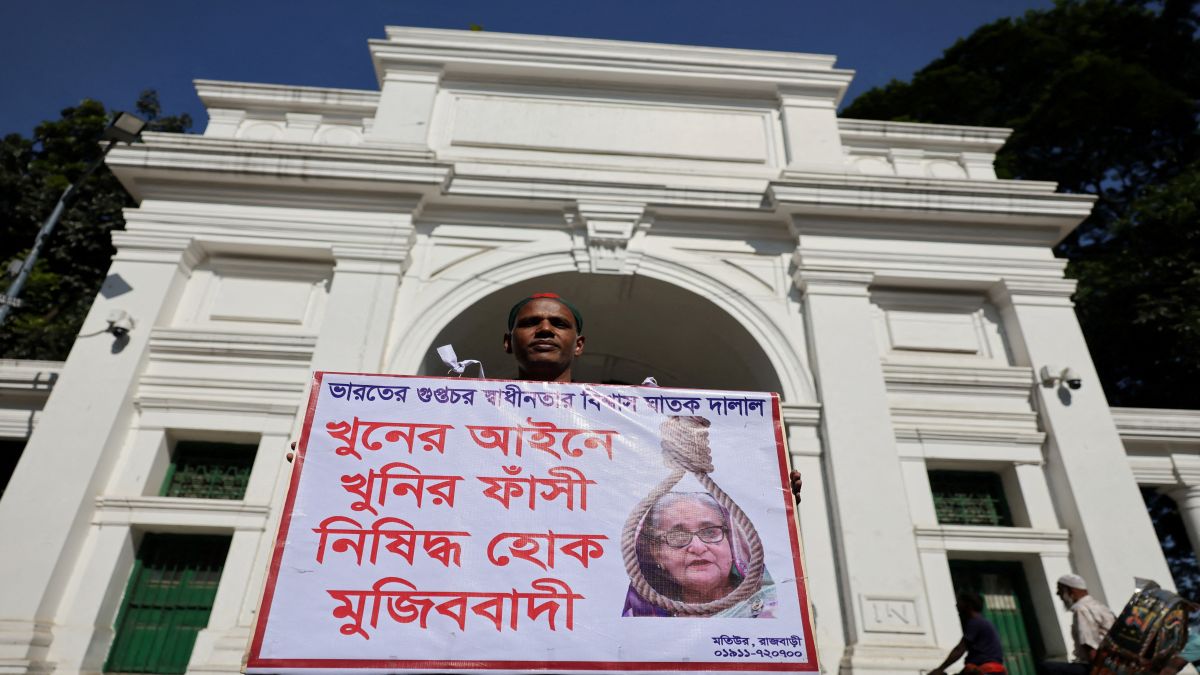
 "A man holds a poster outside the court demanding the death penalty ahead of the verdict in the case against ousted Prime Minister Sheikh Hasina on charges of crimes against humanity. File image: Reuters")
Former Bangladesh State Minister Mohammad Ali Arafat’s recent article in Firstpost collapses under the weight of its own selective reasoning.
His case depends on portraying Sheikh Hasina’s trial as a political vendetta wrapped in constitutional theatre, but the core claims he advances—about evidence, procedure, legality, and motive—crumble once examined against the record.
The procedure that he labels a “constitutional farce” is, in reality, a difficult but necessary judicial reckoning with the scale of violence unleashed under ousted Prime Minister Sheikh Hasina’s watch.
Arafat begins by insisting the evidence is spurious, that audio recordings implicating Hasina in ordering lethal force were manipulated or illegally obtained. This is a claim without proof.
The tribunal’s nearly 500-page verdict, analysed in detail, did not rest on one audio clip. It wove together corroborated testimonies, forensic analyses, governmental communications, and a clear chain of command mapping how orders flowed from the top and resulted in mass killings. Media houses like BBC and Al Jazeera independently verified the audio and established the chain of command responsibility.
Arafat’s argument that the recordings violate Article 43 privacy rights is equally hollow. Privacy protections do not shield state officials issuing violent directives. They do not immunise executive orders that result in the deaths of more than a thousand people.
Quick Reads
View AllArafat’s reading imagines privacy as an escape ramp for the powerful rather than a protection for the ordinary citizen. If that interpretation prevailed, every authoritarian leader could hide behind a privacy clause while authorising violence off-camera.
Then comes the centrepiece of his outrage—the trial in absentia. Arafat portrays Hasina as a victim of coercion, forced to flee and therefore denied a fair hearing. The record shows something different.
She fled willingly, deliberately, and refused to participate despite repeated summons. Under Bangladeshi law—as in many jurisdictions—trial in absentia is permitted when a defendant absconds.
The tribunal appointed counsel. Proceedings continued. And crucially, the absence was not imposed on her; it was chosen by her. Arafat’s logic is that flight should automatically nullify accountability. That is essentially impunity.
His insistence that the trial moved “too quickly” similarly misleads. The gravity of the crimes demanded urgency. More than 1,400 people were killed in 2024’s uprising, which Hasina violently suppressed, and many of those deaths were documented by human rights groups such as HRW .
Families waited for answers. Evidence needed preservation. Witnesses needed protection. Dragging out proceedings for years—standard in international tribunals with unlimited budgets and no political clock—was never viable in a traumatised, destabilised country.
The tribunal moved decisively because the conditions required it. Justice deferred would have meant justice eroded.
Arafat also claims the International Crimes Tribunal was the wrong forum because it was “designed” for 1971. This argument ignores the evolution of the law itself. Bangladesh amended the tribunal’s mandate, expanding definitions of crimes against humanity and command responsibility to cover modern state violence.
The charges against Hasina—incitement, unlawful orders, mass killings, the use of state machinery to suppress civilians—fit within that expanded statutory framework. The law was updated precisely because atrocities are not limited to the past; they can happen in peacetime, against protesting citizens.
Arafat treats 1971 as sacred legal territory and 2024 as somehow beneath the threshold of accountability. The reality is the opposite: the machinery of repression in 2024 was coordinated, lethal, and systematic in ways that demand legal response.
It is necessary here to acknowledge what rights groups have said. HRW and others raised concerns about trial standards, representation, and the use of the death penalty. These criticisms are real and should not be dismissed lightly.
But even HRW’s critique does not claim the crimes did not occur. It does not claim Hasina bore no responsibility. It does not claim the verdict fabricated the chain of command. It simply argues the process fell short of international best practices—a valid point, but not the same as calling the entire trial illegitimate.
No legal system on earth, facing mass atrocity, operates in pristine laboratory conditions.
This is where Arafat’s argument collapses most dramatically. He demands perfection in procedure while ignoring the enormity of the crimes. He argues as though Hasina’s decisions existed in a vacuum, as though more than a thousand families are not mourning deaths tied directly to state orders.
He pretends that the tribunal’s flaws erase the substance of its findings. They do not. Imperfections in process do not magically convert documented atrocities into political fiction.
The core purpose of the trial was accountability. Bangladesh has suffered decades of impunity among its ruling class—disappearances, extrajudicial killings, partisan policing, and an ever-expanding security apparatus that answered only upward.
Arafat’s argument, if taken seriously, would ensure that no leader could ever be held responsible for the violence they unleash. That is not justice. That is a blueprint for permanent authoritarianism.
What the trial achieved—despite its shortcomings—was the opposite. It placed a former prime minister under legal scrutiny. It established a chain of responsibility. It documented the scale of atrocities with forensic precision. It sent a message that no rank or title can shield anyone from accountability.
And for the families of the dead, it offered something Bangladesh has rarely provided: recognition, not erasure.
Arafat’s rhetoric masks a deeper fear—that once a nation holds one leader accountable for mass violence, it will expect the same standard for all. His defence of Hasina relies on the same logic that has historically protected abusive leaders across the region: that political status should override legal consequence. But Bangladesh today is not obligated to reproduce the impunity of its past.
The trial was imperfect. But it was far from a farce. It was an attempt—improvised and necessary—to confront crimes that were real, documented, and devastating. The alternative Arafat proposes is excusing power and entrenching impunity.
Arafat calls this shameful. But the only shameful thing would be refusing to confront the truth of what happened in 2024, and letting the victims vanish into footnotes. The trial did not shame Bangladesh. It forced Bangladesh to look squarely at what it had become—and what it refuses to become again.
(Faisal Mahmud is the Minister (Press) of Bangladesh High Commission in New Delhi. Views expressed in the above piece are personal and solely those of the author. They do not necessarily reflect Firstpost’s views.)